1688's Undefined 40% of AI Demand, and the Payroll a Foshan Factory Cut
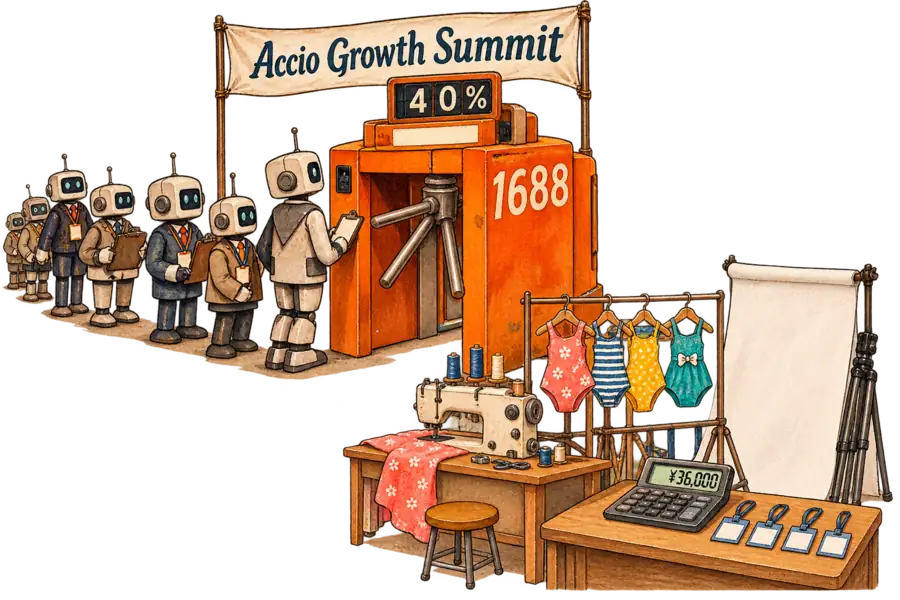
1688 says AI now initiates about 40% of the demand on its wholesale platform, double the figure it gave in July, without saying what counts as a demand. The Foshan children's-wear maker interviewed beside the claim measures AI's return in cheaper photos and a monthly payroll it no longer carries.
Neritus Vale
Wang Qiang, a vice-president of Alibaba’s wholesale platform 1688, told a late-October summit that AI now initiates about 40% of the demand on the site, Guangzhou Daily reported. The Foshan clothing makers the paper interviewed counted something else: shoots they no longer book and staff costs they have cut. No account of the figure says how it was counted. The factories’ gains sit where money can be counted, on the cost line.
The figure came with a warning. For suppliers missing from AI procurement, the question is no longer how much business they win: “you may disappear permanently” (你可能会永久地消失), Wang said. The share, Wang predicted, could reach 60% to 80% next year. In the paper’s account of his view, suppliers must now express protocols, interfaces and data, not only goods and services: “AI-friendly supply” (AI友好型供给).
The number has a short public history. At the World Artificial Intelligence Conference in July, 1688 said 20% of its procurement demand was initiated by AI agents (由 AI Agent 发起), Leiphone reported. The claim arrived packaged with a trading protocol for agents. Its forecast was 80% within two years, and Wang’s October forecast brings that date forward by a year.
Ebrun’s September survey of Zhejiang factories, republished by 36Kr, cited public figures expecting the share to pass 40% this year. It did not say who had made the forecast. October’s figure is “about 40%”, so the share landed on a forecast whose author and base are both unpublished. That is hard to tell apart from a target.
The wording has loosened since July. Wang’s spoken version drops the agent: demand is now “initiated with AI” (用AI发起), the paper quoted. Ebrun’s account, carried by Sina, describes the change: a buyer states a need instead of typing keywords, and AI interprets, screens and compares. It adds that AI already takes part in procurement workflows on the site and that some brands and buyers run their own purchasing agents. On that description the share measures where a request enters, and no account says whether those self-built agents are in the count. Nor does any say whether a demand is a query, an inquiry or an order.
On 13 October 1688 widened access to Accio, Alibaba’s AI workbench, which more than 100 million annual active buyers can now enable, Leiphone reported. Its procurement assistant finds suppliers, compares prices and sends inquiries. If the share counts requests typed into that assistant, opening it to every buyer could lift the share by itself.
1688’s protocol shows how early in a trade that request enters. UTP, announced with the China Electronics Standardization Institute and Ant Group and billed as an open standard, splits a B2B deal into six actions: sourcing, inquiry, ordering, payment, fulfilment and dispute resolution, Beijing News reported. Demand begins at the first. The protocols Wang tells suppliers to present are probably this one. If so, the platform that counts the demand also co-wrote the format it arrives in.
The 40% was announced at a summit named for Accio, which 1688 sells. Ebrun’s account says helping merchants improve their supply information is a job Accio wants to take on. In the published Q&A, an edited stenographic record rather than a transcript, Wang said selling it has been a challenge: the sales team knew memberships and ads, and Accio “is not a standard product” (不是一个标品). As with Kuaishou’s AI shop staff, the help comes from the party that sets the rules.
The Foshan ledger is easier to read. Zhou Yan, general manager of Foshan Yusheng Apparel, told Guangzhou Daily that a shoot used to cost ¥500 and meant booking models in advance. That price covered a session, so the comparison is looser than it looks. Zhou put an AI image at ¥0.2 to ¥0.6, with no booking.
The bigger number is a payroll. Yangcheng Pai profiled a children’s-wear factory founded by Zhou’s father in 2008, in a piece carried by 21jingji. Its design, retouching and operations posts cost about ¥36,000 a month, a sum now saved by the owner’s account. Those posts designed the clothes, dressed the pictures and ran the shop. Apart from the sewing floor, the factory is now four people.
Yangcheng Pai’s profile promises orders, but the evidence under that promise involves no AI buyer. Its subhead says the first factories to get AI working win new orders first (先跑通的工厂,先拿到新订单). Under it, children’s swimwear, hard to shoot, is now generated by AI, and sales rose anyway. The gain runs through a picture, which is the old way to sell clothes.
Cai Jielin, general manager of Foshan Yige Apparel, told Guangzhou Daily that titles and detail pages are now written so AI “can read them” (让AI读得懂). That is Wang’s advice taken. Cai is writing for a reader whose share of demand nobody has defined.
Wang’s own Q&A does not claim Accio’s edge lies in photos. “If it’s only images or video, plenty of specialist models can do that” (如果只是处理图片或视频,有很多专业模型可以做), Wang said, and Accio may not beat them at single tasks. In an earlier answer he said Accio should not be understood as an efficiency tool alone and must be tied to business growth. The Foshan ledger records efficiency.
The strongest objection is that the definition hardly matters. Agents shortlist and people sign: the sourcing agent in Alibaba.com’s Accio Work toolkit “cannot close deals on its own”, Digital Commerce 360 reported. 1688’s own UTP pitch promises more, a buyer’s AI that finds goods, orders, pays and tracks fulfilment in one run. Either way, a supplier left off the shortlist loses the order. If AI-started requests convert like keyword searches, AI already stands in front of 40% of 1688’s demand, and the argument here fails.
The objection is right about the mechanism and silent on the evidence. No summit account gives a conversion rate for AI-started requests. The one order-side gain a seller quantified came from inside the shop: Xiao Zhiming of Dongguan Yihe E-commerce had AI match an employee to a weak store, and its inquiry conversion rose 10%. Until 1688 shows the ordering step, the 40% says where requests start and nothing about where they end.
Only one side of this market can show receipts, and it is the side being told it may disappear.
If 1688 publishes what counts as a demand, whose agents start it and how many requests become orders, the 40% becomes a number factories can plan around. Until then, rewriting a catalogue for agents is a purchase made on the vendor’s word. The only return on record is what factories say they saved on photographers and staff. Those are gross, self-reported figures, before any tool costs, and the Yangcheng Pai profile dates the factory’s use of AI image tools to 2023, so the saving may owe nothing to Accio. A factory can still bank it without believing the forecast.