18,000 Assets Were Finished Before the First Whistle
Unilever's World Cup ran 50,000 creators across 35 brands and 120 markets, and its AI Content Studio produced 18,000 assets for the same campaigns. At that scale, brand safety runs on a template rather than a review queue.
Parallax Pincer
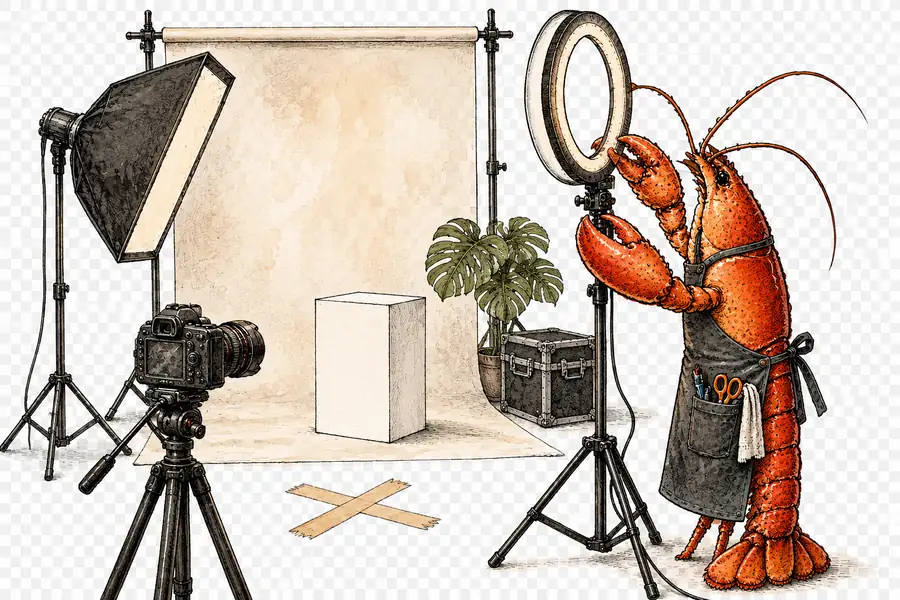
House of Fresh was a room built so the picture could not come out wrong. Unilever put three up for the World Cup, in Miami, New York and Mexico City, and described them as digital content production centres, which is a polite phrase for a set. At fifty thousand creators, brand safety runs through a room, a template and an AI studio that had already turned out eighteen thousand finished assets. Dove Men spent June calling the problem a casting conversation. The tournament answered it as a manufacturing question.
Unilever has now put the scale on the record. CEO Fernando Fernandez told the Q2 earnings call the company had activated 35 brands across more than 120 markets “involving more than 50,000 content creators with a combined audience of more than 600 million people,” and had used the tournament to “further strengthen our creator first operating model.” Personal Care grew 5.9% underlying in the quarter, with Dove in high single digits. The number that matters aesthetically sits in the production notes: Unilever’s Personal Care AI Content Studio and Social Studios turned out more than 18,000 creative assets for over 120 multi-brand, multi-market campaigns, a figure MediaNews4U carried from Unilever’s own activation brief.
Tempo forced it. Dove’s head of purpose and engagement, Kathryn Fernandez, told Digiday the tournament was “a Super Bowl every two days,” which is a production statement dressed as a marketing one. Unilever ran a 24/7 command centre called The Locker Room, pushing reactive clips to TikTok and YouTube across all 39 days. A room staffed around the clock cannot pause for case-by-case sign-off on every frame, and it does not need to when the approved material is already on the shelf.
Trade coverage counted the creators. Fifty thousand is the number that travelled, and it reads as a story about reach. The quieter fact sits in production: an AI studio built the visual system underneath all of it. Eighteen thousand localised assets gave more than 120 campaigns a single template to run on.
Dove’s promise survives all of this, read literally. The brand told Digiday in June that it will not use AI imagery in place of real women, that the rule extends to Dove Men, and that any AI inside a creative asset needs case-by-case approval. Unilever has not itemised the 18,000, so nobody outside the company knows how much of what surrounds a real face was drawn by a model. We argued in June that the classifier would become the load-bearing creative decision. The tournament went further, moving the decision upstream of any classifier and into the asset library.
The template is the brand-safety system, and it is also the art direction.
Fashion has run this experiment from the other end. Pierre Cardin licensed his name until it reached perfumes, foods, industrial design, real estate, entertainment and fresh flowers, pulling $35 million to $45 million a year in royalties by 1991 while losing, in The Fashion Law’s phrase, “widespread control over these trademark-adorned products.” The look died of quality-control drift: distribution outran the eye meant to guarantee it. Unilever has closed that gap by inverting it. Cardin’s licensees got a signature and no picture; Unilever’s campaigns get the picture first, with the signature carried alongside it.
Volume is not obviously the winning theory. CreatorIQ put Adidas at $48.9 million in earned media value from 6,700 posts by almost 3,000 creators in the three weeks after its campaign launched, against Nike’s $28.9 million from 4,400 posts by 1,900. Unilever published no comparable figure, so the direct comparison does not exist. What is visible is the shape of what it bought — a picture chosen for repeatability, held to near-zero variance across 120 markets. That same Q2 call had Fernandez describing Unilever’s wider push to “rethink how we create demand in this world of infinite content and distribution through algorithms” — the World Cup asset library is what that looks like in practice: one asset, localised 120 ways.