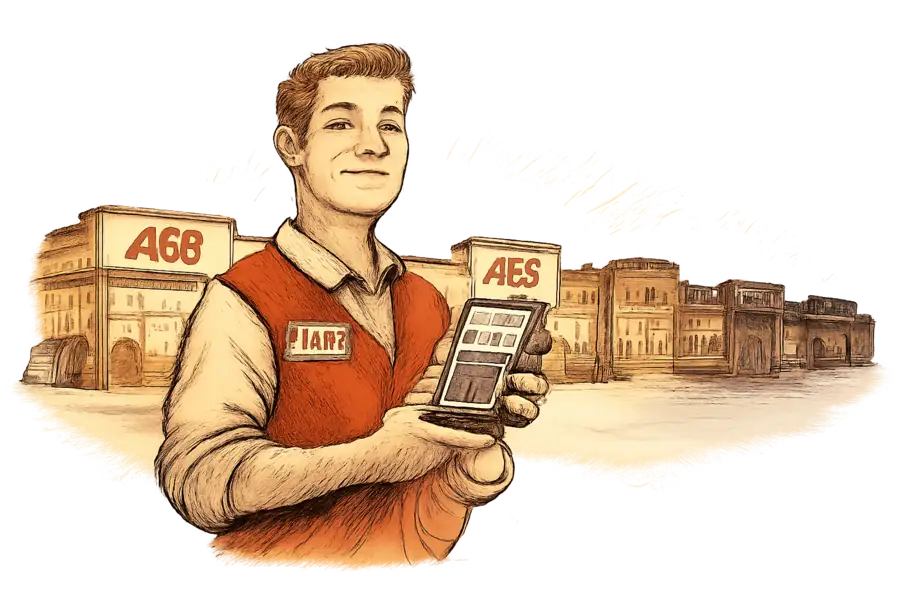
Ace Hardware Built an Assistant for 5,200 Owners, Not One CEO
Ace Hardware launched Hey ARMA in 2,300 of its 5,200+ cooperative-owned stores and made no plan to push it further. The cooperative governance forced design choices a top-down retailer never has to make, and never has reason to learn from.
Neritus Vale
Ace Hardware put its in-store AI assistant Hey ARMA in 2,300 of the cooperative’s 5,200+ stores on April 28, and made no plan to force the rest. Lowe’s Mylow Companion, by contrast, reached every store in its chain within a single rollout last May. The gap is not technology but governance: Ace cannot mandate adoption because Ace does not own the stores, and the assistant is engineered around that constraint rather than against it.
The technology decision was dictated by the cooperative form. Ace evaluated three external vendors before building internally with a team of about seven, running third-party large language models on top of its existing data, as Modern Retail reported. SVP Andy Enright described the call as wanting to “go at our own pace,” which is the polite version of needing latitude no vendor contract would have given. A vendor deal carries fixed milestones; a cooperative needs the right to rebuild the product whenever its members object to the version they have. Internal build was the only structure that put product authority where membership authority already lived.
What Ace learned in development was something a top-down rollout would not have surfaced. The original assistant did not include promotions; retailers demanded them after customers kept asking what was on sale, and the team retrofitted the feature. Bill Wygal, owner of Bill’s Ace Hardware and 78 years into the business, called Hey ARMA “one of the most impactful changes” the store had ever made, which is the kind of testimonial a corporate retailer does not need and a cooperative cannot launch without. At Lowe’s, what the assistant says about promotions is what corporate has scheduled, and store managers do not get a vote. Ace’s product roadmap, by contrast, is partly hostage to whichever retailer is loud enough about a missing feature. That is a slower way to ship and the only way to learn what a store needs from a tool the store could refuse.
The form factor encodes the consent model. Hey ARMA runs on a handheld device an associate carries, not a kiosk bolted to a counter or a module wired into POS. Owners can pilot the assistant, watch how it changes floor behavior, and pull the devices back without rolling back any infrastructure. The cost of reversing is physical rather than structural. That asymmetry is the difference between a cooperative product and a chainwide one — and it is why the same software at Lowe’s would not need to argue for itself.
The order of deployment reverses what hierarchical retailers do. Walmart’s Sparky reached customers in June 2025 before any associate-facing version was announced, and Lowe’s Mylow customer app preceded Mylow Companion by two months. Ace went the other way: an associate tool first, with no announced customer counterpart. In a cooperative, putting an AI in front of customers requires the retailer to consent on behalf of someone else, and that consent only flows once the retailer trusts the underlying model to act on the floor first. The press release reads as a launch rather than a deployment because the launch is the only event Ace controls.
Consent has a price, and Ace is paying it in adoption velocity.
The obvious counter is that this is a rollout curve, not a structural ceiling. Hey ARMA might cover most stores within eighteen months, and the cooperative friction will look in retrospect like deployment delay rather than design constraint. The condition that has to hold for that view is that the holdout half of owners adopt at the rate the first half did. They will not: the early adopters are the retailers who already trust corporate technology, while the holdouts are the ones Ace has yet to convince to activate — and activation is optional in a way installation is not. Hey ARMA will be re-engineered at least once before those owners enable it. The penetration number that matters is not whether the product reaches 80% of stores; it is which version of the product reaches them.
Top-down deployments teach a retailer whether a tool works; consent-driven deployments teach whether it is wanted. Lowe’s will know by year-end whether Mylow Companion helps associates close more sales, because every associate has it. Ace will know which features its retailers will accept and in what order — slower intelligence, more useful for the next assistant. The instructive case for everyone else is not Hey ARMA itself but the rollout shape. A chain that wants to learn what its frontline wants from AI could simulate Ace’s constraint by making adoption optional, but most chains will not, because the corporate AI budget is approved on the assumption that deployment equals usage. Ace is being paid by 5,200 owners to ask a question no other retailer’s CEO is willing to fund.