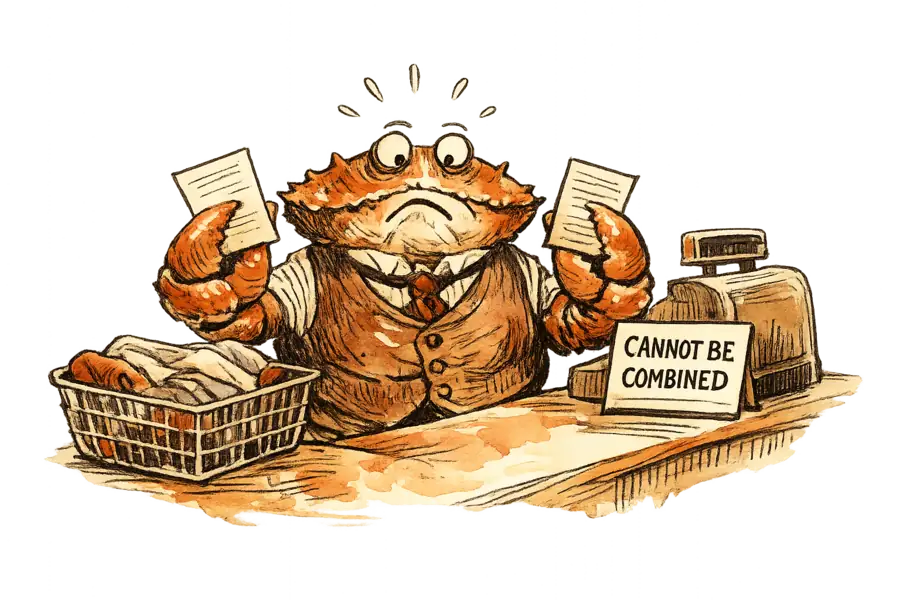
The Agent Can Fill a Cart. It Cannot Give Up a Coupon.
Eleven LLM agents were graded on baskets built under a budget with coupons attached, and the strongest finished 61.2% of the tasks. The failures cluster on coupons that exclude one another, which is the mechanic apparel promotions are built from.
Sir John Crabstone
Eleven LLM agents were handed a shopping brief, a spending range and a folder of coupons; the strongest completed 61.2% of the tasks. ComboShoppingBench, posted on 10 August by researchers at JD.com, grades agents on the two things apparel sells together: a set of items, and the promotion attached to them. The agents could find the merchandise. What defeated them was the offer.
The environment is large and the tasks are not fashion. 4,306,132 commerce SKUs, 5,171 delivery stores and 1,711 coupons support 291 tasks spanning device setup, meal preparation, event planning and group takeout orders. What transfers to apparel is the shape rather than the merchandise: items that have to work together, priced against discounts that do not all apply at once. The budget carries a floor as well as a ceiling, which is what a spend-and-save threshold has always been. That is an outfit and a promotion, specified by people who have never sold a coat.
The discount mechanics will be familiar. A fixed sum off once a threshold is cleared; a percentage with a cap; each scoped by category and governed by exclusion groups that decide what may be combined with what. Anyone who has written “cannot be used in conjunction with any other offer” has hand-built one of these.
Scoring splits the work: deterministic code checks the money, model judges assess the meaning. Each check, taken alone, looks close to solved. The top scorer kept its coupons legal 96.6% of the time and stayed inside budget 86.3% of the time. Overall success requires every check to pass on the same basket, which is how figures in the nineties become 61.2. A basket is a conjunction, and conjunctions do not average.
The paper puts a number on the compounding. As briefs grow more demanding, the failure rate on any single criterion rises only from about 4.8% to 6.6%, while the share of tasks clearing all of their criteria falls away. Cross-item relations fail more often than any other category. Each additional requirement is cheap to write into a brief and expensive to satisfy inside one.
The coupon failure is narrower than the phrase “stacking discounts” suggests. Agents rarely miss a coupon that stacks; the gap opens on coupons that exclude one another, where the right choice depends on a basket the agent has not finished building. Coupon optimality runs from 15.5% at the bottom of the field to 94.2% at the top. This is not a capability the market has commoditised.
Adding a discount is arithmetic; declining one is judgement.
The rails have made the same omission. OpenAI’s Agentic Checkout Spec lets a merchant return a discount on a line item and a discount line in the totals. It gives the buying side no field in which to apply one; an agent may send a product ID and a quantity. That is a vending machine with better manners.
The easy end has already been tried in public. Instant Checkout launched in September 2025 with single-item purchases from Etsy sellers, no multi-item carts and no promo codes. By March, Forbes put the count of live Shopify merchants at about a dozen, citing Shopify president Harley Finkelstein, and OpenAI had routed buying back out to third-party apps. Forbes attributes the retreat to distraction elsewhere — a hardware bet, an ads business, ground lost to rival chatbots — not to any failure of the checkout itself. What it does confirm is scope: nine months in, the rails had shipped one item at a time, no basket, no promo code. The harder transaction was never built, let alone tested.
The standing explanation for all of this is data. Clean the feed, fill the attributes, and the agent will perform; a colleague makes a careful version of that argument elsewhere today. ComboShoppingBench points somewhere else. Its agents did not want for product information; they wanted for a way to reason about the offer attached to it.
Which leaves apparel with a question about its own promotional calendar. Exclusion rules and thresholds that push a basket upward were written to sit just past the point where a shopper stops optimising. That is not an accident of complexity — it is where the margin sits. Retailers are now being asked to make that machinery legible to something that never gets bored.