Asked to Let an AI Agent Buy Their Clothes, 7.3% of Americans Said Yes
This season's AI-shopping surveys run from 72% of shoppers in $75,000-plus households consulting chatbots for gift ideas to 5% buying on an AI's word, because each asks a different question of a different panel. The one that asked about clothes found 7.3% of Americans would let an agent buy them, which points apparel sellers' AI spend toward what shoppers check after a recommendation rather than agent checkout.
Neritus Vale
This season’s AI-shopping surveys disagree because they ask different questions of different people. When a Prosper Insights & Analytics poll asked Americans whether an AI agent could buy their clothes, 7.3% said yes. For apparel sellers, that answer argues for spending this season’s AI money on what shoppers check after an AI suggests something, and for leaving agent checkout until later.
Modern Retail’s Gabriela Barkho gathered three of the season’s surveys on 22 October under one reading: AI wins discovery, and reviews close the sale. That gets the direction right, but the lineup sets figures side by side as if they described one shopper, when each panel asked a different thing, at a different time, of different people.
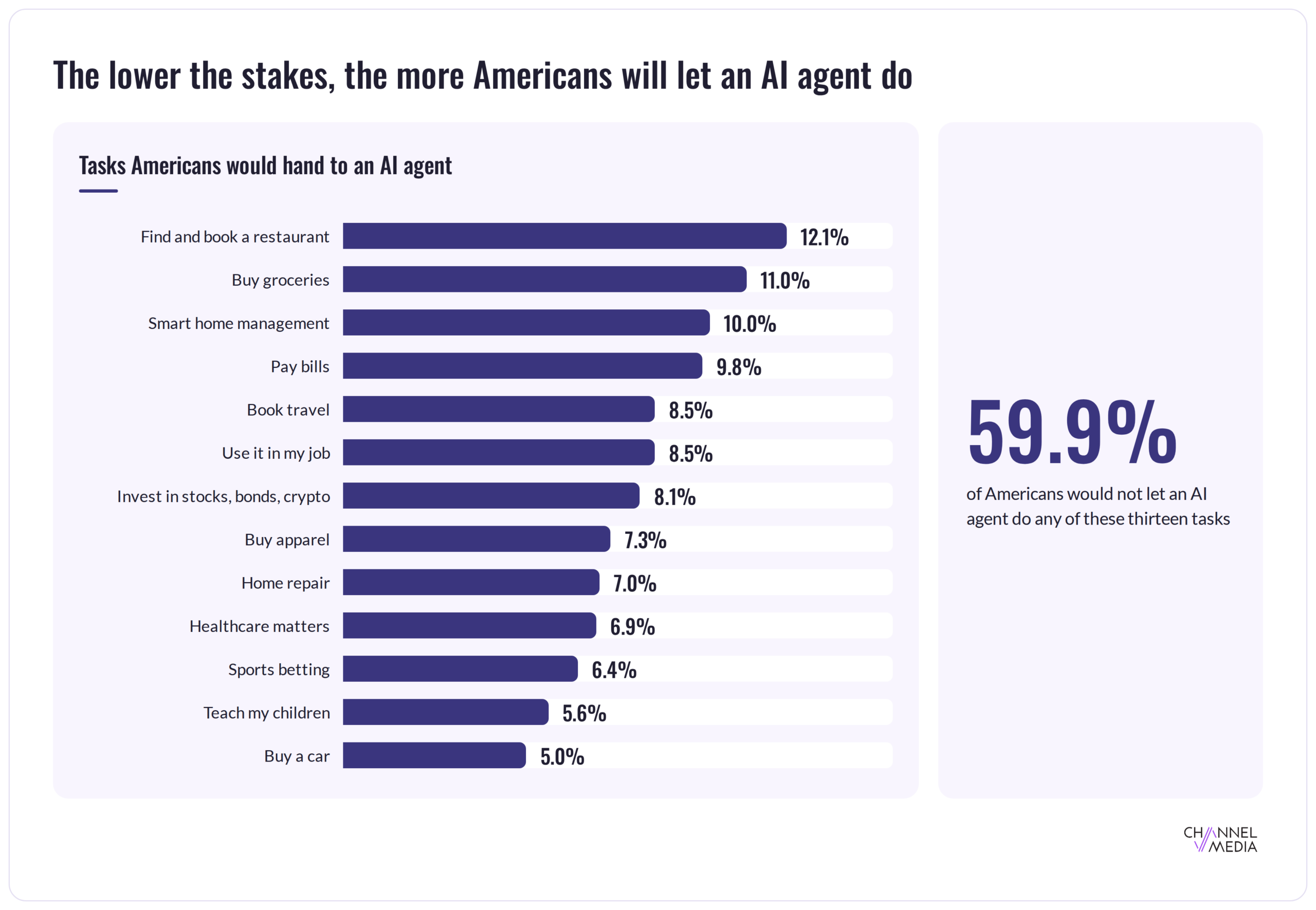
Prosper’s question described an agent that acts largely on its own. In June the firm showed 7,675 US adults a definition of agentic AI, systems acting “with minimal human intervention,” and asked which everyday tasks they would use it for. Channel V Media, a PR agency that helps companies “shape how AI engines describe them,” analysed and published the results.
Clothes sit in the middle of Prosper’s list. Modern Retail’s account named only tasks that beat apparel, so apparel looked like the floor. Channel V’s chart ranks apparel eighth of 13, ahead of home repair, healthcare, sports betting, teaching children and buying a car. Prosper’s headline number is far higher: 40.1% of Americans would let an agent do at least one of the 13 tasks.
More Americans would let an agent pay their bills than buy their clothes, and Prosper’s sample is big enough to show the gap is real. Prosper publishes no margin of error, so this is our arithmetic: assuming simple random sampling, the 2.5 points between the two answers are nearly three times the margin of error, even if nobody ticked both. The published figures cannot separate apparel from home repair or healthcare.
Kieran Powell, Channel V’s executive vice-president, illustrated the result with a price the survey never named. “If people won’t let AI buy a $40 shirt for them, they won’t let it tell them which shirt is good,” he told Modern Retail. The task on Channel V’s chart reads “Buy apparel,” with no price attached.
The season’s loudest number answers a far gentler question. Optimove, a marketing-software company, reported that 72% of “U.S. consumers” regularly or occasionally consult tools such as ChatGPT, Claude or Gemini “for shopping ideas and gift recommendations.” Asking a chatbot for gift ideas now and then counts as a yes.
Optimove’s panel was narrower than “U.S. consumers.” All 648 respondents, surveyed in the spring for a holiday report, came from households earning $75,000 or more, the release says.
At the other end, Feedvisor asked what shoppers do when an AI recommends a product, and 5% said they buy on the spot. Sourcing Journal quoted the report on the rest: they “check elsewhere first,” with Google and Amazon among the places they search. The AI answer works as a lead that other sites close.
Feedvisor’s report, based on a Zogby Analytics poll of 1,006 Americans in August, concludes that AI “starts the shopping journey, but marketplaces finish it,” Sourcing Journal reported. Feedvisor sells advertising and pricing software to Amazon sellers.
Even the questions about delegation set different bars. Deloitte’s survey ran between 26 August and 10 September, Modern Retail reported. Its version kept the shopper in charge: 16% of 3,700 respondents agreed they “would let gen AI complete the purchase with permission.” Prosper’s definition all but removed the shopper.
Feedvisor’s panel was blunter: 62% said they would never let an AI agent order and pay on their behalf, and among the rest, 76% would cap a purchase at $100 or less.
Where these surveys follow shoppers past the AI answer, they find a check. PartnerCentric, an affiliate and creator marketing agency, analysed 696 shoppers who had already bought something an AI recommended. A third of these shoppers still said they go straight to reviews after an AI suggestion, Net Influencer reported. The agency calls its figures “directional and not projectable to the U.S. population,” a caveat the Modern Retail roundup left out.
The next stop is seldom the brand’s own website. Only 14.8% of PartnerCentric’s AI buyers went there, Modern Retail reported. If clothing shoppers behave like this sample, reviews, rival prices and other retailers’ listings do more of the persuading than the label’s own site. Modern Retail’s account also has a third of the sample saying shipping and return policies often or always change what they buy.
The strongest objection is that refusal measures unfamiliarity. Two-thirds of Prosper’s sample had never heard of agentic AI before the survey defined it, Channel V found. Walmart this week opened a beta gateway to approved agents, as we reported earlier today. Comfort is rising too: 37% of Deloitte’s 3,700 respondents said they were more comfortable using gen AI than six months earlier. If use turns refusers into delegators, the apparel figure is a floor, and sellers who wait for the surveys to move will build agent checkout too late.
The heaviest AI buyers point the other way. Among PartnerCentric’s heaviest AI converters, who buy after AI recommendations rather than through agents, half said shipping timelines and return policies change what they buy, against 22% of lighter users. The source does not define “heavy” or “lighter” and the sample cannot be projected to the country, yet it is the only one here built from people who already buy on an AI’s word. If agents do take over, the one sent for a coat would still have to weigh the same reviews and return terms.
Only Prosper’s 7.3% concerns clothes; the other surveys cover shopping in general. For an apparel seller, this season’s AI budget is a choice between two destinations. One is agent checkout, built for the 7.3% who say they would send an agent for their clothes. The other is everything a shopper checks after the AI has spoken: reviews, prices elsewhere, delivery dates and the return page. Only the second would pay off whether shoppers or agents do the checking.