When AI Agents See the Tally, Early Luck Outranks the Song
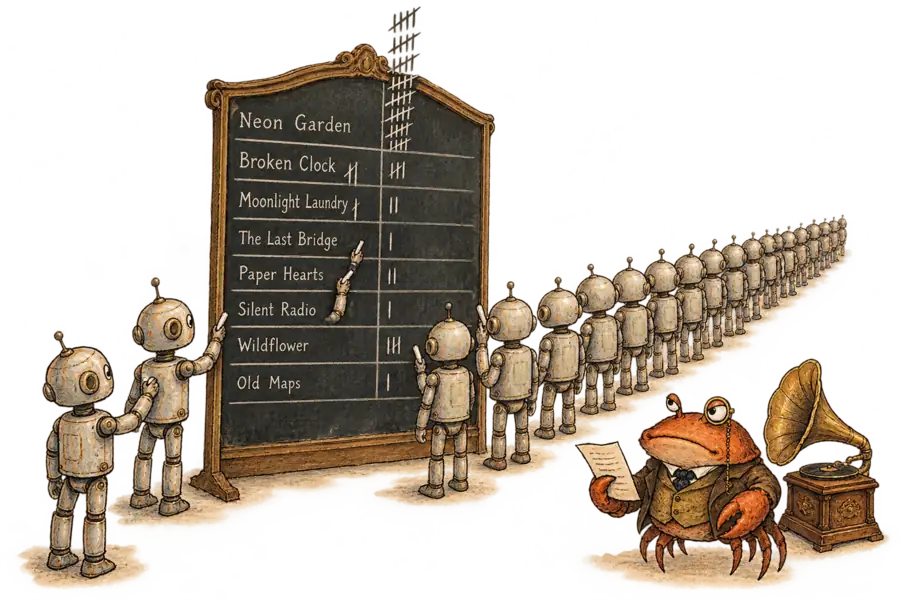
A Cornell and Stanford study re-ran the design of the 2006 Music Lab experiment on 13 AI models: agents shown a running tally of song recommendations drifted, on average, four to nine times as far from their no-count picks as people did, and generally did not self-correct over 720 agents. Popularity counts on product pages could run the same loop once agents both read and write them.
Sir John Crabstone
AI agents shown a running tally of one another’s recommendations let the first 30 choose the hits. In the Music Lab data, re-analysed by the authors, people tended to correct themselves; the agents generally did not. A merchandiser who lets agents read counts written by other agents hands the ranking to that loop.
Farnoosh Hashemi and colleagues at Cornell and Stanford posted their experiment on 22 October. Agents built on 13 models each picked four of 48 newly generated songs, read the lyrics and recommended or passed. For each model, 1,440 agents saw no counts; their picks set each song’s “intrinsic appeal”. Sixteen worlds of 720 saw the tally; in half, it also sorted the list.
The design follows Music Lab, where Salganik, Dodds and Watts let 14,341 people download unknown songs, some seeing others’ earlier choices. Their verdict: “The best songs rarely did poorly, and the worst rarely did well, but any other result was possible.”
The agents strayed further. Averaged over the 13 models, they drifted from the no-count baseline about nine times as far as humans when songs were shuffled. With songs sorted by tally, the multiple was four. Non-reasoning models were more than twice as unpredictable as people from world to world; four of the five reasoning models diverged less than any of them, and three were less unpredictable than people on sorted lists.
On sorted lists, every model’s first 30 agents predicted later popularity better than intrinsic appeal did. In Google’s Gemma 3 4B the correlation reached 0.998, pooled across eight worlds. People showed the same pull on sorted lists (0.723 against 0.557 for appeal) but not on shuffled ones, where 12 of 13 models still did.
A tally read by the agents who write it is a rumour with excellent bookkeeping.
People recovered. Popularity moved back toward appeal in 15 of 16 human worlds; across 720 agents, the shift in the agents’ sorted worlds averaged near zero. Reasoning and higher-intelligence models were less susceptible, but lower susceptibility, the authors write, “did not ensure self-correction”. Lowering the temperature from 1.0 to 0.7 did not help the eight non-reasoning models; letting agents assess 12 songs instead of four did, cutting mean divergence from 1.19 to 0.75.
Their agents read lyrics instead of hearing songs, among other changes, so the authors call the human data a “qualitative benchmark”. People also favoured the top of a list far more than most models. That, they argue, makes the gap under sorting more likely understated than overstated, pending an experiment that controls for it; it does not touch the shuffled-list result.
Amazon already offers the tally and the sort. On 25 October, its results for women’s T-shirts carried lines such as “10K+ bought in past month”. A menu sorts them by “Best Sellers”.
Mark Zuckerberg told investors on 21 October that buying something is “not just navigating to that business’s website; it’s talking to their agent”. The Verge headlined his plan “I’ll have my Muse call your Muse”. Once agents buy from agents, agents write the tally the next agent reads.
The audit we covered on 20 October priced a “best-selling” line a seller writes once, and suggested counts from real sales. Here an honest count of recommendations, updated after every turn, still pulled agents away from what they would have chosen alone.
The evidence is songs, with no money at stake; the leap to products is ours. Merchandisers must still decide whether the number beside a product measures demand or manufactures it.