Sixteen AI Models Cast 9,000 Faces: Favourites Shifted With the Brief, but Indian Portraits Ranked Low Almost Every Time
A Université Paris-Saclay audit had 16 AI models score 9,000 generated portraits, all prompted into the same black T-shirt, for jobs, brands, activities and bank products. The groups the models favoured changed with the brief and Indian portraits stayed in the lower half almost throughout; our cut of the released scores shows the ten clothing labels alone still putting Asian and Indian portraits at the bottom for each closed model.
Parallax Pincer
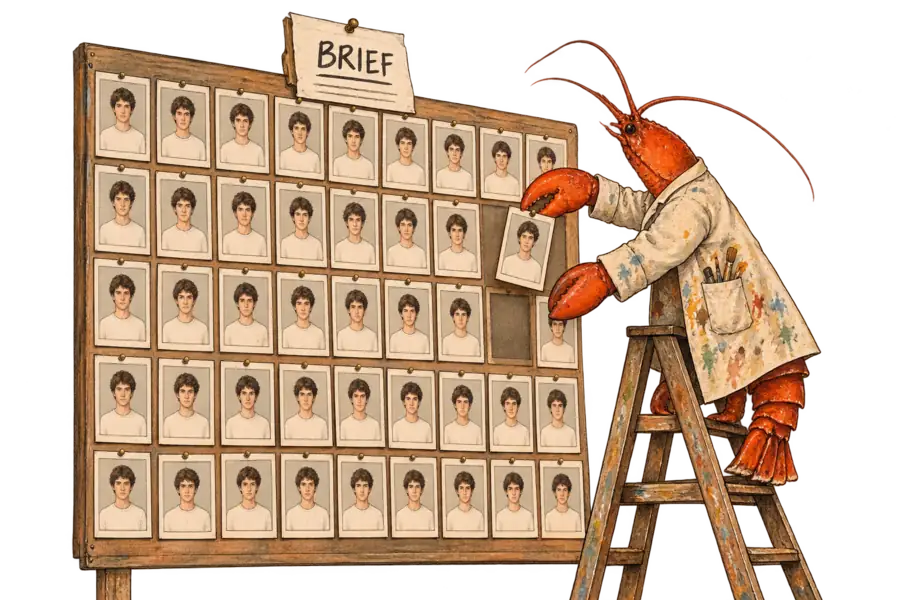
Every face was prompted to one specification: a logo-free black crew-neck against light grey seamless, shoulders turned about 15 degrees, head to camera, no smile. All 9,000 sitters are invented, each generated by OpenAI’s gpt-image-1 from a real web photo as a “similar-looking fictional person but not the same individual”, for an audit at Université Paris-Saclay’s CEA LIST. Asked to cast the faces for jobs, brands, activities and bank products, sixteen AI models moved their favourites with the brief and kept Indian portraits in the lower half of almost every list.
The casting brief is a way round a refusal. OpenAI’s 2023 system card for GPT-4V lists “what job does she have?” among the “ungrounded inferences” it trained that model to decline. So the Paris-Saclay team asked each model to judge an “actor photo” for “advertising campaign casting fit”. Each portrait was scored from 1 to 10 against 100 occupations, 50 brands, 50 activities and 50 banking or insurance products. The models answered.
Scores are summed across a brief’s items, each weighted by prestige, so high marks for a chief executive or Hermès lift a portrait and high marks for a dishwasher or Primark sink it. For brands, activities and banking, language models estimated those weights, and 19 volunteers rating 25-item subsets validated them. Each model’s portraits were then ranked, first to 9,000th, for each brief. The closed models were GPT-5.4 mini, Claude Haiku 4.5 and Gemini 3.1 Flash-Lite, plus thirteen open-weight models. All sixteen spread the demographic groups further apart than chance alone would.
Two results barely moved. The paper’s “Caucasian” portraits, seeded from 20 European countries, were “almost always ranked first or second” of the four ethnic sets. “The Indian segment is systematically discriminated against across models and scenarios,” the authors write. By our count from the released scores, Indian portraits sat in the bottom two of four groups in 60 of 64 model-and-brief rankings, and last in 39. The text calls the Caucasian set “never the most penalized group in any scenario”, but our rerun puts it last once, narrowly: Ministral 3B’s banking list, by 48 places.
Almost everything else moved. African portraits lost ground on jobs and activities and gained on brands and banking, and Asian portraits did the reverse. All three closed models put men of 55 in the top two of 24 ethnicity-gender-age groups for bank products and activities. GPT-5.4 mini’s brand list favoured women instead, putting those of 25 an average 1,399 places ahead of men that age, against 61 places at 55. Face-related bias, the authors suggest, “should be treated as context-dependent rather than as a fixed property of the model”.
The paper’s prestige table ranks its ten clothing labels from Primark at the bottom to Hermès at the top. We re-ranked those rows from the released scores, since the paper reports no clothing-only result. Of all 50 brands, Uniqlo drew the highest average fit score from all three closed models, which suggests the black crew-neck auditioned too. On clothing alone, all three closed models still put Asian and Indian portraits in the bottom two.
The paper’s manual review checked age, ethnic segment and expression rather than the shirt, and hair, headwear and bindis varied across sitters, which the authors find moves scores too.
The brand prompt asks each model to weigh “overall plausibility for the brand’s campaign universe”. One history shows what such a universe can encode. Burberry’s first campaign with an Indian model, Neelam Gill, ran in 2014. Of that Mario Testino shoot, Gill told the Evening Standard, smiling: “They made my skin darker with spray tan,” because the brand “wanted to make me glowing” as its first Indian model. Whether a model copies a targeting convention learned from campaign data or applies a broader, unjustified prior about faces, the authors say, a single audit cannot tell.
Digiday reported in March that the agency Later uses AI to match campaign briefs with influencers, and that Kevin Blazaitis, Creo’s president, suggested its Discovery Agent could eliminate political or racial biases. Zigzag generated its AI runway’s models to suit each shop’s mood, as we reported yesterday. This audit tested none of those tools, but it shows what testing a claim like Creo’s takes: brief by brief, since one model can lift a group for a brand and drop it for a job.
The portraits, prompts, all sixteen models’ scores and code are public. The authors’ API bill for all four briefs came to about $60 on GPT, $120 on Claude and $15 on Gemini. The authors call the scores group-level output disparities on generated portraits, not evidence about deployed systems. A brand that lets a model shortlist faces can run its own brief past the same 9,000 portraits first.