AI Answers on Weekend Menswear Cited an Office-Wear Label in More Answers Than Ten Brands' Sites Combined
Plateer Japan found ten apparel brands named in 61.2% of AI answers about men's weekend clothes, but their own sites cited in 12.7%. Its blog shows an office-wear label's site in 508 answers against 476 for the brands' sites taken together, and the most-cited brand doing best with a listicle on its own store that puts it first.
Sir John Crabstone
In one vendor’s test, AI engines named Japanese clothing brands freely and cited them sparingly. Plateer Japan asked four engines 80 questions about men’s weekend clothes, 12 times each. In the 3,737 valid answers, at least one of ten apparel brands was named 61.2% of the time. Their own websites were cited in 12.7%, or 476 answers; one of the ten, Ciaopanic Typy, had no official site counted, so that figure covers nine. A single office-wear label’s site turned up in 508 answers. Plateer sells the brands a remedy.
The press release, issued on 10 November, leaves the outside sites to the blog. Its headline names Freak’s Store the citation leader at 11.1%, a rate from the 20 questions about taste and look; the lead gives 6.6% for all 80. The headline takes the brand’s best quarter of the survey.
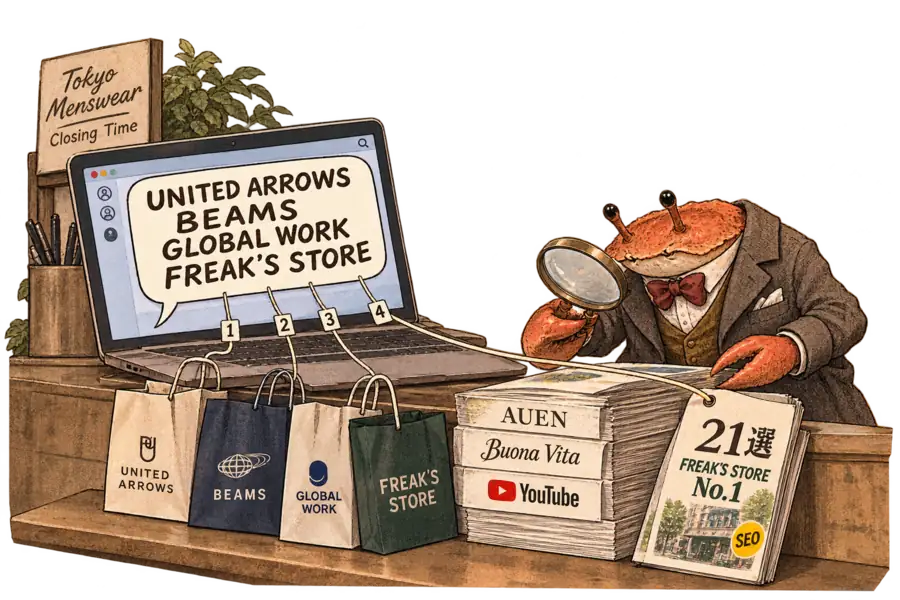
The label is AUEN, formerly DCOLLECTION, whose site appeared in 508 answers against those 476. The comparison counts each answer once, however many brand sites it cites. Added brand by brand, Freak’s Store (245), United Arrows (184) and Beams (77) already reach 506. Buona Vita, another online shop with style explainers (メンズ通販・ファッション解説), appeared in 471. Google’s own search and product links turned up in 451.
AUEN presents itself around office wear; its slogan is 「平日5日、迷わず整う」, roughly “five weekdays, sorted without dithering”. Plateer does not say which AUEN pages were cited; the URLs sit in the gated report. One of its guides, 「30代メンズの服はどこで買う?」 (“Where should men in their thirties buy clothes?”), recommends 13 brands, among them Ships, Nano Universe and Beams Hart, a cheaper Beams line. Six of the 13 sit under casual clothes for days off and outdoors. The guide is credited to “AUEN’s AI writer” and carries affiliate links.
Plateer singles out a home page for eight of the ten brands: Beams’ appeared in 51 answers, United Arrows’ online store in 41. Freak’s Store, top of Plateer’s citation table, is credited with two feature pages on Daytona Park, its official online shop, cited in 94 and 45 answers.
The 94-answer page is a listicle titled 「メンズ服の人気ブランド21選!」 (“21 popular men’s clothing brands!”). It numbers its picks for two age groups, and Freak’s Store is first in both. Daytona Park lists SEO among the page’s topics.
Freak’s Store’s most-cited page is a ranking that puts Freak’s Store first.
Plateer’s remedy, genrank, builds AI-readable HTML and structured data from product pages, FAQs and the like. The aim is an official site cited “as a source that answers the customer’s question” (顧客の質問に答える情報源として). Every question the blog quotes asks where to shop or which brand to pick. A product page describes a shirt; those questions ask for a shop.
Wording moves the answers, too. Asked where to buy a full set of weekend clothes, the engines named Beams in 79.2% of answers and Global Work in 77.1%. When the question capped the budget at ¥20,000 for top and trousers, Beams fell to 12.5% and Global Work rose to 97.9%. Each rate rests on 48 answers, and the second question also asks what kind of shop, not only what it costs. A keyword version of the first question gave Global Work 75.0% and Beams 62.5%.
The release’s small print says its ranking depends on the questions and the judging rules and does not reflect market share. A citation rate, it adds, does not directly show visits, purchases or sales (サイト流入や購入、売上への効果を直接示すものではありません). Plateer sells a way to raise a rate that it does not tie to sales.
Three of the four engines are Google’s: Gemini, AI Mode and AI Overviews. The published figures pool all four, so Google’s share of the gap is unknown. Plateer’s form asks for a company name and a phone number, and staff send the report within three business days. Competitors, individuals and free-mail addresses may be refused. The evidence is free, provided one is a prospect.
A French study found a similar split in another sector. Dekuple Insight tested ChatGPT and Gemini across six retail sectors, as Comarketing-News reported it. In high-tech, retailers’ own sites made up 91% of the domains used for omnichannel services such as delivery, availability and click-and-collect. Questions of quality, price or reliability leaned more on third parties. High-tech is not menswear, and the study does not separate mentions from citations, so it is a parallel to Plateer’s gap, not an explanation of it.