AI Clones the Design Overnight. UK Law Still Argues Over the Handbag.
Generative tools now take a handbag from prompt to finished design in an afternoon. Britain's copycat law, the only protection an independent designer has, still needs years and live witnesses to stop a single copy.
Sir John Crabstone
A major accessories label designed a handbag this year by prompting Raspberry AI. The tool took the Loop shoulder bag from sketch to finished design and saved, by its account, two weeks of sampling. A machine that fast cannot tell invention from imitation, and the law that polices the difference still needs years and live witnesses.
An independent designer in Britain has no unfair competition law to fall back on, the protection designers rely on across the Channel. What she has instead is passing off, a Victorian tort that requires goodwill and deception to be proved before it will act. It does not ask whether she was copied; it asks whether a substantial number of shoppers were deceived, which means producing the deceived shoppers themselves. That proof is slow to assemble, and the buyer who knew she was paying less for the lookalike was deceived about nothing.
Her other shield is the supplementary unregistered design right, which runs three years and bites only on copying she can prove. Proof means evidence of access and similarity, almost always circumstantial. A small label cannot fund years of that fight, and most never bring one. The machine that copied her needed an evening.
The fashionable worry is that AI asks the law new questions, when the old ones already take too long to answer. Magmatic sued over its Trunki ride-on suitcase, knowing the rival had built a cheaper version after seeing one. The claim failed at the Supreme Court in 2016, because the registered design read as a horned animal and the rival read as an insect. A litigant with money, a registered right, and derivation the Supreme Court itself found plain lost on whether a child sees antennae. If that derivation went unpunished in 2016, derivation that a machine performs by the thousand will go unpunished now.
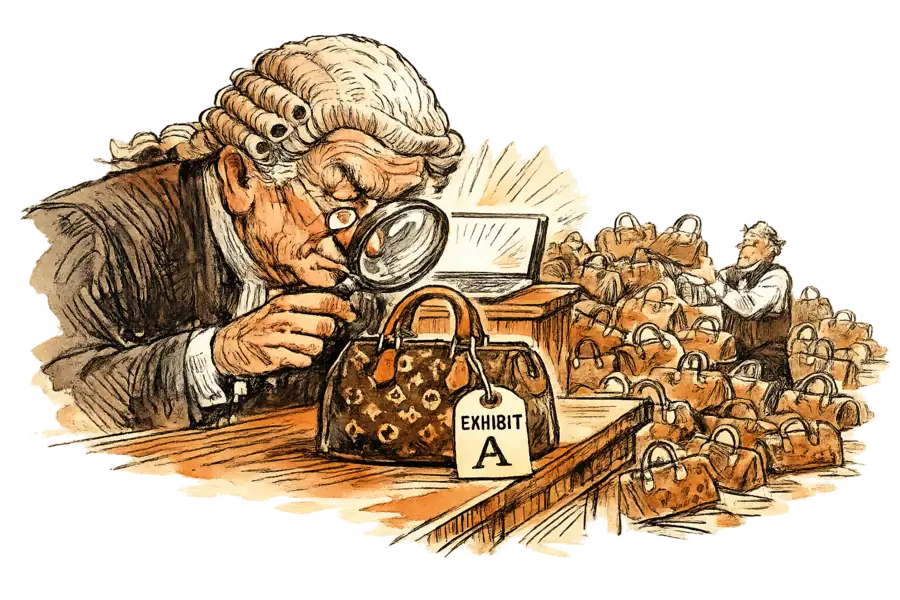
The clone ships overnight; the remedy keeps lawyer’s hours.
When the law does move, it moves like this. Thatchers sued Aldi over a lookalike cider can and lost at first instance. It won only on appeal in January 2025, and only on a registered trade mark, not the passing off a smaller designer would be left with. Years of litigation and a war chest, to halt one can of cider.
Shoppers have already chosen. Walmart’s third-party sellers offered a Birkin lookalike called the Wirkin for about $80. The Birkin resells from $14,800 to past $300,000. Hermès said nothing. The get-up of a handbag is the hardest thing in retail to protect and the easiest thing to covet. The next one will not need a factory, only an afternoon.
Slow law was survivable while copying was slow. Copying is no longer slow. The first label cloned at machine speed will learn this before its lawyers finish reading the brief. The courts have not noticed, and they are still arguing, with great care, about one handbag.