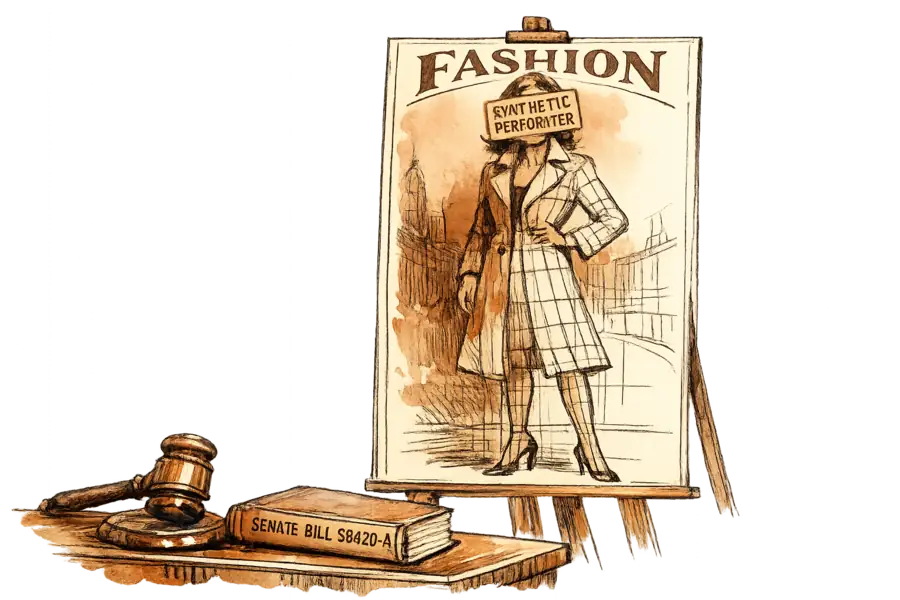
Albany Labelled the Model. Nothing Else in the Frame Wears One.
New York's Synthetic Performer Disclosure Law, in force since 9 June, requires a label when an advertisement features an invented human being. Generated garments, backdrops, product shots and the licensed digital twins of real models carry no label at all.
Sir John Crabstone
New York’s Synthetic Performer Disclosure Law took effect on 9 June. It obliges any advertiser reaching a New York audience to label an advertisement featuring a digitally created human being who resembles nobody in particular. The regulated unit is the person in the picture. The coat she is wearing may be equally invented, and the statute has nothing to say about it.
The definition does the narrowing, and does it quietly. A synthetic performer is an asset made by computer and intended to create the impression that the asset is engaging in an audiovisual and/or visual performance of a human performer who is not recognizable as any identifiable natural performer. Two conditions, both concerned with humanity: the asset must read as a person, and as no person in particular. Penalties reach $1,000 for a first violation and $5,000 thereafter, though nobody has yet settled what “conspicuous” means.
Everything else in an apparel advertisement is unregulated. Backgrounds, environments and product imagery sit outside the statute, as do generated depictions of objects. A brand may generate the backdrop, the shadow under the hem, the fall of the wool and the shoes, and declare none of it. The single element it must announce is the element it can most easily hire.
The proportions here are not marginal. Zalando told Reuters that around 70 per cent of its editorial campaign imagery in the fourth quarter of 2024 was AI-generated, cutting production from six or eight weeks to three or four days at roughly a tenth of the cost. Zalando advertises into Europe rather than New York, but the figure remains the clearest published measure of how much of a garment image is now manufactured rather than photographed.
Two further limits narrow the law again. The duty attaches only where the advertiser has actual knowledge that a synthetic performer was used, and that standard is what leaves a brand that buys imagery from a vendor and never asks in a defensible position, whatever the vendor did. The statute also carves out digital replicas of identifiable real people. A twin of a living model is recognisable as that model, which fails the second condition. Consent and a licence make the image lawful; they also make it silent.
H&M announced thirty such twins in March 2025, each model keeping rights to her likeness and paid as for conventional image use, the images watermarked on Instagram and TikTok. It is also the version New York exempts. H&M marks those images because H&M decided to.
The law demands a label for the model who does not exist and permits silence about the one who does.
The inversion makes sense once you know who drafted it. The bill was union-backed, carried by Senate Deputy Leader Michael Gianaris and Assemblymember Linda Rosenthal, and signed at SAG-AFTRA’s New York office. That is not a disclosure law with a labour history — it is a labour law that borrowed the word disclosure. Judged as protection for working performers, it is coherent. It was never built to inventory what apparel advertising manufactures, and it does not.
For a brand advertising into New York this settles into a preference. License a real model, build her twin, then generate the studio and the garment behind her: the campaign is almost wholly synthetic and carries no label. Invent the woman outright and the label appears. The statute prices the likeness and leaves the rest of the picture free.
The compliance advice reads it the other way round, treating the statute as America’s first general rule on synthetic advertising and instructing brands to audit their AI imagery. The audit will find the faces and stop. For most apparel advertisers, compliance costs one line of type and no change whatever to the pipeline that produced the image. The label tells a New York shopper that the woman is not real. It says nothing about the coat, which is the thing for sale.