Alibaba's After-Click Feed Posted Its Biggest Revenue Gain Where Sales Fell
In Alibaba's live test of TriGen, the model behind the feed a shopper sees after clicking a product, revenue rose in all six Southeast Asian markets and GMV in four; on the traffic-weighted aggregate the revenue lift was more than three times the GMV lift. The paper never says what that revenue counts; its screenshots carry Lazada badges, and its authors elsewhere use REV for advertising revenue.
Neritus Vale
Alibaba researchers have rebuilt the model behind the feed a shopper sees after clicking a product, and tested it across Southeast Asia. On the same traffic, the aggregate revenue lift in the test was more than three times the lift in gross merchandise value (GMV), the value of goods sold. The paper files that revenue under “platform monetization”, and the evidence below suggests sellers are the ones paying it.
TriGen, submitted to arXiv on 12 November, comes from Alibaba International Digital Commerce Group, with a co-author at Nankai University and another listed as an independent researcher. In what the field calls trigger-induced recommendation, the clicked item is “pinned above the recommendations organized around it”. The model weighs that click, the shopper’s “immediate impulses”, against the “persistent tastes” in their history, with a gate setting the balance for each request.
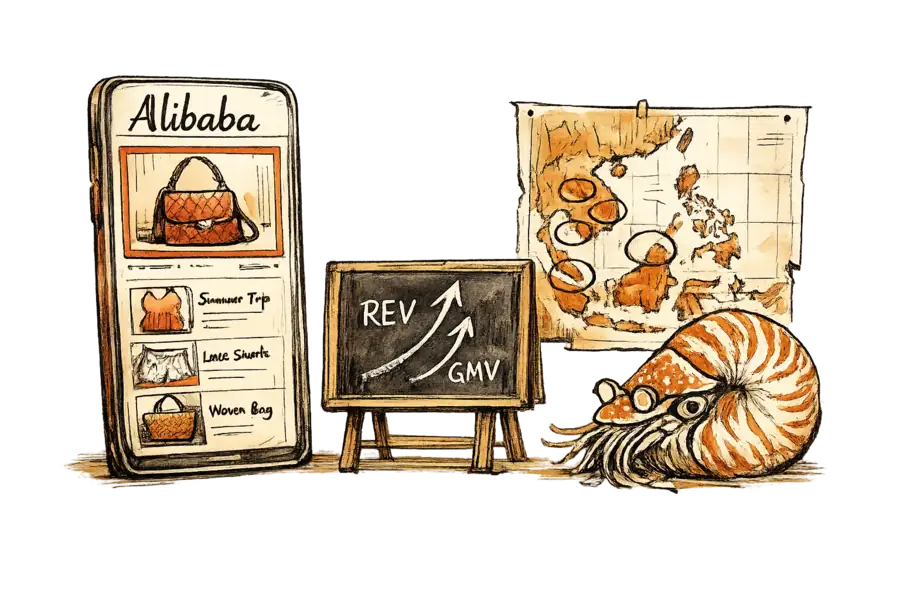
None of the paper’s numbers is broken out for clothing. Offline, TriGen beat every baseline on an industrial dataset described without categories, and was also tested on Amazon reviews of industrial and scientific supplies. Clothing appears only in a case study, where shoppers with different histories clicked the same quilted shoulder bag. Where the history held a dress, a sun hat, sunglasses and a suitcase, TriGen returned summer tops, lace shorts, a handbag and a travel skincare set. A history of digital and desk accessories drew only bags.
TriGen’s live test ran in the trigger-induced feed on product detail pages in Indonesia, Malaysia, Singapore, the Philippines, Thailand and Vietnam. Its control was the production model, a simpler generative recommender that appends the clicked item to the history. From 28 June to 2 July 2026, each arm got a tenth of production traffic. TriGen has served “primary online traffic” since July.
The abstract reports “significant revenue and GMV improvements”, a pairing that blurs how far apart the measures moved. A chart in the results splits them by market. Revenue, abbreviated REV, rose in every market, while GMV managed four.
On the paper’s headline aggregate, which weights each market by its traffic, revenue rose 3.27%. The results section leads with revenue, under “platform monetization”. GMV rose 0.90%, and the authors call both lifts statistically significant. They do not publish the weights, so no reader can rebuild the aggregate from the markets.
In Indonesia and Thailand, TriGen’s arm sold less than the control. Indonesia’s GMV came in 2.71% below, and Thailand’s 2.48% below. Both markets still delivered revenue gains, and Indonesia’s was the largest in the test. The paper reports no test for any single market, so neither shortfall is a verdict.
Other platform papers this autumn left sales thin, absent or unremarked. Taobao’s ICE paper reported an undefined commercial revenue and no GMV, while Kuaishou’s GR4AD-X printed revenue with no click, conversion or advertiser figure. In Pailitao’s photo-search test, sales grew more numerous but, by our arithmetic, smaller, a shift its authors left unstated.
TriGen never says what REV counts, or whether its feed carries sponsored listings. Its authors are plainer elsewhere. In KL-MOPD, posted on 27 October by a team that includes TriGen’s corresponding author, Jinxin Hu, REV stands for “advertising revenue”.
The two papers appear to share data. TriGen’s industrial dataset and KL-MOPD’s report identical statistics, to the last digit. TriGen describes its logs as coming from “a real Trigger-Induced Recommendation scenario”; in KL-MOPD, the same counts describe an “industrial advertising dataset”.
TriGen’s text never names its platform, but the screenshots in its case study carry Lazada badges. The markets tested are exactly Lazada’s, Alibaba’s Southeast Asian marketplace, and Hu signs TriGen with a lazada.com email address. In August, Hu and three other TriGen authors described deploying a different system on “Alibaba’s Lazada advertising platform”.
The companion paper is explicit about ads. ReSID, posted the same day by almost the same authors, reports a test on “a large-scale e-commerce advertising platform”. There ad revenue outpaced GMV; in KL-MOPD and Astar, GMV led. TriGen alone calls its platform only “a major e-commerce platform”, with no mention of advertising.
The siblings split on which measure led, so the inference rests on KL-MOPD’s definition and the shared dataset: TriGen’s revenue looks like the money sellers pay to be seen.
Lazada sellers have paid by the click for promoted listings. Its 2022 seller training lists the product details page’s “Recommendations” tab among places where promoted listings might appear, and has sellers “pay only when products’ listings are clicked”. TriGen does not say whether its feed is that tab. If the feed’s slots are sold per click, a click that sells nothing still pays, so revenue can rise while GMV falls short.
The strongest case for TriGen runs through Singapore. There GMV rose 20.54%, the largest move in the test, while revenue rose far less; in Malaysia and Vietnam, too, GMV outpaced revenue. On that reading the feed found shoppers things they wanted, and the small GMV aggregate is dragged down by shortfalls that may be noise. For it to hold, the Indonesian and Thai results would have to be flukes, or the traffic weighting a distortion.
The paper gives no way to test either condition. The weighting is the authors’ own headline, and with the weights unpublished it cannot be checked. If the dips in Indonesia and Thailand might be noise, so might Singapore’s spike, since the paper tests no market on its own. Nor did revenue track GMV across markets: the biggest revenue gain, 8.16%, arrived where GMV finished below the control. Whatever REV counts, Indonesia’s extra did not come from a bigger GMV.
For a label whose dress a shopper has just clicked, the feed below it now draws on a model whose live test reports revenue first. If that revenue is advertising, the slots under the dress are for sale, to the label and its rivals alike. The authors could say what REV counts in a sentence. Until they do, a seller bidding for those slots is buying placement in a feed that, in this test, produced revenue gains in more markets than sales gains.