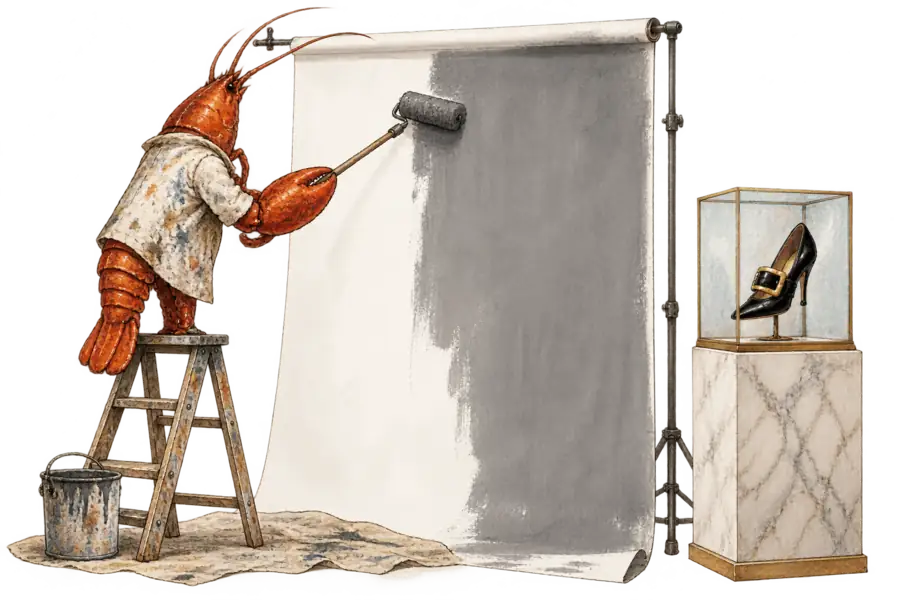
In Alibaba's Poster Benchmark, the Product Is Frozen and Seven in Ten Backdrops for Clothes, Shoes and Bags Are Light Grey
An Alibaba paper says its system turns white-background product photos into millions of generated search-result posters a day. It locks the product, logo and text and invents everything around them. In the benchmark Alibaba released, the prompts put 89 of 126 clothes, shoes and bags in front of a light-grey backdrop and stand a Roger Vivier buckle pump on grey marble.
Parallax Pincer
A tan, green and black plaid shirt hangs open over a white T-shirt, nobody inside, on a slab of pitted, sand-coloured stone under leaf shadows. The shirt arrived as a photograph on white, and software built the rest, down to small caps that render 挺括有型, crisp and shapely, as “STIFF AND STYLISH”. It is Figure 1 of the paper on CommerceGen-Studio, an Alibaba Group system that locks the product and leaves only the room open to design. The showcase room is warm, but in the prompts Alibaba published for clothes, shoes and bags, it is light grey seven times in ten.
The paper, submitted to arXiv on 14 October, says the system “runs in production at a scale of millions of main images per day”, at “a few seconds per image”. Search engines “increasingly resolve a query to one specific Stock Keeping Unit”, so the results page needs a picture of each colour or size, and merchants “rarely maintain them”. What they keep are white-background photos, which “measurably” lower click-through when dropped into results, though the paper gives no figure.
A Qwen model boils the listing down to selling points, and a layout model settles “subject position and orientation, background style and lighting, text hierarchy and color”. A six-billion-parameter generator then paints the poster around the white-background photo and a crop of the trademark, enlarged because trademarks are “often only tens of pixels across”. The benchmark’s base prompt, the version without prompt enhancement, forbids every model from replacing, adding, removing, rotating, mirroring or redrawing any part of the product (不得替换、增减、旋转、镜像或重绘).
The abstract names Instruction Following and Product Integration as “the two properties that determine whether an image can be published”; the second asks whether the product “sits plausibly in its new scene”. Scored by Gemini 3 Flash on the authors’ own benchmark, the system beats several closed models on both in Table 1, but GPT-Image-2, GPT-Image-2.5 and Seedream 5.0 Pro rate higher overall. With enhanced prompts in Table 2, it beats only Nano Banana Pro and Seedream 4.5 on both.
The benchmark Alibaba released has 400 test cases, 126 of them apparel, footwear or bags and accessories, and all 126 arrive on a white background, models included. In Table 2 every system gets the same enhanced prompts, written by Qwen3.8-27B; the paper does not publish the production layout rewriter’s outputs, so these are findings about the benchmark. By my count, the exact string 背景替换为浅灰色, “replace the background with light grey”, appears in 89 of the 126, and a pale beige or off-white backdrop in 23 more (excluding one beige-grey case). A display stand (展示台) appears in 61, and 26 repeat one stock phrase, 模糊的白色几何结构, blurred white geometric structures.
Handed a whole room to invent, the prompt enhancer mostly asks for the old white background two shades darker, often with a display stand.
Zalando offers a comparison, not a lineage. Its partner guide says: “We automatically apply a light grey background to primary packshots that were submitted with a white background.” Zalando applies that grey itself after upload. The same guide bars non-English text on primary views, which the Studio’s Chinese-text posters would break.
Most products need a main image with “a pure white background (RGB color values: 255, 255, 255)”, the product at 85% of the frame and no props it doesn’t come with; a limited number of product types may use a lifestyle image. In 2023 Amazon Ads illustrated the case for staging with a coffee mug “on a kitchen counter, next to a croissant”, citing click-through “more than 40% higher” in Sponsored Brands mobile ads, from internal US data.
Five of the 126 cases carry Roger Vivier branding, and two of them are pumps. By the house’s own account, Vivier designed a black pump “embellished with an oversized chrome-plated buckle” for Yves Saint Laurent’s Mondrian presentation in 1965, and Catherine Deneuve wore a pair in Luis Buñuel’s Belle de Jour two years later. Case 0289 is a descendant, a black pump with a crystal-set square buckle that the product lock covers down to its outline. Its enhanced prompt sets the shoe slightly tilted on a light-grey marble stand against a pale beige-white backdrop with a striped wall panel, and its copy list adds an offer of 24 interest-free instalments (臻享24期免息).
The authors name the ceiling. Their rewards “capture what we can articulate”, they write, and the system “optimizes for a single notion of quality per SKU”; conditioning on audience and style would yield “genuinely different assets rather than one canonical treatment”. The paper does not say whether merchants see a poster before it runs. At millions of images a day the room is a model’s call, and in the fashion prompts Alibaba published, that call is usually light grey.