Amazon's €20bn for German SMEs Sits Just Above What Its 2021 Release Implied
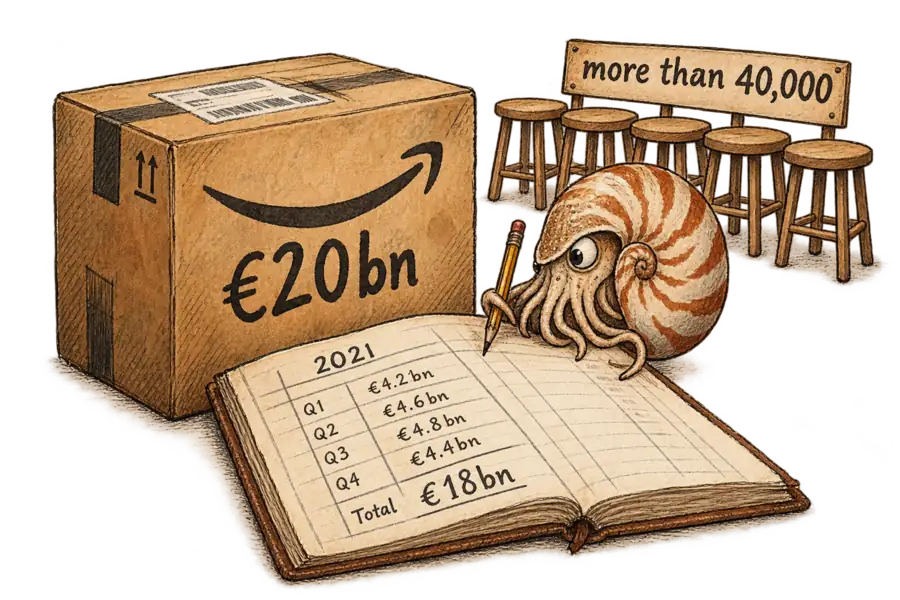
Amazon's total for German SMEs, more than €20bn of sales in 2025, comes with no history, but its 2021 release implied at least €18bn for 2020. The seller count is back at that year's 'more than 40,000', units sit at their 2021 floor, and German sellers supplied about a tenth of the export growth Amazon reported for the EU.
Neritus Vale
Amazon has put a total on German SMEs: more than €20bn of sales through its stores in 2025, its new SME report says. Ecommerce News Europe reported on 22 October that Amazon had not disclosed such a total before. A total with no history cannot show growth, and Amazon’s earlier figures point to a business that has grown abroad and shown no sign of growth at home. Its 2021 release implied at least €18bn for 2020, and the new figure sits just above it.
Amazon now says “more than 40,000” German small and medium-sized firms sell through it, the same wording its 2021 release used for 2020. Quoted phrases from Amazon’s German pages are our translations. That is a floor, and a lower one than last year’s count of around 47,000.
This year’s report mentions its seller count once, in the section promoting AI tools, as a present-tense aside rather than a count for the sales year.
The total is new only as a printed sum, because the 2021 release published both ingredients. Beside the count, it put the average 2020 sales of German SMEs at €450,000. It does not say whether that is sales on Amazon, and it does not define “KMU”, so the product of at least €18bn is our estimate on that assumption. It is a floor because the count was a floor. By sales year, the count is back at its 2020 floor and units sit at their 2021 floor.
| Sales year (Amazon source) | German SMEs selling | Exports | Products sold |
|---|---|---|---|
| 2020 | more than 40,000 | €3.75bn | more than 650m |
| 2021 | more than 45,000 | more than €4.25bn | more than 750m |
| 2022 | about 47,500 | more than €4.75bn | more than 725m |
| 2023 | about 47,500 | €5.5bn | more than 750m |
| 2024 | about 47,000 | more than €5.7bn | more than 750m |
| 2025 | more than 40,000 (aside, not a labelled sales-year count) | €5.9bn | more than 750m |
The total arrived without definitions. Amazon gave it in a 15 October release on its German investments, days before a government summit where it pledged more than €16bn for 2027. This year’s report page, like the 2022 and July 2025 report PDFs, never says what counts as an SME. Nor does it say whether “Umsatz” (sales) includes VAT, returns, or the commission and fulfilment fees Amazon keeps.
The one unit figure that grew belongs to Amazon’s warehouses. The 15 October release says units handled through Fulfilment by Amazon for these sellers rose by almost 10%. That part of their trade can grow while the whole stands still.
Exports, the figure Amazon led with in most past reports, have slowed. Amazon reported growth of at least 10% a year for sales years 2021, 2022 and 2023. For 2024 and 2025, by our sums, the pace is about 3.5% a year, on figures that are themselves floors.
The slowdown is a German one. Across the EU, SMEs selling on Amazon added €2bn of exports in 2025, Amazon said in April. Most of that came from elsewhere: German sellers added about €0.2bn.
Most of the total is sold at home. Subtract the €5.9bn of exports from the €20bn floor, and more than €14.1bn remains, assuming everything not exported was sold in Germany.
That is at least a sixth of German online goods spending. Germany’s e-commerce association, bevh, counted €83.1bn of it in 2025, including VAT, from a consumer survey. Amazon does not say whether its euros include VAT or sales to businesses, so the comparison is loose.
Exports alone cover the gap between the two floors. They rose by €2.15bn from 2020 to 2025. Floors cannot prove that sales at home fell. They do mean Amazon has published nothing showing them rising.
Flat sales at home would match the market. In 2020, bevh put German online goods sales at €83.3bn, a shade above 2025; both figures are nominal and include VAT. SMEs on Amazon may have moved with it, which sits awkwardly with the three “growth levers” the report promotes.
The strongest objection is that the floors hide a healthy consolidation. On that reading, casual sellers have left, and a smaller, more committed base sells well above “more than €20bn”. For the thesis to fail, 2025’s total must sit far above its floor while 2020’s sat close to its own.
Amazon’s wording makes a total far above its floor unlikely. The report calls exports “almost a third” of the total, a loose descriptor, but one that puts the total between about €18bn and €20bn. Nothing pins the 2020 figure that tightly, because it rests on an open-ended count. Its true value is likelier to sit further above its floor, so comparing floors flatters 2025. The average that would show whether sellers sell more appeared in the 2021 release and in no release since.
The other reading is that Amazon now counts differently, and it has changed its basis before. Its 2020 report put German selling partners’ average sales at more than €120,000 for June 2019 to May 2020. The 2021 release, counting SMEs by calendar year, gave 2019’s average as €350,000 and does not explain the difference. Averages move with their basis, which is why the €18bn above is an estimate.
Amazon’s EU labels changed too. Its April 2025 post credited “127,000 EU sellers” with 2024’s exports and said over 100,000 of them reached international customers. This April’s post speaks of “100,000+ EU-based SMEs”, which may be the exporter subset rather than a smaller seller base.
The report’s bureaucracy section tells of Calcuso founder Alexander Giersz, whose wife needed three to four months just to set up as a seller. If red tape is thinning the ranks, a count that has fallen back to its 2020 floor would give Amazon an argument for the simpler EU rules it wants.
For a small German label weighing Amazon against its own shop, the total says the channel is big. The floors show no sign of growth at home since 2020. Clothing was among SMEs’ five best-selling categories in the 2021 and 2022 releases; this year’s gives no split, so a label cannot see how its own category fared. Publishing the exact count, the average and the definitions is a choice Amazon can make, and until it does, the €20bn measures size and nothing else.