Amazon Holds 63% of German Online Sales. The Search Box Is Where Rivals Could Cut In.
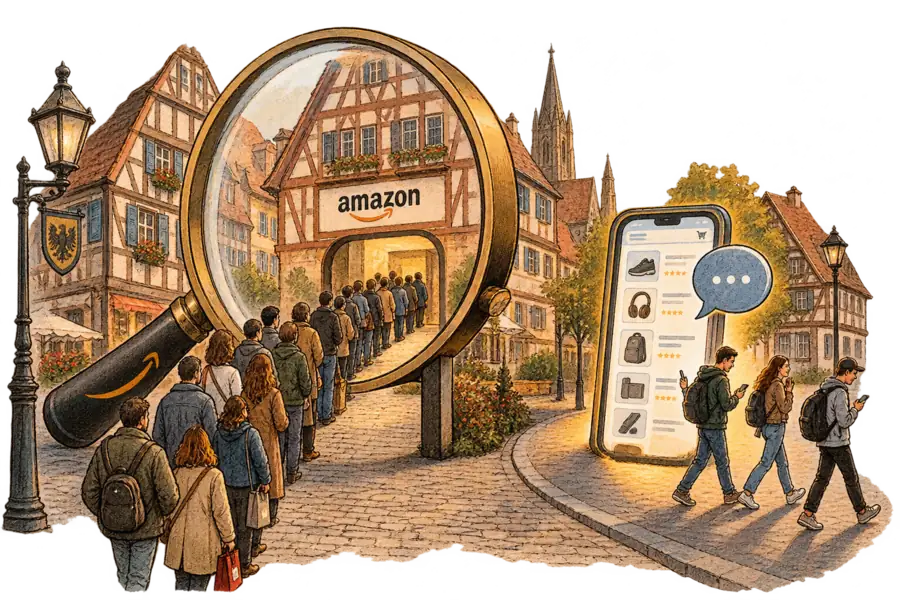
IFH Köln's new study gives Amazon 63% of German online sales and shows its pull reaching sales it never makes, through product search and price checks. If Temu and Shein, which the study names, and the AI assistants an Etribes adviser names work on that search step, they do not need to match Amazon's delivery.
Admiral Neritus Vale
IFH Köln’s new study with the data firm General Evidence gives Amazon and its marketplace about 63% of German online sales in 2025, and the evidence points to the search box as the source of that pull. Across sectors, Amazon ranks with Google among Germans’ most important sources of product information, dpa reported from the study in a story carried by TextilWirtschaft. Prices and customer reviews are what Germans look for there most. The study names Temu and Shein as the challengers gaining ground, and an outside adviser adds TikTok Shop and AI assistants. If those challengers win the first step of a purchase, they do not have to beat Amazon’s delivery.
The search box shapes sales Amazon never makes, and IFH has measured them before. Its 2019 Amazon study found shoppers checking Amazon’s price before 27% of their purchases in physical shops, Horizont reported. That is an average across the sectors studied. A shop that doubles as the price reference sets the benchmark every rival is measured against.
The new study describes Amazon as a product search engine, an advertising environment and a central point of access, as well as a marketplace. Amazon’s own trade makes up 17.2% of the revenue the study examined, and a further 24% is influenced by Amazon through product search, price orientation or the visibility of offers. That base is wider than online retail, so the 24% cannot be added to the 63%.
The two explanations quoted in the coverage stop at service and price. Karolin Junker de Neui of the consultancy Etribes gave dpa the service version: Amazon customers know “fairly precisely what they are getting: a large selection, a simple buying process, fast delivery and uncomplicated returns.” The price version came from Martin Groß-Albenhausen, deputy chief executive of the e-commerce association bevh, who said in July that the Asian platforms are popular “above all because of their low prices,” Schwäbische Zeitung reported. Price explains why a shopper buys a cheap dress on Shein. How that shopper found the dress is a separate question, and neither quote answers it.
IFH’s figures show the service lead holding. Shoppers still rate Amazon clearly ahead on selection, ordering convenience and delivery speed. Amazon added about €3.2bn in German sales over the year, a gain that fits the service story on its own.
The gains elsewhere do not point to a single rival. Temu and Shein added about €1bn between them, and Otto and Zalando about €1.4bn. Hansjürgen Heinick, the study’s author, puts the real change less in Amazon than in the market around it: “New providers today manage to build visibility and reach much faster.”
Fashion is where the Asian platforms are strongest, and where Amazon’s hold was lower in IFH’s last sector measurement. The 2019 study found that about a quarter of fashion sales depended on Amazon, counting its own sales and those it influenced, and Horizont reported that the share was markedly higher in other sectors. IFH’s 2026 release gives no fashion figure; it says only that Amazon’s influence varies considerably by product range. For the Asian platforms, bevh counted more than 16% of all online fashion orders in the second quarter, FashionUnited reported. That is a share of orders on bevh’s own definition, and it cannot be set against IFH’s figure for Amazon.
Neither figure shows how those fashion orders were reached. The working hypothesis here is that feeds build visibility without waiting for a search. TikTok Shop, Junker de Neui told dpa, offers a shopping experience Amazon cannot replicate.
The second challenger is the AI assistant, which Junker de Neui told dpa could push Amazon’s role in product search into the background. IFH’s media-research unit measured current use last month in a study with the leaflet distributor Media Central, covering groceries, DIY, electricals and furniture but not fashion. It found 21% of consumers using AI to research products and offers. They use it for answering concrete questions, comparing products and making recommendations, which are the jobs a search box does. More than five in six of those users rely mostly on ChatGPT or Gemini. Amazon put its own assistant, Rufus, into its German app in November 2024, but the survey does not show it leading among AI users.
The strongest objection is that the assistant adds a step in front of Amazon’s search box without replacing it. IFH itself reads AI as mainly a supplementary channel: as the first choice in any phase of the search it draws between 3% and 10%. Of the AI users, 84% check the results through other sources, and Amazon is one of the main places Germans go for prices and reviews. The AI study does not measure Amazon as a channel, so it cannot say where those checks happen. On the objection’s reading, the assistant sends traffic to Amazon’s search box.
Amazon’s customers are also still buying more there: one in three told IFH they had increased their purchases over the past one to two years, while 18% bought less. Heinick says Amazon is “by no means in retreat.” For the thesis to fail, the division of labour has to last: the assistant suggests, Amazon confirms, and the confirmation keeps the sale.
That division holds today, but it hands the first move to someone else. Whoever draws up the shortlist decides which products reach the price check, and for AI users that shortlist comes mostly from ChatGPT or Gemini. The habit skews young: 32% of 18-to-29-year-olds already turn to AI at least occasionally when searching for products, against 10% of 60-to-69-year-olds. If the young keep the habit as they age, a growing share of German shopping could begin outside Amazon’s search box without a shopper deciding to leave it.
Delivery speed cannot answer a question that was asked somewhere else.
If the argument holds, the first thing Amazon loses is the influence that never needed a sale. The 24% it shapes through search and price orientation depends on Germans checking there first. So does the advertising environment IFH describes beside the shop, which sells brands that same first look. The warehouses would feel it last. For everyone else in German retail, that turns Amazon’s 63% from a verdict into a choice. The first look can still be bought on Amazon, where nearly every online shopper buys, or won in the feeds and in assistants such as ChatGPT and Gemini, which Amazon does not run.
German-language quotations are translated by Rack & Reason.