Amazon's Basket Gap and Google's Click Parity Leave Out the Sale
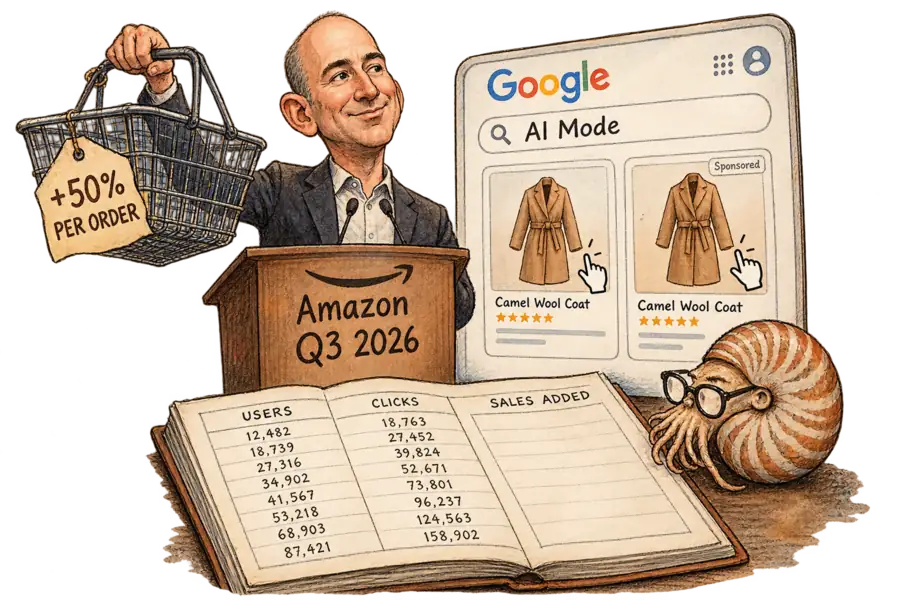
On consecutive earnings calls, Amazon said US users of Alexa for Shopping spend 50% more per order than non-users, and Google said sponsored listings in AI Mode draw click rates similar to free ones. Neither figure counts sales the assistant added, a number Amazon stated at least twice for Rufus and left out of its latest release.
Neritus Vale
Amazon gave investors one user-versus-non-user figure for AI shopping this week, and Google gave one click figure; neither counted a sale. On 29 October Andy Jassy said American customers using Alexa for Shopping spend 50% more per order than those who don’t. Google’s came a day earlier, when Philipp Schindler said shoppers click sponsored product listings in AI Mode about as often as free ones. The first figure describes who uses an assistant, and the second describes what shoppers click. Neither says whether the sale would have happened anyway.
Amazon’s figure is narrower than it was first reported. Modern Retail’s Anna Hensel reported the premium without its qualifiers and read the figures as “a powerful growth lever”. The Fortune transcript has Jassy limiting the premium to “U.S. customers” and to spending “per order”. Amazon’s earnings release counts more than 400 million users over the past year, with no such limit.
A gap between users and everyone else measures who opens the assistant before it measures anything the assistant does. If shoppers ask more about a winter coat than a phone charger, an assistant that answers questions will gather the larger orders without changing anyone’s mind. Amazon’s comparison cannot tell that pattern from a real lift. Last year Jassy made the same kind of comparison for Rufus, saying its users were “60% more likely to complete a purchase”. Walmart reports its Sparky premium the same way.
The same call ran the same comparison on groceries. Jassy said customers who shop perishables with same-day delivery buy “nearly seven times more Everyday Essential units than those who don’t.” That sentence describes a kind of household, not an effect of delivery. Active grocery customers, he added, “spend over two times more” on non-grocery categories such as home and apparel. The comparison flatters whatever the heaviest shoppers adopt first, whether a chatbot or same-day milk.
Amazon once put a sales figure on what its assistant added, and never said how it counted.
When the assistant was called Rufus, Amazon put a number on it. On the call a year ago, Jassy said Rufus was “on track to deliver over $10 billion in incremental annualized sales.” Amazon did not say how it measured “incremental”, a word that implies sales that would not otherwise have happened. In February, the fourth-quarter release put the 2025 figure at “nearly $12 billion”. Rufus became Alexa for Shopping in May, and neither the second- nor the third-quarter release, nor the third-quarter call, has repeated the estimate.
Amazon’s sales line cannot answer the question this quarter either. Online stores revenue rose 2%, the release shows. Prime Day distorts that figure, having moved into the second quarter for most large countries. Amazon says total growth would have been about four points higher without the move.
Google’s figure is a click rate, measured over two weeks. “Click-through rates are already similar between sponsored and organic product list items within AI Mode,” Schindler said on the call. TechCrunch paraphrased it as rates “comparable” to organic listings. Google’s Ads blog footnotes the claim to internal US data from 20 August to 3 September, and says the ads are clearly labeled “Sponsored”. It also announces AI Mode ads in ten more countries, with the UK among those due this quarter.
Click parity shows that shoppers click a labelled sponsored item about as often as the free ones beside it. Barry Schwartz of Search Engine Roundtable noted that the product results are “super graphical” and asked about text links. Neither a click rate nor a label says what the click was worth. If the sponsored card shows a product the free list would have offered anyway, the brand pays for a visit it would have had free.
Google’s search growth slowed this quarter, and Schindler named AI Mode as one cause among several. Search and other revenue rose 12% in the third quarter, its slowest rate this year. Asked whether Google was showing fewer ads, Schindler called currency “the single largest driver”. He then pointed to Asia-Pacific retail advertisers hit by the EU de minimis change and to the timing of World Cup spending in media. He also conceded that “the strong growth in AI Mode queries had an impact because of the lower monetization we were seeing in AI Mode.” The click figure is Google’s case for showing more ads there; it is silent on whether they add sales.
A 2014 experiment at eBay found that search ads return far less than the usual estimates suggest. Tom Blake, Chris Nosko and Steven Tadelis found that “returns from paid search are a fraction of conventional non-experimental estimates.” On non-brand keywords, frequent users, “whose purchasing behavior is not influenced by ads,” accounted for most of the ad spending. The study covered eBay’s search ads, not assistants. If heavy shoppers click most and use assistants most, both figures will peak among the shoppers whose buying they change least.
The strongest objection is that Amazon’s premium has grown as the assistant has spread. In July, Amazon’s second-quarter release put it at “over 40%”. If heavy shoppers adopt first, lighter latecomers should dilute the gap, so a widening one suggests the assistant itself lifts orders. For that reading to hold, the figures must cover comparable periods and the newer users must be lighter shoppers.
Neither condition can be tested from the figures Amazon gave. Neither states a period, and the July one appeared in a release for a quarter that included Prime Day. The releases do not say who Amazon’s newest users are. Until Amazon publishes an incremental estimate again, the widening gap fits a change in who joined as well as in what the assistant does.
Both assistants now carry ads, bought by the brands whose sales are in question. Amazon introduced Sponsored Products and Brand Prompts in Rufus this year, and Google is putting ads into follow-up questions in AI Mode in the US. Retail contributed most to Google’s search growth this quarter, its finance chief, Anat Ashkenazi, said on the call. If the platforms price that space on this week’s figures, brands will be buying engagement as though it were sales.
For a brand, the choice is what to ask for before the holiday budget goes out. Amazon has shown that an incremental estimate can be made, because it stated one for Rufus at least twice. Google’s click figure covers a fortnight of American data. A brand that accepts a basket gap and a click rate instead risks paying mostly for shoppers who would have bought anyway.