Amazon Built the Shopping AI. Now Its Rivals Rent It.
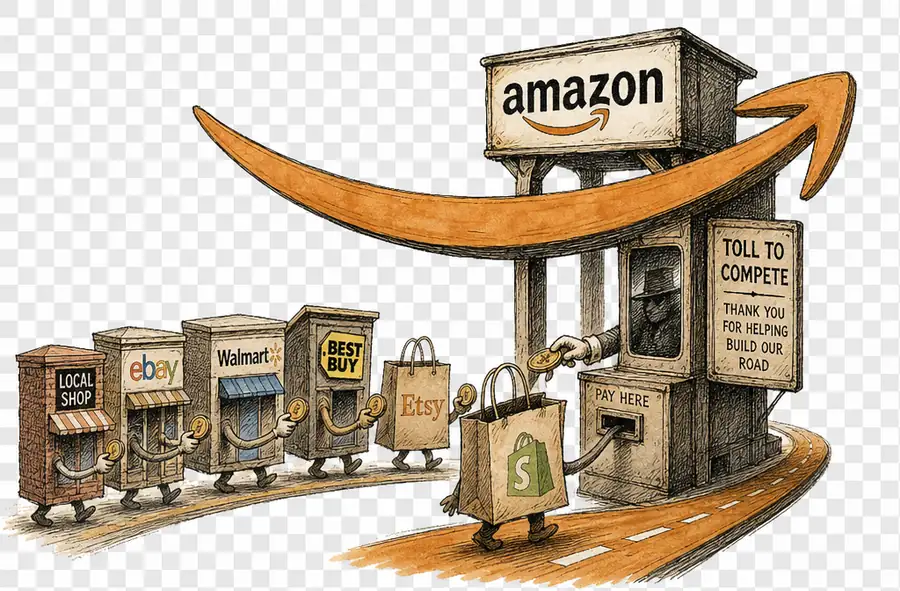
Amazon's AWS division has begun selling the technology behind its own shopping assistant to the retailers it competes with. The move converts Amazon's costliest consumer-AI experiment into an industry toll and seats it one layer beneath agentic commerce, as supplier rather than rival.
Neritus Vale
Amazon has put the AI behind its own store on sale to the stores it competes with. On May 27 its cloud division launched the AWS Agentic Shopping Assistant, a packaged version of Alexa for Shopping, the merged Rufus and Alexa+ system that runs inside Amazon’s app. AWS says it can install the assistant on a rival’s website in roughly sixty days. The deal turns Amazon’s costliest consumer-AI experiment into a toll the rest of retail pays, and seats the company one layer beneath agentic commerce, as supplier rather than competitor.
The assistant Amazon is selling carries a track record no independent vendor can match. Inside Amazon’s app it reached more than 300 million shoppers last year, a population most retailers will not see in a decade. On Amazon’s own accounting it drove $12 billion in incremental sales, the figure that turns a cost center into a product worth reselling. AWS is not offering retailers a model so much as proof of performance at a scale none of them can reproduce alone.
This is the cloud playbook, aimed now at the part of Amazon its rivals fear most. Amazon’s habit is to build a capability for itself, prove it at scale, then rent it to everyone, which is how an in-house computing department grew into a business larger than most of the software industry. David Dorf, who leads retail solutions at AWS, gave Modern Retail the unornamented version: “Everybody could benefit from this, so let’s productize it a little bit and figure out a repeatable way to deliver the same technology to multiple retailers.” Conversational shopping is the new target, the layer starting to sit between a shopper and a catalog.
An infrastructure business does not need to win the sale; it needs the sale to run through it.

Amazon is now working both sides of the same counter. While AWS sells retailers an agent to greet their shoppers, Amazon’s own app has spent the past year learning to reach past those shoppers entirely. Its Buy for Me feature, in beta since April 2025, completes purchases on outside brand sites from inside the Amazon app, so the customer never has to land on the retailer’s page. Petra Schindler-Carter, an AWS general manager, names the fear plainly: retailers worry about “getting disintermediated” as agents step between them and their customers. Amazon is selling the remedy for a condition it is also spreading.
The toll runs at two rates, and the second is the one retailers should read closely. Conversational sessions inside Amazon’s app convert at 3.5 times the rate of keyword search, the number that justifies selling the assistant as a conversion engine. It earns Amazon more than that: internal planning documents summarized by Fortune projected the assistant would contribute over $700 million in operating profit in 2025. A retailer that adopts the architecture is buying into a model in which the recommendation is also the ad slot.
The strongest objection is that no retailer will hand strategic AI to the competitor best placed to use it against them. The fear is rational and has precedent: in 2017, Walmart pushed its suppliers off AWS, telling vendors it preferred its most sensitive data not sit “on a competitor’s storage offering.” Neutral suppliers exist, too; OpenAI and Google are both building shopping agents a wary retailer could wait for. For the thesis to fail, that caution would have to hold across the market, not only at its top. It will not, because the argument never needed Walmart or Target; it needs the long tail of brands that cannot build this themselves and cannot wait three years to try. Tapestry’s Kate Spade, which launched an AI gift concierge on the AWS stack in April, is the tell: a brand with the budget to choose independence chose the faster path to a working agent instead.
The price of the sixty-day assistant comes due later, and not as a license fee. If Accenture is right that more than $3 trillion in commerce could flow through AI agents by 2030, then the layer supplying those agents collects on each sale that passes through it, whoever appears to make it. A retailer that rents the agent rents more than software: it takes the landlord’s roadmap and hands back the data its shoppers generate. It accepts an exit cost no one can yet name, on terms set by a company that sells against it down the street. Amazon has arranged the choice so that it no longer runs between using a shopping agent and refusing one. It runs between building one slowly and owning it, or renting one quickly and being metered on it. Amazon paid for the research either way; the question it has handed its rivals is who pays it back.