Amazon's Draft Memo Admits Rufus's Wrong Answers and Turns to Brands' Websites
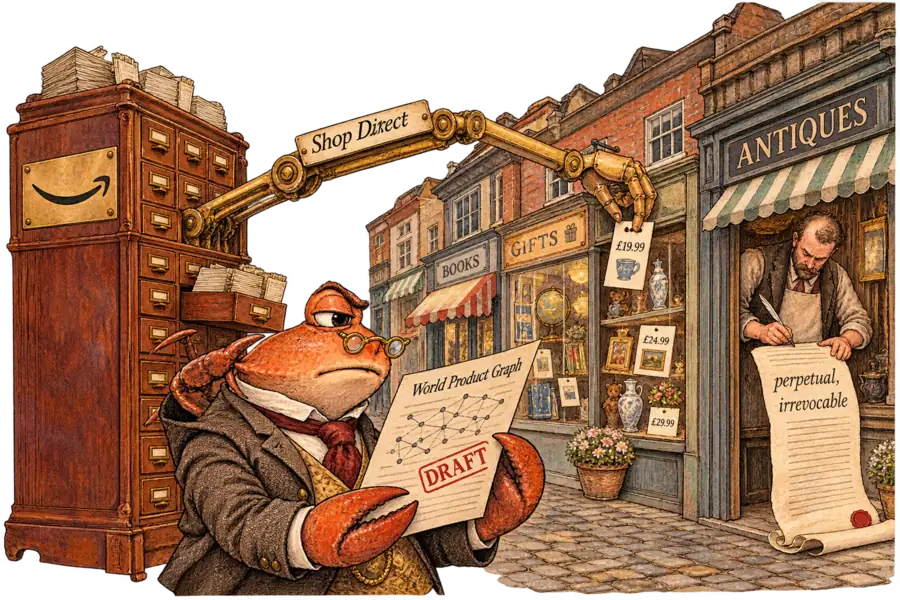
An internal Amazon draft says many Rufus answers are wrong or incomplete and that customers cannot tell; Amazon calls it a brainstorming document. Its fix depends on how brands organise their own websites, and Amazon's live Shop Direct programme says it may use those public pages and takes a perpetual licence to any catalogue sent through its portal.
Sir John Crabstone
An internal Amazon document reviewed by Reuters, syndicated by Euronext, is written like a press release. It confesses what no release would: “Many Rufus answers are factually wrong or incomplete, but customers lack expertise to detect these errors.” The fix it proposes depends on brands’ own websites, and Amazon’s Shop Direct FAQ says it may use those same public pages.
The plan, World Product Graph, would gather data on virtually every item for sale, stocked by Amazon or not. It “depends on discovering how brands organize their products on their own websites,” the document says, which Reuters glosses as feeds plus crawling other retailers’ sites. Reuters could not determine how Amazon planned to crawl them, or whether it would need to seek permission in all cases. Rufus searches are “expensive”; fuller data would allow cheaper models.
Amazon told Reuters that “Draft, outdated documents often paint an incomplete picture,” and that Alexa for Shopping, Rufus’s name since May, is roughly 97% accurate globally. The document’s aspirational release date is 1 October 2027; Reuters could not determine “if or when” the plan will be implemented. No definition of the 97% was reported.
Publicly, the assistant has had better notices: Amazon’s February results credited it with helping deliver “nearly $12 billion in incremental annualized sales” in 2025. Both verdicts can be true. The release does not say how the figure was measured, and sales measure persuasion, not accuracy.
The Verge sets the plan against Reddit: it is meant to make Amazon “more useful than Reddit for people and AI agents.” It then quotes the confession only as far as “incomplete.” The omitted half is the one brands should read: if shoppers cannot catch errors, the data has to be right before it reaches them.
Coca-Cola and Bayer are named as contributors, and the document records a “CEO-level P&G/Amazon summit” for a Procter & Gamble trial, Reuters reported. The companies did not respond to requests for comment. Reuters also reports that employees describe the graph as the beginnings of an expansion of Buy for Me and Shop Direct, which list other sites’ goods.
Shop Direct got a sign-up form on 4 November. Its Merchant Workspace lets eligible merchants submit whatever items “they want to include” and “opt out at any time.”
The form’s terms are less casual. A merchant grants Amazon a licence “to use, reproduce, and create derivative works of” its catalogue data, non-exclusive but “perpetual, irrevocable.” It also gives Amazon access to its website, including to verify prices and stock “in any way that Amazon reasonably requires,” and Amazon may correct price and availability data in listings.
A merchant may stop sending data and ask for its products to come down; the licence to what it sent does not go with them.
Brands that never sign up may be listed anyway. The Shop Direct FAQ says Amazon “may use publicly available information from your website” to make products discoverable, and holds merchants “responsible for the accuracy and completeness of the information on the merchant website.” A brand that objects can email shopdirect@amazon.com; the FAQ promises a reply within two business days. Participation can happen to a brand before it asks.
The usual control is robots.txt, which Amazon’s crawler page says its automated crawling respects. But a file that admits search engines without naming Amzn-SearchBot admits it too, and Amzn-User, fetching for a customer, “may not follow all robots.txt directives.” The page does not say which agent, if any, gathers Shop Direct’s information.
Amazon calls the memo a brainstorming document. Shop Direct’s terms are not one.