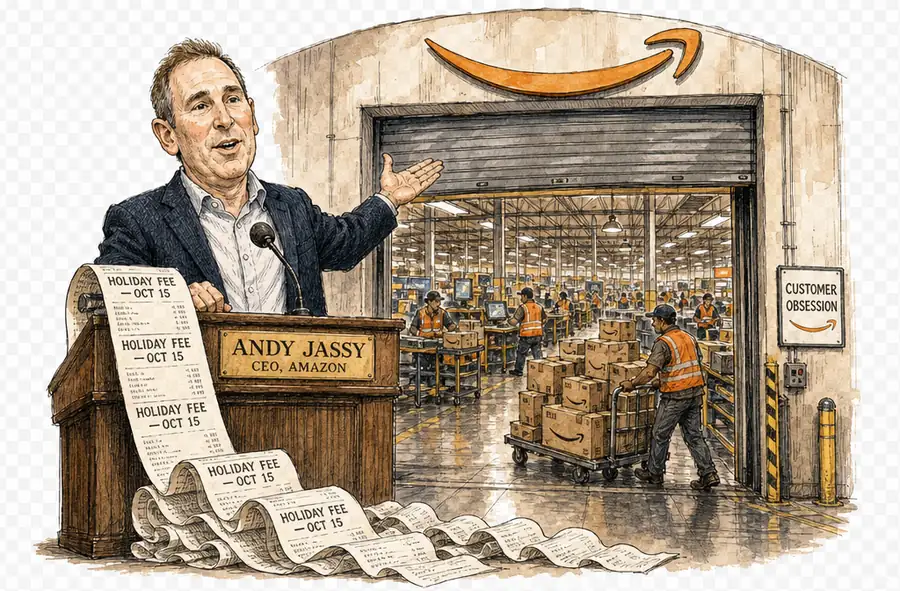
Amazon Opened the Network. The Toll Came in the Same Mail.
Amazon opened its supply chain logistics network on 4 May, two days after extending a 3.5% surcharge to more sellers. Capability and cost arrived in the same news cycle, with the holiday peak fee waiting on 15 October.
Sir John Crabstone
Amazon spent the first week of May 2026 telling sellers two things. The first sounded generous. The second arrived as a footnote. The footnote was the larger of the two.
On 4 May, the company opened its logistics network to every business with cargo to move. Amazon Supply Chain Services bundles ocean freight, customs clearance, distribution, and parcel delivery into one console. Lands’ End, American Eagle Outfitters, Procter & Gamble and 3M were named as anchor adopters — two of them fashion brands, apparently willing. The framing was civic.
Two days earlier, a quieter notice had extended the company’s 3.5% fuel and logistics surcharge to Multi-Channel Fulfilment and Buy with Prime. The surcharge was first imposed on 17 April. It sits atop January’s base-fee changes. Amazon described those as $0.08 per unit; AMZ Prep’s internal fee analysis across its client accounts found sellers paying eight to ten percent more. The official number was the headline. The other is what most sellers are actually paying.
The April charge was labelled “temporary.”
The holiday peak fulfilment fee then arrives on 15 October. Amazon has held its peak surcharges at last year’s rates: $0.19 on a small standard unit, $0.31 on a large, $4.42 at the upper end. The headline reads steady. The base does not; the absolute October fee will run higher than last year’s even with identical deltas.
This is the architecture worth naming.
Cross-border friction is the seller’s problem; Amazon offers a tool. When fuel costs rise, Amazon adds the surcharge to the seller’s invoice. The holiday peak is a calendar event neither party invented, and only one party gets to set its price.
Amazon’s preferred verb in the May press cycle was “open.” The doors are open. The cost of using them has been listed in a different memo.
That is not generosity — it is a logistics arm that has finally found a way to charge third parties for what once was Amazon’s own cost of doing business.
ASCS is, on its merits, a useful product. Customs clearance from Shenzhen to Kentucky is not a service many fashion brands ever wanted to manage in-house, and few platforms have the scale to do it. But sellers were already funding Amazon’s logistics build through every fulfilment line item. Now they will pay for it twice: as the cost of moving each box, and again as a fee to use the network those boxes already paid for.
A seller can decline ASCS and route its container around the company. Most will not, because most cannot. That is the leverage Amazon has spent two decades acquiring: the marketplace makes the supply-chain product the path of least resistance.
Fashion brands feel this hardest. The tool is most useful to sellers least able to absorb the October surcharge on top of January’s base-rate increase.
Seattle now presents this logistics arm as a business line in its own right. The infrastructure is built from seller fees.
A landlord who installs a better elevator does not generally lower the rent.