
Amazon's Block on Perplexity Is the Opening Shot in Fashion's Next Channel War
A federal court's CFAA ruling against Perplexity's Comet agent establishes that platform authorization — not user consent — controls AI agent access to retail marketplaces. Fashion brands selling across closed and open commerce platforms face a channel split with different legal rules on each side.
Lady Clementine Brine
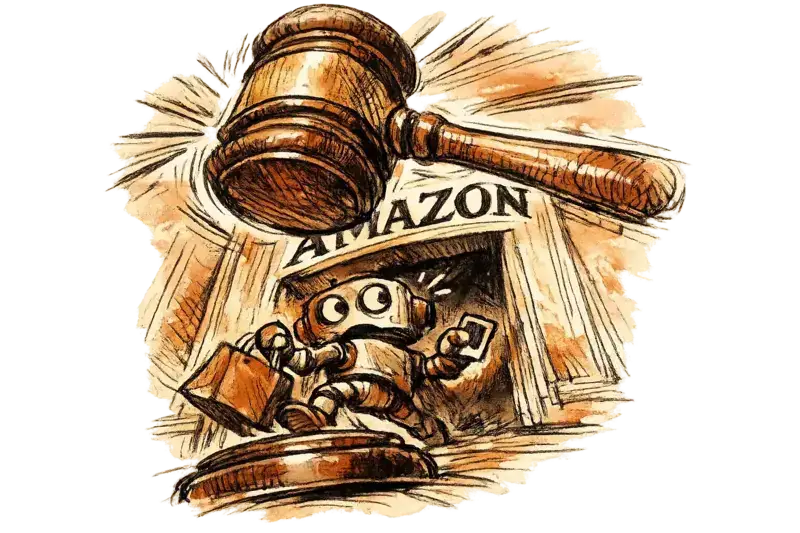
On March 10, U.S. District Judge Maxine Chesney granted Amazon a preliminary injunction blocking Perplexity’s Comet browser from accessing password-protected areas of Amazon’s marketplace. The legal basis was the federal Computer Fraud and Abuse Act. This is the first courtroom test of who controls AI agent access to a retail platform, and fashion brands with marketplace exposure sit on the resulting fault line.
What the court found
Amazon sued Perplexity in November 2025, alleging that Comet — a browser agent that logs into Amazon accounts and completes purchases on the user’s behalf — accessed its systems without authorization. Comet presented itself as a standard Chromium browser, refusing to identify as an AI agent. When Amazon deployed a technical block in August 2025, Perplexity pushed a circumvention update within 24 hours.
Judge Chesney found Amazon likely to succeed on both CFAA and California computer fraud claims. The injunction bars Comet from password-protected Amazon accounts and orders destruction of all Amazon data Perplexity collected through the agent. A seven-day stay was granted; Perplexity filed a Ninth Circuit appeal on March 11.
The authorization distinction
The ruling’s operative finding: Comet accessed Amazon “with the Amazon user’s permission, but without authorization by Amazon.” Two separate legal requirements, tested for the first time against an AI shopping agent.
If upheld, platforms can refuse AI agent access regardless of consumer consent. Amazon reinforced this by updating its Business Solutions Agreement on March 4, requiring all AI agents to identify themselves. The legal ruling and the updated terms of service now point in the same direction: Amazon controls who enters.
Perplexity’s stated position is that users have “the right to choose whatever AI they want.” That argument failed at the district level. The Ninth Circuit outcome will set the boundary for every AI agent attempting to transact on a closed platform.
The split market
Amazon’s legal strategy treats unauthorized agent access as computer fraud. The Universal Commerce Protocol, co-developed by Google, Shopify, Target, Walmart, Macy’s, Zalando, and more than 20 other partners, takes the opposite position: a standardized layer for AI agents to discover, negotiate, and transact with merchant permission.
Shopify merchants saw 14x more agent-driven orders between January 2025 and January 2026. The protocol is live for eligible U.S. merchants. Walmart and Target are testing ways to work with AI shopping platforms while preserving their transactional role.
Closed platforms now control agent access at the gate. Under open protocols, that decision falls to the merchant.

Fashion’s channel exposure
Fashion brands with dual distribution straddle both regimes.
On Amazon — which captures roughly 40% of U.S. e-commerce — agent-driven discovery is legally contested territory. eMarketer forecast Amazon’s retail media ad revenue at $56.2 billion for 2025, its fastest-growing segment at 22% year-over-year growth. Shopping agents that bypass sponsored listings and promoted placements threaten that revenue. Amazon’s incentive to block agents is structural.
On open platforms, agent visibility depends on structured product data. The McKinsey/BoF State of Fashion 2026 report found 92% of fashion companies plan to increase AI investment. Only 1% report mature deployment. The gap between stated intent and operational readiness is where channel risk sits.
Assessment
This case is a jurisdictional contest over the agentic retail layer. The CFAA framing makes it federal law, not contract dispute. The authorization distinction, if upheld, gives platforms unilateral control over agent access independent of consumer choice.
Fashion brands do not need to predict the appeal outcome. They need to answer three questions. Where are their products listed? Which of those platforms allow or block AI agent access? And do they have any visibility into how agents interact with their catalog on each?
The legal line is being drawn now. Channel strategy that does not account for it has an unpriced risk.