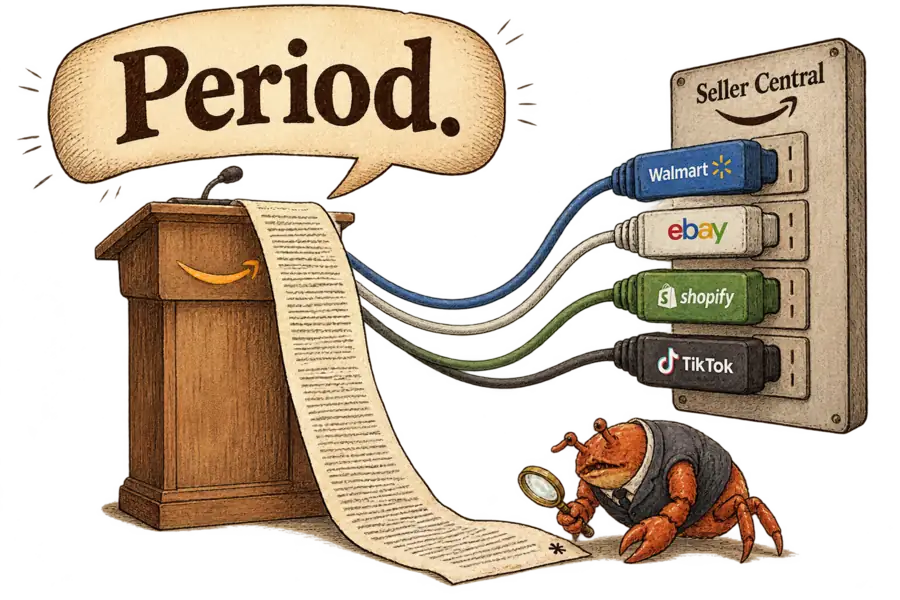
Amazon's Promise on Sellers' Walmart Data Is Louder Than Its Footnote
Amazon's vice president told GeekWire that sellers' Walmart, eBay, Shopify and TikTok data is never used except to show it back to them. The announcement's footnote promises less, naming only other sellers and Amazon's retail business, and is silent on the marketplace that polices prices.
Sir John Crabstone
Amazon has made two promises about sellers’ Walmart, eBay, Shopify and TikTok data, and only one appears in its own text. That one shields the data from other sellers and Amazon’s retail business. It says nothing of the marketplace, the part of Amazon that polices sellers’ prices.
The multichannel selling tools began rolling out to sellers in Amazon’s US store on 24 September. They import and link a seller’s listings from the four rivals and put every unshipped order on one screen, each a few clicks from fulfilment through Amazon. More than 95% of Amazon’s independent sellers sell on several channels, Amazon says, and the tools are free. Few will need persuading.
Mary Beth Westmoreland, the vice president who signed the announcement, raised the data question herself when GeekWire interviewed her. Multichannel data that might surface in Seller Central, she said, is “never used for anything other than surfacing it to that specific seller. Period.” Asked whether it could hurt a seller’s standing, she was more emphatic: “We never, ever, will touch this data or use it for any other reason other than to show it to you.”
The written version is narrower. The announcement says off-Amazon data stays “secure and private, accessible to the seller for the purposes of managing their business.” That says who may see it, not what Amazon may do with it.
A footnote adds that the data “is not shared with other sellers or used to inform Amazon’s retail business decisions”, a phrase the post never defines. PPC Land noted that this omits advertising and the systems that assess offers, though the silence “may reflect nothing more than brevity.” A footnote is the one place a company is never brief by accident.
Prices are the marketplace’s business. Its Fair Pricing Policy says Amazon “regularly monitors” prices in its stores and “compares them with other prices available to our customers.” A price “significantly higher than recent prices offered on or off Amazon” can cost a seller the Featured Offer. The policy does not say whose recent prices count; read plainly, it could catch a label that clears last season’s stock on Shopify and leaves Amazon at full price.
In the announcement, Amazon’s retail business has sworn off the data; the arm that checks prices has not.
Price policing sits at the centre of the Federal Trade Commission’s 2023 antitrust suit, and Amazon denies the allegation. The complaint says nearly 98% of Amazon purchases go through the Featured Offer, or Buy Box. It describes an algorithm that disqualifies an offer from winning the Buy Box if the item is cheaper “even by a penny” at a store Amazon designates a “Select Competitor”. Amazon then tells the seller the lower price but, the FTC alleges, “deliberately withholds the source.”
By the FTC’s account, Amazon will not say where it found a seller’s lower price. Sellers are now invited to show it where they sell. Westmoreland’s “Period” is the better promise. It is not the one in the footnote.