Amazon Wrote the Questions. Kate Spade Keeps the Answers.
AWS sells retailers the architecture behind Amazon's own shopping assistant, and the contract leaves every query log in the retailer's hands. The asset that changed hands was not the data but the right to decide what shoppers get asked.
Admiral Neritus Vale
Amazon’s shopping assistant now ships to its competitors with the questions already written. AWS launched the Agentic Shopping Assistant on May 27, handing retailers the architecture, starter code and consulting hours behind the system that runs inside Amazon’s own store. What a conversational assistant does that a search box cannot is ask, and whoever writes the asking decides what a retailer can ever learn about its customers.
AWS treats the offering as professional services more than software — the Marketplace listing names three engagement models, routes delivery through the AWS Generative AI Innovation Center, and tells prospective buyers to contact their AWS account rep rather than quoting a price. The deliverables run past the chat window: the system remembers a shopper’s preferences across sessions, one of the few specifics AWS confirms. A retailer buying that is buying, from a competitor, the instrument through which it will read its own customers.
The numbers doing the selling were produced inside a store no adopter resembles. Amazon credits the assistant with nearly $12 billion in incremental sales last year, the line AWS now quotes to buyers. That figure comes from a catalog that dwarfs anything a licensee will run, where an assistant earns its keep by finding one right answer inside an abundance no shopper can survey. AWS pairs it with the claim that conversational sessions convert at 3.5 times the rate of keyword search. On a boutique apparel site the task inverts, because the assistant has to persuade a shopper that a narrow assortment contains their answer at all. Same interface, opposite problem.
Search recorded what shoppers called things; conversation records what they would settle for.
The queries an apparel assistant collects are the ones the business has always had to guess at. A shopper who types “black dress” has said almost nothing, while a shopper who explains that they need something for an August wedding, cannot wear strapless and will not go past $200 has described a product a buying team could brief. Those constraints arrive before the purchase, which separates them from every signal a retailer already holds. Returns record what failed after the fact, and sales record what cleared. Conversation is the only channel that captures the sale that was never made, along with the reason.
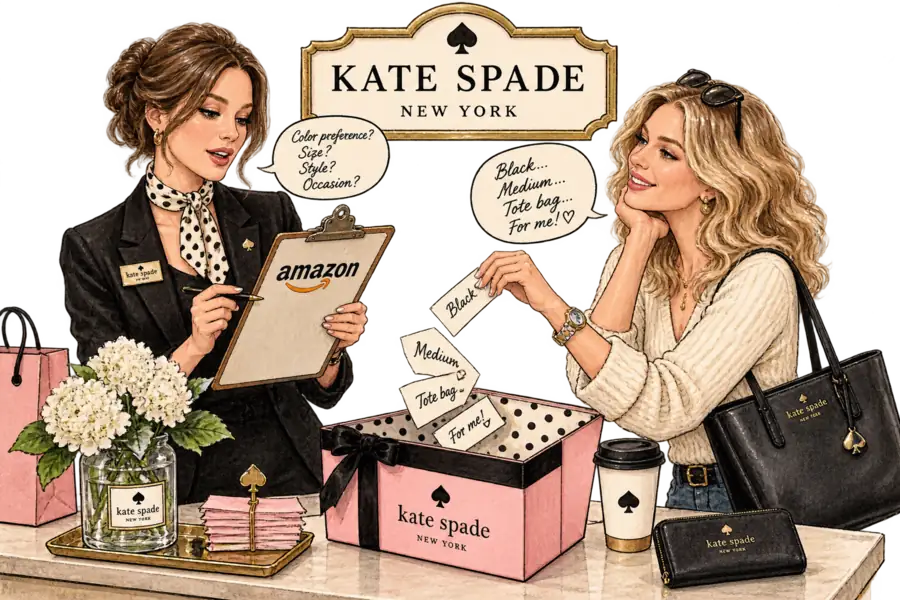
Kate Spade’s concierge shows how narrow that collection can be. The brand went live on April 13 with a gift assistant that works through occasion, style and recipient before it shows a bag. Tapestry’s chief data and analytics officer, Fabio Luzzi, told Digital Commerce 360 that it “came directly from listening to our consumers and figuring out what they actually needed.” The same report notes the tool was informed by questions customers put to Alexa for Shopping and the answers that led to purchases. Occasion and recipient are what the concierge will learn. Fit complaints, price ceilings and the substitution a shopper made when the first suggestion missed are absent from the transcript, because nobody wrote them into the questions.

Which questions to ask, and when, is an open research problem rather than a solved one. A paper posted to arXiv on July 7, “When and How to Ask”, finds that the best elicitation strategy shifts with the stage of a conversation: attribute questions work early, while item-based prompts do better once a shopper’s preferences have refined. Its authors studied conversational recommender systems in general rather than apparel, and built a dataset annotated for whether asking is warranted at all. That the timing is still contested is the point. A retailer deploying through AWS inherits an elicitation policy fitted to Amazon’s shoppers and tuned by Amazon’s consultants, and its own customers had no vote in it.
The strongest objection is that the contract has already settled this in the retailer’s favor. Amazon Bedrock’s terms are specific and checkable: inputs and outputs are never shared with model providers or used to train base models, connectivity runs over a private VPC with a private model copy for tuning, and AWS states that adopters keep the advantages of their proprietary customer insights. On that reading a retailer receives priors refined on billions of interactions it could never generate, keeps every transcript its own shoppers produce, and pays cloud margin for the trade. For the argument here to fail, one condition has to hold: the retailer must already have somewhere to put the log and someone whose job is to read it.
That condition is the one AWS has quietly priced. Cross-session preference tracking sits on the deliverables list, and a retailer already able to read conversational demand would not be buying the apparatus to do it. Amazon’s edge was never possession of queries, which it held in volume for a decade before it built an assistant. The edge was a loop that turned questions into ranking changes and ranking changes back into evidence, run continuously on its own traffic. AWS sells the output of that loop, not the loop. The retailer ends up owning the transcript and renting the reading.
Most coverage has filed the risk under platform dependency and data leakage. eMarketer puts the standard version plainly, warning that adoption hands Amazon “visibility into third-party shopping behavior and consumer preferences that will bolster its retail industry position.” That is the worry a contract can answer, and Amazon’s does. The harder question was never whether Amazon reads the retailer’s queries. It is whether the retailer does.
The term worth negotiating is not the price. A retailer signing this should be arguing over who writes the question list, whether it can be rewritten without the vendor’s consultants, and whether the transcripts leave in a form its own analysts can query. If conversational surfaces keep taking share of high-intent discovery, then retailers that treated the assistant as a channel will have bought conversion, and retailers that treated it as an instrument will have bought a reading of demand their competitors cannot see. Amazon settled that question about its own store years ago. It is now selling the result and keeping the method.