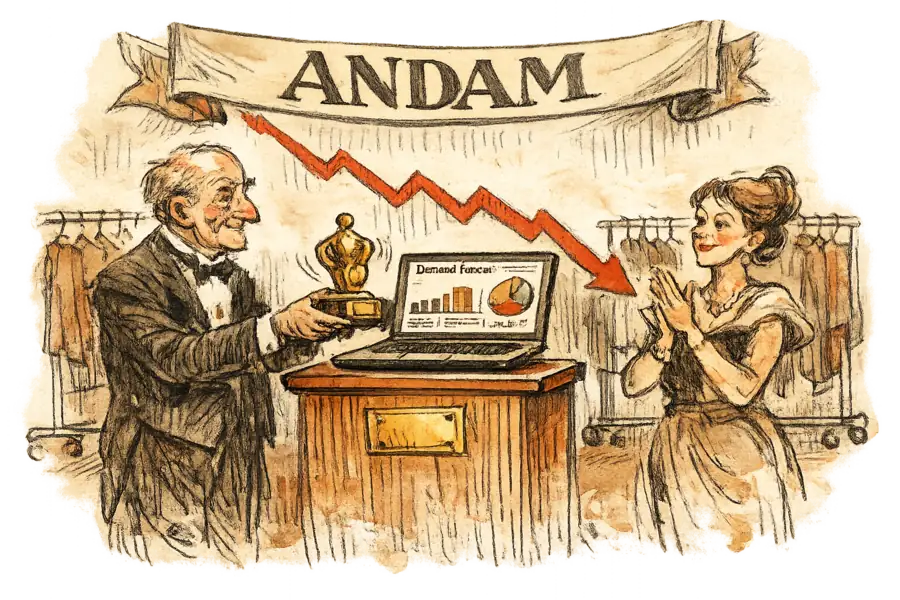
France's Stores Fell for an Eighth Month. ANDAM Crowned the Forecast.
ANDAM gave its €100,000 Innovation Prize to Alphalyr, an AI vendor for demand and supply, in the same week France's clothing chains logged an eighth straight month of falling store sales. Sustained market contraction — eight months of it — moves AI into the stockroom faster than any growth narrative could.
Sir John Crabstone
An innovation prize is meant to celebrate appetite. ANDAM’s 2026 award reads more like an admission. On 20 May the French fashion association gave its €100,000 Innovation Prize to Alphalyr, a Paris firm whose AI reads demand and steers stock across the supply chain, from forecast to shop floor. The timing is the argument.
That same stretch, France’s clothing chains posted their eighth consecutive month of falling store sales, down 3.1% in April. Inflation and a fuel-price shock from the Strait of Hormuz blockade had pushed shoppers off clothing. Online grew; the shop floor did not. A shrinking market forgives nothing.
The pain is not spread evenly. Counted across every channel, French clothing spend was close to flat in April, held up by online; chain store locations took the fall. The aggregate figures imply online exposure cushioned total damage — but neither dataset breaks this out by retailer. The floor still paid. Allocation and the markdown calendar are applied to that store estate — exactly what Alphalyr’s software is built to manage.
A falling market is what makes any of this pay. Growth is forgiving: rising demand clears an over-bought line at full price, and a clumsy allocation rights itself before anyone notices. Contraction sends the invoice. Unsold stock turns into financed loss, and a late markdown becomes margin no one recovers. The buyer’s guess stops looking like flair. The discipline is worth buying only once the guessing starts billing.
Alphalyr is not a styling toy. For years, fashion’s AI budget went to the campaign: the recommendation engine and the retargeted shopper. This prize sits in the stockroom. Its clients run from Balmain to Galeries Lafayette, and its software forecasts demand and moves stock between shops before a season turns. These are the calls a buyer once made with a spreadsheet and a hunch; they are the calls that now carry a price.
The same ceremony made the contrast plain. ANDAM’s special prize went to Pili, which makes bio-based dye through microbial fermentation, the kind of romance these awards were built to reward. The headline prize went to a firm that keeps retailers from buying the wrong coat for the wrong shop. One honours what fashion would like to be; the other answers what it can no longer afford.
ANDAM’s founder, Nathalie Dufour, called this the year “an AI applied to retail, the supply chain and sales management” arrived — the phrase translated from French by FashionUnited. The prize money followed the diagnosis: eight months of contraction had done what growth never managed. The jury rewarded a machine for anticipating demand in the very months demand refused to hold.
Nobody automates the buy when the buying is easy.
The trade press filed the win under progress: AI had reached the core of the value chain. The sales line tells a colder story. Retailers did not suddenly grasp what the algorithms could do; they lost the growth that had paid for guessing. The margin for error shrank with the margin on the rack. The technology did not change this spring. The price of getting it wrong did.