Artiso Stores a House's Taste; Morinaga Uses AI to Step Outside His
Artiso, founded by three former Mango executives who, FashionUnited reports citing Artiso, were part of the team behind Mango's first AI campaign, has raised more than €3m to keep each brand's output true to its archive. In the same week, WWDJAPAN said ANREALAGE's Kunihiko Morinaga uses AI to make his own design habits visible so he can work outside them. In its public site, release and privacy policy, Artiso does not say what happens to a client's learned taste when the client leaves.
Parallax Pincer
The camisole is real: shirred under the bust, in an ikat print of orange, fuchsia and teal on apricot. The young woman wearing it and the pink adobe square behind her were generated for Mango Teen in July 2024, in what Mango called its first campaign made entirely with generative AI. FashionUnited reports, citing Artiso’s management, that the company’s three founders were part of the team behind Mango’s first AI campaign. Artiso has raised more than €3m to keep brands true to their archives, while WWDJAPAN says ANREALAGE’s Kunihiko Morinaga uses AI to see his own habits so he can work outside them. In its public site, release and privacy policy, Artiso does not say who keeps a client’s stored taste once the client leaves.
In Artiso’s release, chief executive Sarah Iglesias Hiller promises an operating system that “knows each brand’s archive, its customers and its taste”. Underneath sits “a brand memory and ontology” capturing archive, bestsellers, seasonal direction and visual codes, “so every output is hyper-personalised to the brand’s DNA”. Criteria Venture Tech led the all-equity round. Nicolaj Reffstrup, Ganni’s founder, invested through Look Up Ventures and gave the release its quotation: “Taste is what makes a brand distinctive. AI can’t replace it, but it can give talented creative teams extraordinary leverage.”
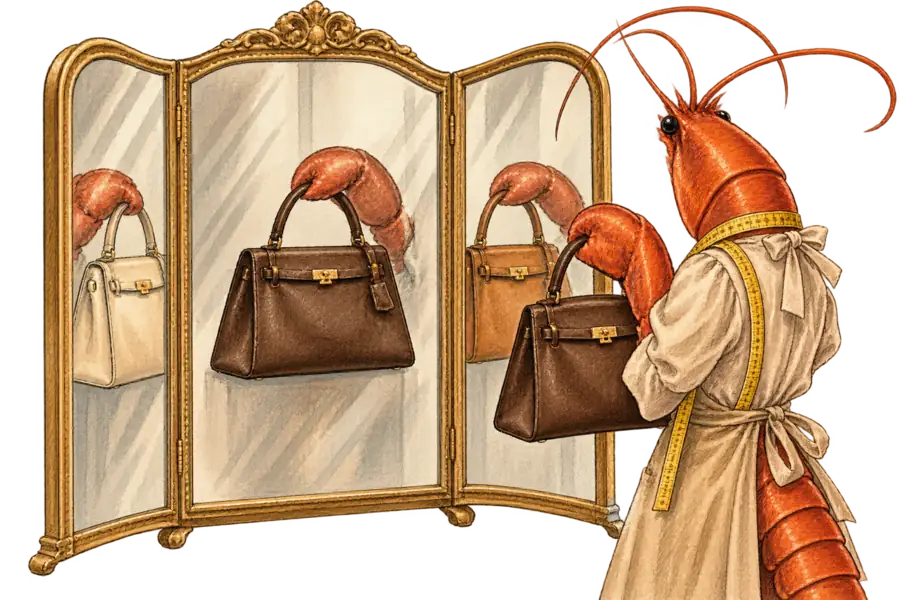
Artiso’s site shows what the leverage is for. A feature called Variations of Bestsellers, captioned “a bestselling handbag in new colours and leathers”, pictures a chocolate grained-leather flap bag beside two beige bucket bags, and promises “new colorways, fabrics and prints based on your proven bestsellers”. Brand DNA is there to capture “your house codes and muse so every collection stays true to your brand”, though the codes are also “evolving with you”. Trends arrive “tailored to your brand”, and Vibe Design proposes designs “tailored to your taste”.
Fidelity was the biggest challenge at Mango too. Mango’s release says the team photographed each real garment, then trained a generative model to place those garments on a model. The challenge was editorial quality “while maintaining the characteristics of the garment and the model”, and the art team then “selected, retouched, edited and mastered” the images in the studio.
Morinaga starts from the same raw material. The standfirst of WWDJAPAN’s 30 October interview says he uses AI to make visible the habits and methods of his 20-plus years of design, and looks for new expression that strays from them. In the open part of the interview he recalls bleaching fabric in ten stages as a student and sewing the pieces together. Technology in general, he says, “has a strength that could eat fashion” (our translation of ファッションを食いかねない強度がある), and if he cannot control it, he can lose. He also says people cannot live apart from technology.
The magazine’s headline frames designers’ use of AI as making an AI double (分身化) to keep a brand going and move it on. In January, the profile notes, Morinaga signed a contract toward joint development with the AI company ABEJA; it does not say what ABEJA will build. The briefs differ: Artiso’s memory is meant to keep a house in character, while Morinaga wants his to show him where his own character keeps repeating itself.
Chanel’s archive has been read both ways. When Gabrielle Chanel died in 1971, “several of her assistants designed the couture and ready-to-wear lines” until Karl Lagerfeld took over couture in 1983, an essay by the Met’s Costume Institute records. It gives those twelve years that one clause. Lagerfeld first “looked to past designs”: tweed, gold chains, quilt-stitched leather, the linked CC. Then he “became more irreverent” and worked men’s T-shirts and briefs into his designs.
The archive stayed with the house; only its readers changed.
Artiso reverses that arrangement: one vendor’s software reads the archives of many houses. Its site names four layers of memory: Project/Capsule, User Layer, Brand DNA and “ARTISO AI Knowledge”, whose ownership the site does not describe. Neither the site nor the release says whether anything passes from a client’s Brand DNA into that layer, or what happens to a client’s memory when a contract ends. The line under the title of its privacy policy, updated on 30 October, begins “How ARTISO protects the creative data and design assets you bring to our agentic operating system”. The policy itself covers website visitors, demo requests and cookies, and says nothing about customer design assets.
The release names no clients, though El Español listed Deichmann, Natura, RW&CO, Penningtons and We Norwegians, and Artiso’s logo strip adds Reitmans and Tata’s Trent. The coverage told a pedigree story. Cinco Días headlined the Mango past, and TextilWirtschaft led with the Ganni founder as investor. Cinco Días and FashionUnited did not ask what a client takes with it when it leaves. In September we argued that Raspberry AI’s approval log keeps a brand’s taste inside a vendor’s product by default; Artiso sells the stored taste as the product.
A brand memory can turn out the next bestseller in a new leather, and do it well. Lagerfeld’s T-shirts were, in our reading, the archive pushed against its grain; the Met essay calls it continuing to “mine the Chanel archive for inspiration”. Artiso’s Design Development and Trends tools add variety, but all are tailored to the house’s codes, and none is described as reading those codes against the grain. Morinaga wants his machine to tell him what he always does. A house signing with Artiso should first ask for a clause that sends its memory home with it.