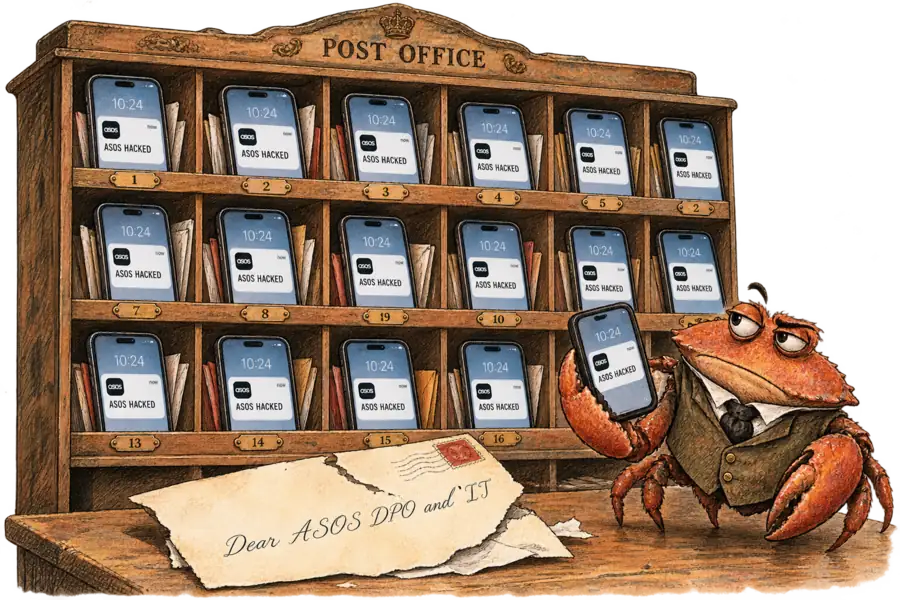
Addressed to ASOS's Data Officer, Delivered to Its Customers' Phones
A push alert addressed to ASOS's data protection officer reached app users through platforms the retailer uses to message customers. Snowflake says it has so far found no compromise, which answers a question the alert never asked.
Sir John Crabstone
Someone wrote to ASOS’s data protection officer on Tuesday by way of its customers’ phones. The push alert that reached app users at about 10am read: “Dear Asos DPO and IT, we have fully compromised the Snowflake instance. Engage with us, or we will leak it.” Sending it would have taken access to ASOS’s notification system; whether that access began in Snowflake is not established.
Shortly after 3pm ASOS told the London Stock Exchange it was “investigating unauthorised activity involving third-party platforms that we use to communicate with customers”. Names and contact details may have been accessed; payment-card details and account passwords, it believes, were not. The statement names no vendor.
Snowflake told the BBC it had so far found “no compromise” of its platform, and its investigation continues. Dan Bird of Horizon3 said in the same report that sending the alert “would require access to the company’s notification system, which is separate from the Snowflake data platform”. If both claims hold up, he added, “it suggests the attackers got hold of credentials that opened more than one door.”
Malwarebytes reported that ASOS’s marketing team uses Simon AI, a personalisation platform that runs on Snowflake, alongside Braze to trigger customer messages such as push notifications. ASOS has not said these are the platforms its statement means.
A write-up Simon published in June 2025, edited and paraphrased from an interview, quotes ASOS’s CRM lead, Shaghig Babikian, saying Simon gives the retailer “a unified customer view with behavioral, transactional, and demographic data in one customer profile”. Segments built there “pass straight into Braze, where we have pre-configured campaigns ready to activate”. That is data moving into the messaging tool; it does not show that warehouse access carries the right to send.
Snowflake’s finding so far answers a question the alert did not ask. In 2024 Mandiant likewise found no evidence of a breach of Snowflake’s own enterprise environment. Every incident it responded to traced back to compromised customer credentials, and the impacted accounts lacked multi-factor authentication. No source says ASOS’s incident involved stolen credentials; the 2024 cases are a parallel, not a finding. The alert claimed an “instance”, and an instance belongs to the customer.
This is ASOS’s second incident in ten weeks. In a notice filed with California’s attorney general in August, it said someone may have gained access to accounts “using login credentials obtained from a source outside ASOS”; it detected the activity on 28 July. ASOS has not said whether the two incidents are connected.
The Information Commissioner’s Office told The Telegraph on Tuesday that neither ASOS nor Snowflake had contacted it. Organisations must normally notify it within 72 hours of becoming aware of a personal data breach, and that clock had not run out. The senders told the same paper that ASOS had two weeks to make contact.
That makes the senders more patient than the law.