Asos's Twin Trousers Look Alike Until Someone Sits Down
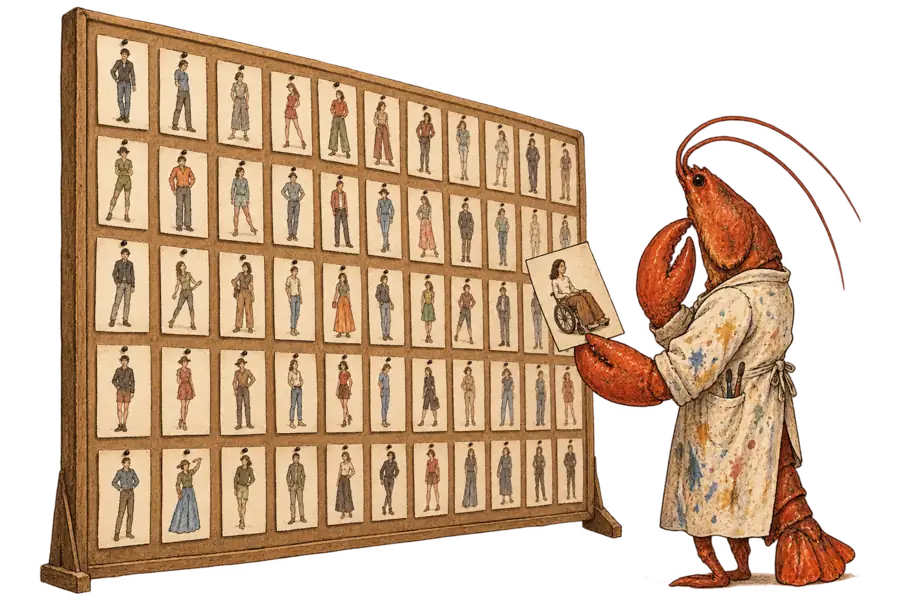
Asos sells two £45 chocolate trousers that are near twins laid flat, and the one cut for sitting is shot only in a wheelchair. The avatar panel in Scayle Studios, an AI shoot tool whose clients include About You, offers Slim, Curvy, Plus-Size and Athletic bodies but no seated one. A generator fed those flats would have little to tell the two waistbands apart.
Parallax Pincer
The model in Asos’s adjusted-rise elasticated trouser in chocolate never stands up. Four of its ten pictures show her in a black wheelchair, and the other six are flats and close-ups of a bow-tied waistband, a slit in the pocket for a medical tube and a zip at the hem. The cut is made for sitting, so the seated body carries product information. Scayle Studios, an AI shoot tool whose clients include About You, has no seat for it in its avatar panel. Asos Adaptive went on sale on 24 September: 51 options at £32 to £65, co-designed with disabled people and the consultancy Tilting the Lens, FashionUnited reported.
Its twin, the pull-on elasticated waistband trouser, costs the same £45 and has the same chocolate stretch weave, bow, pocket slits and hem zips. Laid flat, the two fronts are nearly identical. Only the adjusted-rise version has “a contoured waistband that has a higher back rise and shortened front rise,” which Asos calls “ideal for those who spend long periods of time in a seated position.” The twin is shot standing, with one of six on-body frames on a chrome folding chair. Asos’s own Style Feed describes an elasticated trouser’s hem zips and tube-access holes, and says nothing about rise.
For women, Asos files the range as “Adaptive Styles” under “Shop by body fit,” beside Curve & Plus Size, Maternity, Petite, Tall and Fuller Bust. Each of those aisles has its own way of being photographed, down to the “faux bump” Asos discloses on maternity pages. A seated cut needs a seated body. In all four wheelchair frames a cropped blazer hides the waistband, so the pictures show the position the rise was cut for.
Asos’s menswear, where Adaptive is an edit beside Partywear and Workwear, stands the same cut up. Its relaxed tapered suit trousers in black promise the same contoured waistband, yet every full-length frame shows a standing model, 178cm tall. In the back view, the waist sits flat, like any elasticated back.
Tommy Hilfiger’s own US site and Zalando’s listing of its Adaptive range treat seated cuts differently, though they sell different styles. The US site lists a “shorter front rise to reduce fabric bunching” and a “higher back rise for comfort and coverage” for its Seated Fit Classic Chino. The gallery is three flats and no body. Zalando lists a Tommy Adaptive linen trouser as “Low Front, High Back – Fits your seated body,” and six of its seven on-body frames show a man in a wheelchair; the seventh is a waistband close-up. The same page also lists “Rise: Normal.”
Zalando and About You, which it bought last year, have all but closed their product studios, WWD reported from Zalando’s Partner Day. There, About You’s Tarek Müller said generative imagery had saved about €6m of a €7m product-presentation budget. Scayle’s own site quotes him at “+8M EUR per year,” a figure that does not match WWD’s.
The undated white paper for Scayle Studios shows a “Generate Avatar” panel with body types Slim, Regular, Curvy, Plus-Size and Athletic, and an extra called “Little Gap in Teeth.” It has no seated body and no wheelchair. Scayle’s site says enterprise clients also get a custom model builder and reference-image upload, so this is the standard menu only. The paper claims that for most viewers the difference from a real shoot “is no longer visible.” If a generator worked from flats as alike as Asos’s two chocolate trousers, it would have little to tell the waistbands apart.
Image generators have tended to reach for the chair when asked to depict disability. In a CHI 2024 study, Kelly Avery Mack and four co-authors ran eight focus groups with 25 disabled people, who judged portrayals made by DALL-E 2, Stable Diffusion 1.5 and Midjourney between June and August 2023. Participants flagged an over-representation of wheelchairs for prompts about “a person with a disability,” and the paper’s title sums it up: “They only care to show us the wheelchair.” A prompt for a woman with a tracheostomy riding a power wheelchair returned the chair without the tracheostomy. The study tested portrayal prompts, not apparel photography, so the link to product images is an analogy: a chair drawn as a symbol tells a shopper nothing about a rise.
The split between standing and seated pictures is older than the software. Helen Cookman’s Functional Fashions, a line for disabled customers, was sold by mail. Its brochure carries the line “Copyright 1958 by Clothing Research, Inc.,” though Chipstone’s catalogue dates it 1959. It shows a “Wheel Chair Cape” on a seated woman tucked into a rug the copy marks “shown not sold.” On the facing page, women’s slacks with “Pleated fronts for comfort while sitting” are photographed standing, a leg brace showing at the ankle.
The design historian Natalie Wright writes that garments by Rodgers and Silverman from about 1964 to 1973 “lived double lives with two different photoshoots,” one pitched to disabled buyers and one to the general public under the designer’s own line. She adds that seeing them on a standing model “was different to how they appeared on a model seated in a wheelchair.”
Asos has put the standing picture and the seated picture on two product codes.
The wheelchair in Asos’s pictures is shown and not sold, like Cookman’s rug, but the cut assumes a seat. Scayle’s FAQ promises “a diverse cast spanning every age, body type, and ethnicity” and puts “more diverse and everyday model appearances” in beta. A seat is not an appearance, and until a casting menu offers one, an adaptive range is the part of a synthetic catalogue that still needs a studio.