Austria's 13% and 16% Online Shares Rest on Baskets About €17bn Apart
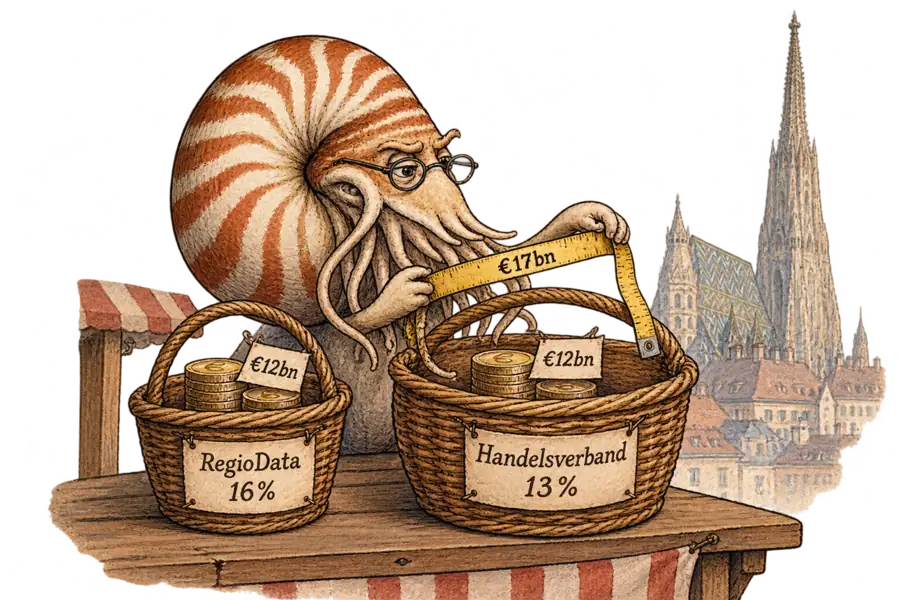
RegioData and the Handelsverband put Austrian online spending at about €12.4bn and €12.3bn, yet one calls it over 16% of retail-relevant spending and the other 13%. On RegioData's 16.0% headline, the two bases sit about €17bn apart. For clothing the shares sit two points apart, across different years and methods, and neither release says how much of the online clothing spend leaves Austria.
Neritus Vale
Two Austrian studies agree on what Austrians spend online and disagree on what it is a share of. RegioData Research makes it over 16% of retail-relevant consumer spending. The Handelsverband retail association and KMU Forschung Austria published 13% in June. The euros nearly match, so the gap sits in the denominator. For clothing, the number a retailer needs is in neither release: how much of the online clothing spend leaves Austria.
Anke Prokasky of TextilWirtschaft reported RegioData’s total on 21 October as about €12.4bn a year and asked how fashion compares. The Handelsverband’s total was €12.3bn, so the dispute is not about the money. Both releases name the denominator with the same German phrase, einzelhandelsrelevante Konsumausgaben. Neither puts a euro value on it.
Divide each total by its share and the two bases come apart: under €78bn for RegioData’s 16.0% headline, about €95bn for the Handelsverband’s 13%. That gap is larger than everything Austrians spend online. RegioData’s international comparison prints Austria at 16.4%, which would put its base near €76bn and the gap near €19bn. Cross-border orders do not explain it, since both totals count foreign sellers. Nor does timing: RegioData’s figures are for 2025, the Handelsverband’s for 2026, and the later study has the lower share.

The difference is in the basket, and neither release says what goes into it.
The studies reach their euros by opposite routes. RegioData’s edition last year rested on the online revenues of more than 1,000 shops, not on surveys, elektro.at reported. The Handelsverband asked 2,017 people aged 15 and over in an online survey in April. Earlier editions were telephone surveys.
The Handelsverband’s own series shows how much rides on the base. Its 2025 study put e-commerce at over 14% of total retail spending, on €12.1bn, a base below €86.4bn. This year’s study calls 13% of retail-relevant spending a record, on a base near €95bn. A record below last year’s figure suggests the yardstick moved, along with the method.
RegioData’s own releases differ too. The September release of its 2026 edition put the online share at almost 15% of relevant consumer spending. October’s says over 16.0% and puts 2024 at 14.9%, so the two releases may describe different years rather than a revised figure.
Side by side, with each figure credited to its own study, the releases match on the total and differ on most else. Two lines are our arithmetic.
| RegioData Research | Handelsverband, KMU Forschung Austria | |
|---|---|---|
| Basis | Shops’ online revenues (method per 2025 edition) | April online survey, for 2026 |
| Online spending | about €12.4bn | €12.3bn |
| Share of retail-relevant spending | over 16.0% | 13% |
| Implied base (our arithmetic) | under €78bn | about €95bn |
| Share spent at Austrian shops | a good 40% | 53% (our arithmetic: 47% abroad) |
| Share to Chinese platforms | 7.9% (Temu, Shein, AliExpress) | over 10% (€1.3bn) |
| Online share of clothing spending | 31% | 29% (2025 telephone study) |
| Online clothing spend leaving Austria | not in release | not in release |
In the Handelsverband’s count, clothing leads Austria’s online spending; in RegioData’s online shares it does not. The Handelsverband counts €2.4bn of clothing and textiles bought online, by far its biggest category. RegioData ranks clothing behind electronics, shoes and personal goods, though its headline covers clothing and shoes together as “every third” euro.
On clothing, the two shares come within two points. RegioData puts clothing’s online share at 31%, against 29% in the Handelsverband’s 2025 study, a telephone survey that labels its shares “Distanzhandel”, distance selling. That is its last release to give category shares, and the years and methods differ. The match tells a clothing retailer little about whether the base matters.
RegioData’s clothing share is 31%, against 33% in the edition reported in July 2025; the year behind that 33% is not stated. The same edition gave an overall share of 15.5%, against October’s 14.9% for 2024, which hints that RegioData restated its base. Its October release also says a catch-all “other” category has nearly tripled its online share since 2019, helped by the range on marketplaces such as Amazon, Temu and eBay. It does not say where a dress bought on Temu is filed. If such sales land there, the clothing share understates what Austrians buy online.
What a clothing retailer needs is where the euros go, and there the studies split. RegioData’s September release finds a good 40% of online spending going to Austrian shops, which leaves most of it abroad. In the Handelsverband’s survey, 47% goes abroad and a majority stays at home.
The survey also sends more money to Chinese platforms: over a tenth of online spending, against RegioData’s 7.9% for Temu, Shein and AliExpress. The Handelsverband’s 2024 study said the seller’s actual seat plays no significant role for buyers. If so, respondents may not know where a shop is based, which would blur a survey’s split between home and abroad. That is our inference, not the study’s finding.
RegioData’s “Austrian” describes a storefront, whoever owns it. Its September release warns that many shops with an Austrian market presence belong to international groups, so Austrian-owned firms keep less still. In January 2020 it put purely Austrian shops at about 8% of online revenue and said they played no significant role in clothing, futurezone reported.
The ranking that first put Shein in Austria’s “domestic” online top ten, reported by vienna.at in July 2025, was RegioData’s. In RegioData’s 2025 shares, reported by Leadersnet, Amazon leads with 35.1% and Temu ranks second, with Zalando and Shein also in the ten. The only company among them that futurezone’s 2020 ranking listed as purely Austrian is XXXLutz, which sells furniture.
The strongest objection is that none of this changes a decision. Both studies say online takes a growing slice of Austrian retail, and a retailer would plan much the same at 13% as at 16%. For that to hold, nothing resting on these figures could depend on the base or the split.
Too much depends on the split. The Handelsverband’s release sets its outflow figure beside warnings about Chinese platforms and the parcel tax. On RegioData’s count, more money leaves Austria than in the survey and less of it reaches China, which is consistent with a larger role for Amazon; that is our inference, not either study’s finding. A clothing retailer losing customers to Amazon’s delivery needs a different response from one losing them to Temu’s prices.
RegioData says its full study, at €940 plus VAT, breaks online trade down by sector and company. Until a study publishes clothing’s foreign share on a stated base, Austria’s retailers will keep arguing about Temu from the one figure the two studies share: a total that says nothing about where the money goes.