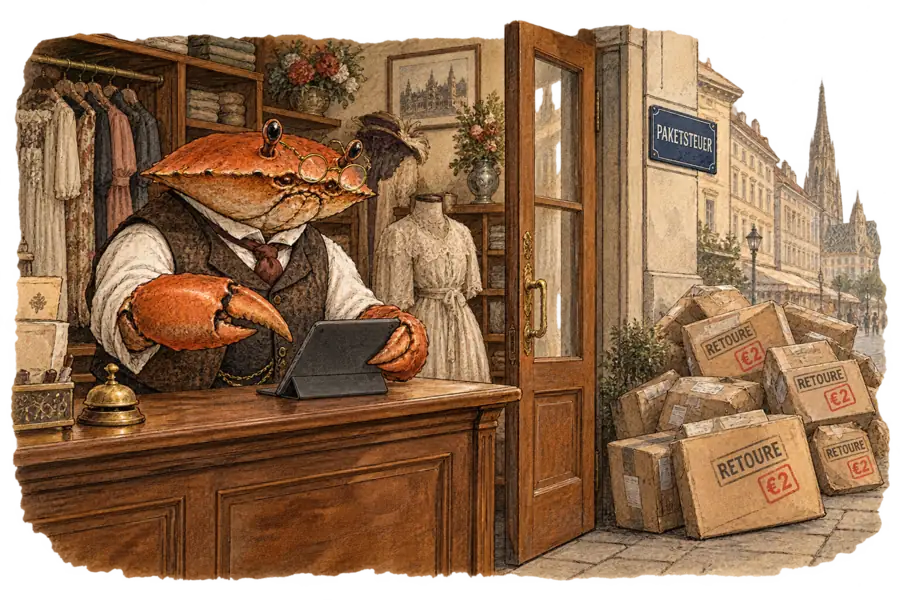
Austria's Parcel Tax Survives the Return and Stops at the Shop Door
Austria's €2 parcel tax falls due when payment is accepted, stays due when delivered goods come back and spares anything bought or ordered in a shop. The first rule matters most in fashion, where returns run highest, and Zalando and Otto have said they will refund customers on full, prompt returns.
Sir John Crabstone
Austria’s €2 parcel tax, levied since 1 October on the biggest online sellers, falls due when payment is accepted and stays due when delivered goods come back. An order taken in a shop escapes it, even when the goods are posted home. The first rule matters most in fashion, where returns run highest.
Clothing is where the first rule bites. In the EHI Retail Institute’s survey of 108 online retailers in the DACH region, mostly German-based, 67.5% of fashion sellers reported return rates above 20%. Not one consumer-electronics seller did.
The finance ministry lets a returned dress reduce a seller’s turnover against the €100m threshold only insofar as VAT treats it that way, and allows no adjustment of the tax on a parcel returned after delivery.
Retailers have begun to settle who carries the tax. Amazon shows it at checkout as a separate line of €2.40 with VAT, once per order, however many parcels follow. Otto Austria and Zalando have said they will refund it to customers who promptly return a whole order. The ministry keeps its €2 either way, so any such refund comes from the retailer.
The shop exemption is wider than it sounds. The ministry’s FAQ says the tax reaches only contracts concluded “exclusively” at a distance, and that goods “bought or ordered in-store” fall outside it. Had the customer telephoned, the same order would be taxed. The FAQ is silent on in-store terminals, so a tax office could treat a tablet order as a distance contract. If it does not, the endless aisle is a tax-free aisle, and only a retailer with a shop floor can build one.
The usual objection is that the exemption is too small to matter. Johannes Kepler University’s retail institute found that click-and-collect carried only 5.6% of Austrian online spending in 2025, Leadersnet reported in May. Researcher Ernst Gittenberger said the tax will probably reach almost every online shopper, which is likely and beside the point. The figure counts pickups and says nothing of the in-store order sent home. Shoppers decide whether to pick up; retailers decide whether their staff carry tablets.
Austria’s labour chamber and union federation said the original aim was to tax parcels from outside the EU, from sellers such as AliExpress, Shein and Temu. They regretted in May that this proved impossible, ORF reported, because the finance ministry held that EU law forbids such a limit. The ministry’s own purpose is fiscal: €280m a year toward the VAT cut on basic foods. Marin Müllauer, who chairs the GPA union’s retail section, called the tax a “sensible instrument” (our translation) to support bricks-and-mortar retail. Amazon’s submission counted 14 of the 15 affected sellers as foreign-based.
Harald Gutschi, who runs Otto in Austria, expects up to ten companies to appeal their assessments, ORF reported. About 4,000 Austrian businesses that sell through large online marketplaces are taxed as well. A pure player in a hurry may yet need a shop, the one asset it was built to do without.