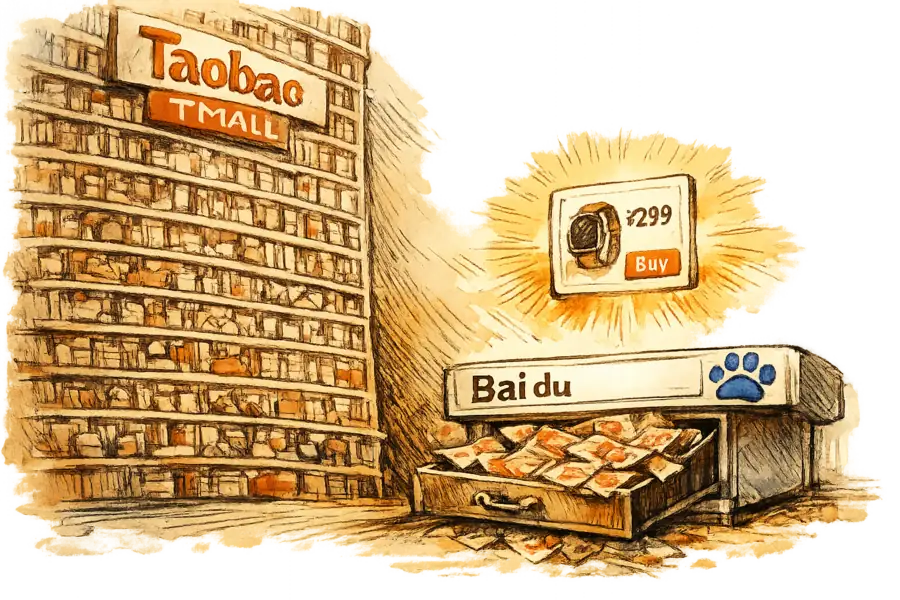
Alibaba Owns the Marketplace. Baidu Is Betting the Answer Is the Store.
Baidu generates an AI answer on roughly 70% of its mobile searches and has wired a checkout into it. Unlike Google, it has no marketplace to retreat to; it is betting it can make the answer itself the point of sale before the answers finish off the advertising business that funds them.
Sir John Crabstone
Alibaba owns the store. Baidu owns the question that used to lead there, and it has begun answering with a checkout attached. For two decades the arrangement paid both: the search box made the introduction and took a fee; the marketplace closed the sale. The AI answer ends it, because an answer that names a product and rings it up sends the shopper nowhere.
The answer has already won the page. By late October, roughly 70% of Baidu’s mobile search results carried AI-generated content. Those are the blue links Baidu spent twenty years selling, now retired by the firm that sold them. No rival is dismantling Baidu’s advertising business as fast as Baidu itself.
A company that can answer every question has solved everything except how to be paid for the answer.
Owning the answer is not the same as owning the sale, and here Baidu has barely begun. Its in-search checkout, which lets the assistant complete a purchase rather than refer it, peaked near RMB 6 million in daily GMV during Double 11 — the festival Alibaba turned into a national holiday. Baidu spent the biggest shopping day of the year proving its checkout works, and proving how little, for now, it matters.
It is building the merchant from nothing. In June 2025 it put an AI-generated avatar of the celebrity livestreamer Luo Yonghao on its own shopping platform for more than six hours; the synthetic host sold over RMB 55 million, about $7.7 million, to more than 13 million views. In several product categories it reportedly outsold the figures Luo had posted in person a month before. The avatar required no contract, no dressing room, and no day rate. Alibaba spent a generation teaching China to shop this way. Baidu would rather synthesize the host than wait out the generation.
Google faces the same collision and can afford to absorb it. Android, YouTube, a cloud business, and an advertising model that earns on brand rather than transaction give it multiple income streams the search click does not fund. When Amazon cornered American intent traffic, Google ceded the category query and kept the brand budget; the machine still earned, just further from the sale. Baidu sold the same kind of attention but never diversified behind it. Its advertising revenue runs through the same search page the AI is now retiring, and behind it there is nothing: no device franchise, no streaming platform, no cloud margin to break the fall. Robin Li keeps telling investors that in the AI era, the application matters most; the application he needs most is the one that gets Baidu paid.
In the trade press this still reads as a China story. The mechanism is the part that travels. Alibaba sells brands a place on the shelf, where a million listings can sit and wait to be found; Baidu means to sell them the sentence the machine speaks back, and a sentence has room for far fewer names than a shelf.