Beauty Grew 791% on Whatnot. Used Cosmetics Are Banned There.
Whatnot's fastest-growing category in 2025 was one where its own rules prohibit used goods. The inventory behind livestream resale is largely new: gray-market wholesale, brand overstock and factory-direct stock. That makes resale a distribution channel rather than a provenance, and the brands feeding it are paying to supply their own off-price competitor.
Neritus Vale
Whatnot’s beauty sales grew 791 percent last year, and the platform does not permit the sale of used cosmetics. Together, the two facts answer the question of what livestream resale is actually selling. It is selling new goods: gray-market wholesale, brand overstock and factory-direct stock, bought by the pallet and sold by the unit. The word “resale” has stopped naming a provenance and started naming a distribution channel. The sourcing layer underneath it is professionalising faster than anyone is disclosing.
Glossy mapped that supply side on 30 July, and found a wholesale business wearing a thrift-store coat. Nicole Buzo and Heather Green, who run the Whatnot shop Mama’s Sweet Repeats, told the publication they moved more than 145,000 items in the past year, including Good American denim and Target footwear. Offers from suppliers now arrive unsolicited and daily, and vetting them has become most of the work. “You can only get these truckloads of inventory if you’re going to buy 10,000 units,” Green said. Some stock comes straight from brands under non-disclosure agreements, and at least one brand withdrew once resellers started comparing notes.
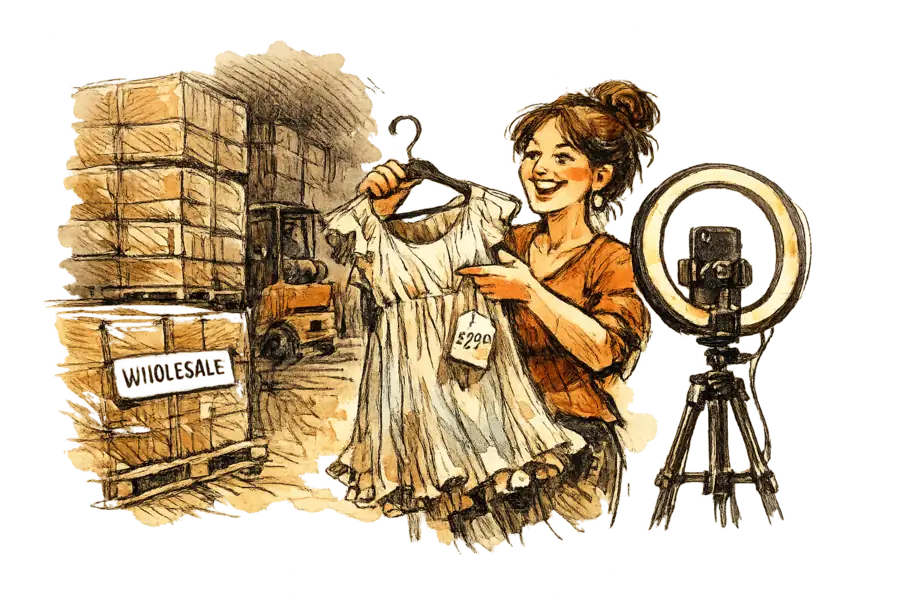
Whatnot did not wait for anyone to formalise that layer; it built one and put it in the app. A wholesale category went live in May 2025, first reported by Modern Retail, letting vetted sellers move pallets of 100 items or more to other sellers. Whatnot’s own rules describe what those pallets hold: stock direct from a manufacturer or distributor, or liquidation inventory made of overstock, returns and past-season goods — though Modern Retail found some sellers sourcing wholesale pallets from thrift stores as well. More than 400 sellers applied in the first five weeks. The platform that sells you the item also sells the person who sold it to you their supply.
The independent version of the same layer is raising capital and calling itself infrastructure. OS Group, founded in 2019, buys out excess stock from a network of more than 800 sellers across thirty to forty countries and resells it in bulk, a model WWD detailed in November. In April it launched a B2B marketplace, and it has since added support for sellers working on Whatnot, TikTok Shop and eBay Live. Founder Oscar Rachmansky told Glossy the company is approaching $200 million in lifetime revenue and calls what he is building “the new wholesale economy.” His phrase is more accurate than the industry’s.
Part of the reason factory goods reach American buyers this way is that the cheap direct route closed. The United States ended duty-free treatment for imports valued at $800 or less on 29 August 2025, with Customs and Border Protection processing roughly four million such parcels a day before the change. Goods that once shipped one order at a time now travel as consolidated freight and clear customs once, which means somebody inside the country has to hold the load, break it down and find buyers. A seller with a live audience does that more cheaply than a paid-search budget. TikTok Shop’s US small-business sales rose 66 percent in 2025, a figure the company gave Modern Retail. The tariff change did not create the wholesale layer beneath livestream selling; it made that layer the cheapest way in.
Nothing in that chain requires an item to have ever been owned.

The measurement layer still runs on the old definition, which is why the drift has gone unpriced. ThredUp’s fourteenth annual resale report, sized by GlobalData, puts the global secondhand market at $393 billion by 2030, and that is the figure that reaches the board deck when a brand approves a resale programme. GlobalData built it partly by asking consumers what they had bought, in a survey of 3,268 US adults fielded in January and February. A shopper who buys new-with-tags overstock on a livestream has had a resale experience. Whether she bought a secondhand garment is a question no consumer survey can reach.
The strongest objection is that this is a labelling problem and nothing else. Off-price is an old and honest trade, Whatnot has never called itself a resale platform, its wholesale rules are published, and the viewer buying at speed is there for price and performance rather than provenance. For that objection to hold, nobody of consequence can be pricing the secondhand label. Two parties are. Brands file resale under sustainability and, lately, under tariff exposure, which is how Steve Madden’s own sustainability executive described it. Congress drew the same line and drew it the other way round, keying the INFORM Consumers Act’s definition of a high-volume third-party seller to 200 or more discrete sales of “new or unused consumer products”, so the identity-disclosure duty attaches to precisely the stock this channel is filling with.
The cost of the mislabel lands on the brands that believe they are running a circular programme. Overstock that reaches a livestream through a wholesaler the brand did not choose, at a price the brand did not set, is not a recaptured second sale. The brand supplied an off-price competitor and got no say in how the goods were introduced to its customer. Buzo named the incentive without flinching: brands want everything to sell at full price, which is why the good deals travel under NDA. A brand that publishes where its overstock goes gives up a margin point and gains a channel it can price. One that does not keeps the point, and learns what its goods are worth when a stranger sells them live, to its own customer, in real time.