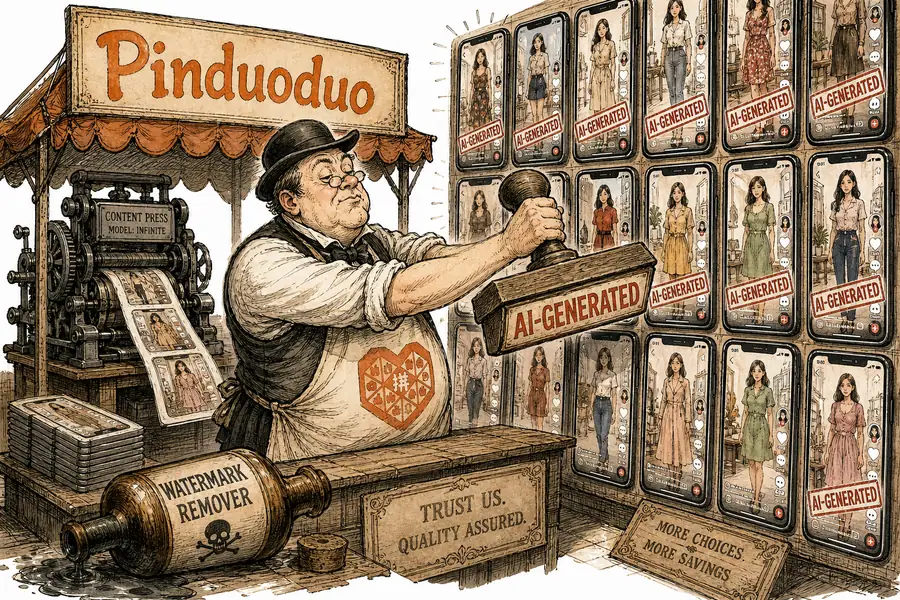
Beijing Required One AI Label. Pinduoduo Wrote Five.
China's regulator required a single label for AI-generated content. Pinduoduo's new seller rules require five, attach the penalties the law forgot, and target the watermark-removal trade, all for content its own AI tools increasingly make.
Sir John Crabstone
On 16 December, Pinduoduo began requiring every product short-video to carry one of five labels before a seller could post it. “AI-generated” is the first of them. Only that label answers a national law; the other four the platform wrote for itself.
Read the other four and the ambition shows. “Fictional dramatization, for entertainment only.” “Dangerous acts, do not imitate.” “May cause discomfort.” “Sourced from the internet.” A staged clip of how a coat drapes is now a disclosable act, and the rules rank it second: below the AI tag, above mere danger. Pinduoduo has decided that a video is honest only when it says so. No statute asked a seller to confess that a garment was performed rather than worn.
A regulator did ask for the first label. Beijing’s regulators made AI-content disclosure national law on 1 September, demanding both a visible tag and a hidden watermark from anyone who distributes such content, marketplaces included. But the law’s subject begins and ends with AI. Pinduoduo’s other four labels demand a kind of honesty no labeling law requires. So the platform fills no vacuum; it fills the gap between a rule that exists and a rule that sticks.
Enforcement is where it gets interesting. Pinduoduo has placed the watermark-removal trade on its target list, the cottage business that strips the original mark from a photo or clip. Remove the watermark and the AI label departs with it; the two are frequently the same pixels. On a marketplace where a dress can be photographed a hundred ways, a stripped watermark lets one seller pass another’s photographs off as their own. The punishments are commercial, not cosmetic: frozen withdrawals, a downgraded store.
This matters because the law has no teeth of its own. A market in anti-labeling tools now sells removal for as little as ¥9.9 and advertises erasing 98% of a file’s AI traces. The September measures, Xinhua reports, set no specific penalty for omission or tampering; legal scholars quoted in the same investigation note that some platforms cannot reliably read the hidden watermark they are meant to check. Beijing wrote the obligation and left the punishment to whoever cared to supply it. Pinduoduo volunteered.
Read this as goodwill and you miss the move. A platform that writes its own disclosure code decides what the words cost to obey, and which rival must answer its draft rather than write one. Self-policing also buys the scarcest thing a Chinese platform can own: a regulator with less reason to call. The label is cheap to print; the power lies in deciding what it means.
There is a complication the platform prefers not to mention. The same platform spent the second half of 2025 shipping the machines that make this content: virtual try-on for clothes, AI “interactive dramas,” a tool that animates a flat product photo into live-action video, and, with conspicuously little fanfare, a test of AI search. Its rulebook now governs precisely the output those tools were built to mass-produce. It hands its sellers the pen, then grades the essay for honesty.
This is not compliance — it is authorship.
Every marketplace that lets a clothing seller conjure a model it never hired and a runway it never filmed will reach the same fork. The wording will differ between platforms; the move will not. The next regulator to draft a labeling rule will find one already written, and signed by the company the rule was meant to bind.