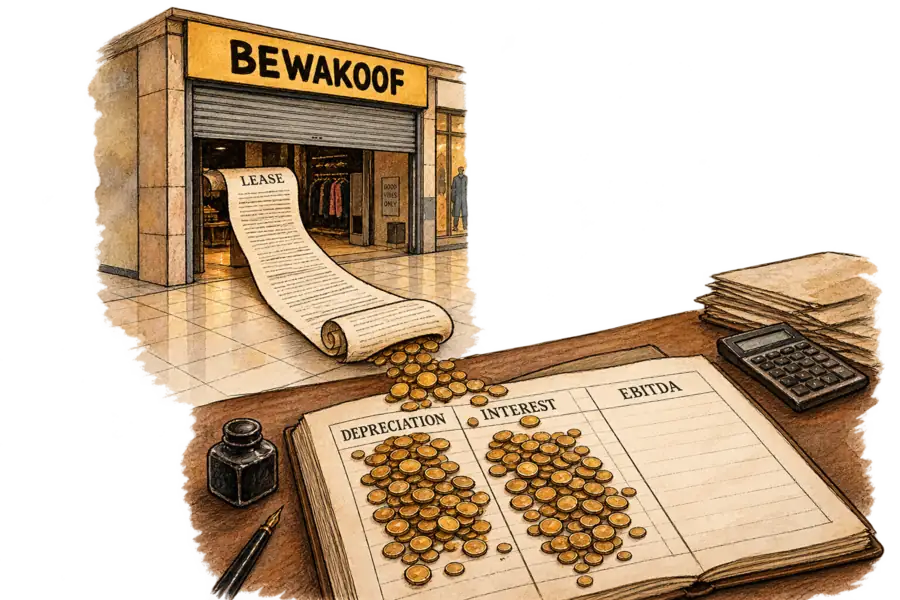
Bewakoof's Loss Grew in the Lines That Carry Its Shop Rent
Bewakoof's FY26 accounts show revenue up 40.6% and a net loss up 19.4%, with more than the whole widening in depreciation and finance costs, the lines where Indian accounting puts shop rent. The brand went from six stores to 36 that year, and EBITDA, the figure its parent leads with, leaves that rent out.
Neritus Vale
Bewakoof, online-first for twelve years, spent the year to March 2026 building a chain of shops, and the cost landed below EBITDA. Revenue at the Gen Z clothing brand, which Aditya Birla Fashion and Retail controls through its TMRW unit, rose 40.6%, Inc42 reported. The net loss widened anyway, to ₹87.4 crore. On our arithmetic, more than all of that widening sits in depreciation and finance costs, the two lines where Indian accounting puts the cost of a signed shop lease.
The two outlets that broke the numbers framed the year as a loss that grew despite better operations, but the operating improvement is thin. Inc42’s narrower EBITDA loss includes, by our reconciliation, other income, which rose by about ₹3 crore from a year earlier and supplied most of the gain. Entrackr, which excludes other income and reported ten days earlier, has the EBITDA loss shrinking by less than ₹1 crore. The margin improved because sales grew; the rupees lost before depreciation and interest barely moved.
The deterioration sits in the lines EBITDA leaves out. Depreciation and amortisation rose from ₹6.1 crore to ₹16.6 crore, a rise of 2.7 times that Inc42 calls “more than doubled” and Entrackr “nearly three times”.
Neither outlet printed finance costs, so they have to be derived. Taking Inc42’s EBITDA loss and depreciation from the net loss leaves about ₹16 crore, and Entrackr’s figures give the same once the ₹5 crore of other income is added back. The same sum for FY25 gives ₹8.1 to ₹8.3 crore on the restated EBITDA, or ₹10.1 crore on the loss Inc42 first reported, so finance costs rose by about 1.6 to 2 times. The figure is derived, not read off the filing.
Together, depreciation and interest rose by about ₹18 crore, more than the ₹14.2 crore widening of the loss.
Those charges grew in the year Bewakoof became a store chain. It opened its first shop, in a Bengaluru mall, in July 2024 and had six by March 2025, India Retailing reported. By March 2026 it had 36, ABFRL’s annual report shows. That is more than any other brand TMRW controls; Wrogn, an associate in which ABFRL holds 35.36%, has 60.
Lease accounting explains why a shop’s cost shows up below EBITDA. Bewakoof sits inside a listed group that reports under Ind AS 116, India’s version of IFRS 16, under which a lease longer than a year, unless the asset is of low value, goes onto the balance sheet as a right-of-use asset with a matching liability. Its fixed rent then reaches the profit and loss account as depreciation and interest, both of which EBITDA excludes. Variable rent, short leases and low-value assets stay above the line. Fit-outs are depreciated too, and the sources do not say how much of the ₹10.5 crore rise in depreciation is leased rent and how much is shop fittings.
Bewakoof’s balance sheet moved the way that rule predicts. Total assets rose by about ₹90 crore in the year, ABFRL’s subsidiary statements for FY26 (p.202) and FY25 (Annexure IV) show. Almost none of that was stock, receivables or cash, since current assets rose by about ₹6 crore (Entrackr). The growth sat in non-current assets, where right-of-use assets, fit-outs and rent deposits are recorded. Liabilities rose by almost exactly as much.
That is the signature of signed leases, though borrowing to fit out shops would leave a similar mark. Bewakoof’s charge register, as listed by Tofler, shows a ₹20 crore charge in favour of Axis Bank from April 2024 and a ₹50 crore charge in favour of ICICI Bank dated 5 December 2025, and Tofler puts borrowings at March 2025 up 90% on the year before. The ICICI charge came with about four months of FY26 left, so it explains little of a full-year rise in interest; the debt behind most of it was probably already there. The register lists amounts secured, not balances drawn, and the notes that separate leases from loans sit in the full filing, which neither outlet published.
ABFRL has already given the store explanation for its own results. Explaining a wider group loss for the quarter to June, its chief financial officer, Jagdish Bajaj, blamed it “primarily” on “higher Ind AS depreciation and finance costs associated with new store openings” (call transcript).
That explanation covers every ABFRL segment, not Bewakoof alone. The group added 45+ stores across brands in the quarter, and TMRW’s count, excluding Wrogn, went from 60 in March to 75 in June. The same call reports TMRW’s own segment EBITDA loss narrowing from ₹63 crore to ₹42 crore, so the quote supports the mechanism but not a verdict on Bewakoof.
The strongest case for the shops is that this is what a first year of stores looks like, and that the fleet will grow into its costs. A new store pays full rent from day one while its sales build slowly, and lease interest is heaviest early on. Some of the operating gain is plausibly the stores’ doing: transport and handling costs fell 17% as revenue rose (Entrackr), and fewer parcels would fit. For that case to win, one condition must hold: store sales have to grow faster than the depreciation and interest the stores carry.
The first year’s evidence runs the other way. Bewakoof added about ₹70 crore of sales in FY26 and its operating loss barely moved, so the new charges below it went straight to the net loss. Its shops opened on a business already losing about ₹60 crore a year before depreciation and interest. A store fleet is leverage, and leverage multiplies whatever margin it sits on.
Larger peers show what a firmer base can carry. In the year to March 2025, The Souled Store made a profit and Snitch stayed close to break-even, each on revenue near ₹500 crore, about twice Bewakoof’s FY26 figure. Both had been profitable the year before. Neither Entrackr report gives store counts, so the comparison says something about the base, not about what stores earn.
The parent has most likely been covering the loss, and it now owns almost all of the business. Bewakoof’s net worth edged up over FY26 despite the loss, which implies roughly ₹90 crore of fresh equity on the arithmetic of the two subsidiary statements. The likeliest source is TMRW, whose stake rose from 87.64% to 89.01% over the year; no document says who supplied the money.
TMRW has money behind it too. In the same year it raised about ₹437 crore from ServiceNow Ventures, an investment ABFRL’s annual report presents as bringing “ServiceNow’s AI and automation expertise”. In June TMRW bought almost all of the remaining minority stake, lifting its holding to 99.03% (exchange filing).
Bewakoof’s leadership was due to change in March; its leases run on. Prabhkiran Singh, who led the company through the year, said in February that he would step down at the end of March, and Inc42 notes that the brand is yet to clarify its new leadership structure. A lease, as we argued in September, is a cost a brand cannot switch off.
EBITDA is the wrong test of the shops. The margin improves as sales grow, and moving rent out of operating costs lifts its level, while ABFRL’s latest results presentation leads with EBITDA, a figure struck before the lease charges. ABFRL says TMRW has “a clear path to achieving brand-level cash profitability over the next 12 to 18 months” (call transcript). If that is measured after rent, Bewakoof’s next filing will show whether the stores pay their way. Which measure TMRW reports is a choice; the leases, once signed, are not.