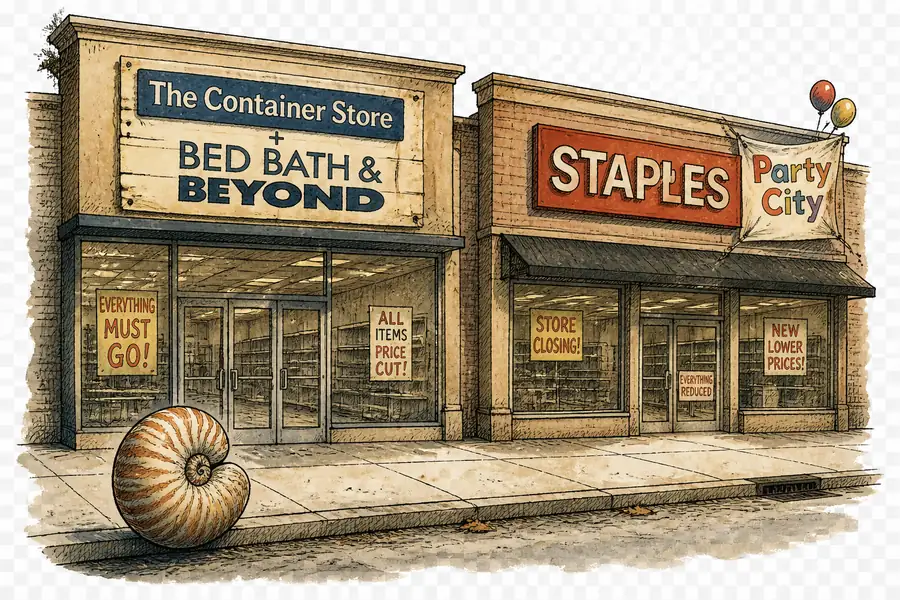
Beyond And Staples Sublet Their Floors To Bankrupt Brands
Beyond Inc.'s shop-in-shop with The Container Store and Staples's shop-in-shop with Party City share a structure: a host with rent it cannot cover and a guest brand that has already lost its store network. The synergy lives on the lease ledger, not the income statement.
Neritus Vale
Beyond Inc. and Staples are not running growth strategies in 2026; they are running fixed-cost amortization plays inside their own square footage. Beyond, which bought the Bed Bath & Beyond name out of liquidation in 2023, begins stocking that brand across The Container Store’s locations in May after the host clears 30% of its selling floor. Staples will install Party City, which filed for liquidation in December 2024, into 700 of its own stores this summer beside the print desk. The hosts have rent they cannot cover with their own traffic. What the guests bring is name recognition that survived the liquidation of their store networks. What is being shared between them is not customers; it is overhead.
The Container Store reached this arrangement after its bankruptcy in late 2024. Revenue had peaked above $1 billion in 2021 and declined steadily until Chapter 11. An earlier Beyond commitment never arrived in cash, and the chain entered and exited court alone. The 2026 acquisition values it at a fraction of its market-cap peak more than a decade ago, with consideration structured as $150 million in stock and convertible notes. Press materials describe the synergy as cost savings and productivity efficiencies — the vocabulary of contraction, not expansion. The thirty-per-cent floor cut tells the same story; that space is being cleared because what stood on it could not earn its rent.
Staples is making the inverse trade with Party City. Sycamore Partners has owned the chain since 2017 and watched the U.S. footprint contract as the business shifted toward B2B delivery. The 700-store Party City rollout fills the floor space that retail foot traffic no longer justifies on its own. Party City itself liquidated and now exists primarily as licensable IP. Staples buys balloon turnover from a name with surviving recognition; whoever owns the IP buys distribution they cannot lease themselves. Marshall Warkentin, Staples U.S. Retail president, framed it as “expanding what customers can accomplish in one place” — the language an empty store uses when it would prefer to look full.
Beyond Inc.’s acquisition pattern is itself the argument. The company, formerly Overstock, bought the Bed Bath & Beyond name out of bankruptcy in 2023, then added Kirkland’s and buybuy BABY, and has signed a letter of intent to acquire F9 Brands, the parent of Lumber Liquidators, Cabinets To Go, and Gracious Home. Each name was acquired below trailing revenue at the trough of its life cycle; the pattern is distressed-asset arbitrage, not portfolio construction. Q1 2026 revenue was $248 million, the first growth quarter since 2021. The company had accumulated losses of $650 million on $4 billion in revenue over the three preceding years. Marcus Lemonis describes the destination as “the first everything-home company”; getting there depends on the cost discipline that makes the rent-share arithmetic hold.
The strongest counter-argument is Sephora-in-Kohl’s. That partnership, first announced in 2020, lifted Kohl’s beauty sales above $1.4 billion by 2023 and gave Sephora a US doorway it could not have built alone, suggesting that two retailers under one roof can compound rather than dilute. The condition for that pattern is that one partner brings a demand engine the other lacks. Kohl’s needed beauty velocity; Sephora needed mid-market scale; the basket they constructed was incremental on both sides. The Beyond and Staples deals fail that test on their own counterparties: Bed Bath & Beyond’s name carries no demand engine that survived its own liquidation, and Party City’s didn’t either. When two failing concepts share one floor, the bleeding becomes cheaper, not the floor profitable.
Three retail-merger precedents make the price visible. Tapestry’s acquisition of Kate Spade ended in write-downs; the Men’s Wearhouse purchase of Joseph Abboud proved transformative for neither party. Hudson’s Bay’s consolidation of Saks, Lord & Taylor, and the Bay ended with those brands seeking bankruptcy or going out of business. Shared corporate plumbing reduces the cost of survival but does not produce the revenue that survival, eventually, requires. Beyond’s “everything-home” construction sits in this lineage. Whether it ends differently depends on whether the savings buy enough time for demand in cabinetry, organisation, and home décor to recover before the lease cycle catches up.
Both deals work on the lease ledger and only on the lease ledger.
The cost-sharing arithmetic is testable inside eighteen months. Beyond’s profitability case depends on the hybrid floor plan lifting sales per square foot well above what The Container Store currently runs. Staples expects Party City corners to draw cross-aisle trips that print and shipping no longer command alone. If category demand returns before the rent-share exhausts the savings, the floor plan reads as survival. If it does not, both chains will exit 2027 with smaller portfolios and the same fixed costs. The retailers had a choice between writing down the loss and renting the loss to themselves; they picked the second.