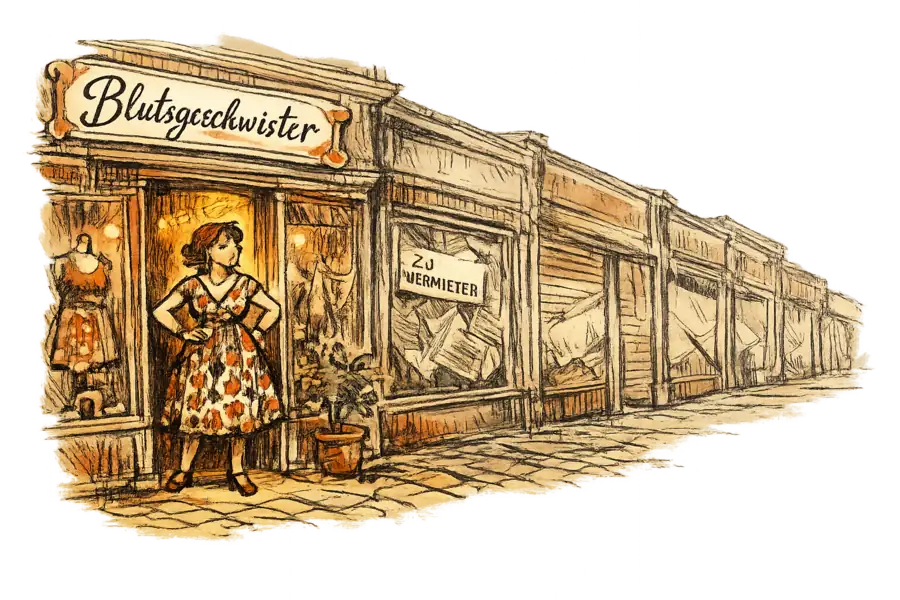
Blutsgeschwister Never Scaled. Half the German Trade Vanished Anyway.
Stephan Künz has run the German label since 2010, taking it from five million euros to eighteen without ever trying to get big. Over the same sixteen years the number of German clothing retailers roughly halved, which is both the case for his strategy and the threat to it.
Sir John Crabstone
Blutsgeschwister is the control group for an argument the industry never bothered to run. Stephan Künz moved from South Tyrol to Stuttgart in the summer of 2010 to manage the German label, and he manages it still, having taken revenue from five million euros to eighteen. More than tripling over sixteen years is, by the standards of the advice handed to brands this size, a rounding error. The trade was told to scale or perish. Künz declined both.
The instruction was obeyed at both ends of the market, with matching results. Germany held just under 22,900 clothing retail companies in 2010 and roughly 12,050 in 2025, Neue Westfälische reported; Gerry Weber and Wormland, which had the national footprint the small shops lacked, spent part of that period in insolvency. Size proved fatal in both directions.
What Künz sold instead was a signature narrow enough to be unmistakable: prints and colour you can name across a room. “Anyone who plays on the same field as fast fashion will lose to fast fashion,” he says. The sentence is usually read as modesty. It marks the border he will not cross.
That kind of narrowness is expensive to hold and cheap to abandon, which is why so few hold it. Blutsgeschwister has been a Fair Wear member since 2013 and scored 80 in the foundation’s latest brand performance check, placing it in the Leader band. Thirteen years inside one auditing regime is not a marketing asset. It is the reason the same factories are still making the clothes.
The same logic governs resale. The label takes back and sells its own garments a second time, a channel already worth 5 to 8 percent of online turnover, against a stated aim of one item in ten eventually selling second-hand. A signature makes that possible; a generic garment has no second-hand market worth owning.
The other asset is a list of names. Blutsgeschwister sells through more than 350 points of sale across Europe alongside 14 of its own stores. Every one of those doors was opened by a buyer who met a salesperson. Nobody bid for the placement.
No algorithm ever promoted Blutsgeschwister, which is precisely why none can demote it.
Being unranked is not the same as being safe. Half of Germany’s stationary clothing retailers posted an operating loss in 2025, and only around 30 percent expect a meaningful rise this year. Every one of them is somebody’s stockist. A wholesale book holds its value for exactly as long as the counterparties do.
Künz’s answer was to hire into the book rather than around it. Blutsgeschwister installed Sebastian Stein, previously of Camper and Lala Berlin, as head of wholesale, tasked with holding the long-standing accounts and opening new ones at the same time. Most growth plans treat those as sequential problems. His does not, because distribution of this kind cannot be bought back once it is gone.
Eighteen million euros in 2025, a mid-six-figure operating result despite a run of investment spend, and first-half pre-orders up by nearly a tenth will not fill a conference panel. It has also kept Blutsgeschwister off the insolvency lists. Künz has built the one thing no platform can confiscate. Whether there will be shops left to carry it is not a question he has ever been allowed to answer.