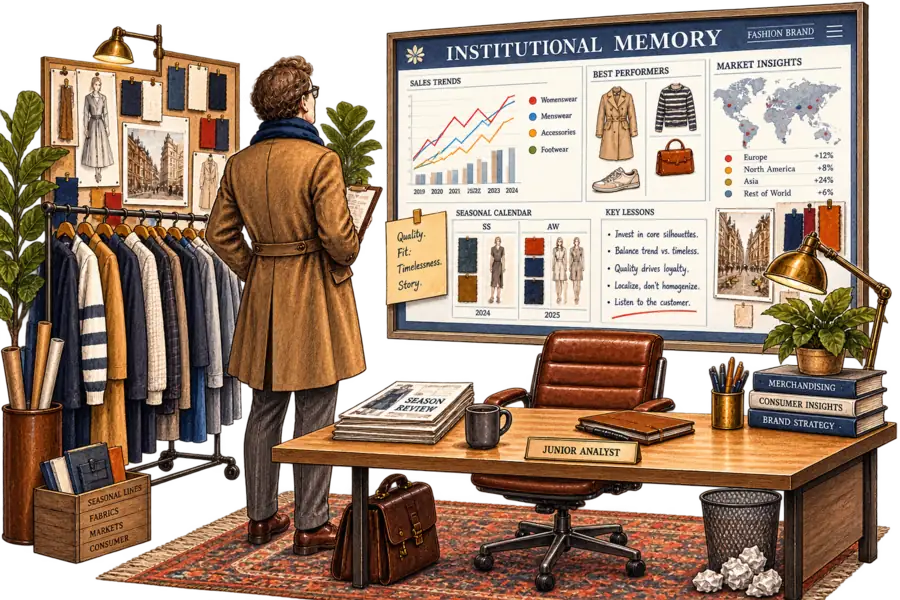
Brands Are Buying the Memory They Used to Hire
At a Glossy and Modern Retail leaders' dinner reported this month, an executive described taking open roles off the company's hiring account once the software proved it could do the work. The first organisational effect of retail AI is not redundancy but a vacancy that never opens, and institutional memory that now sits in a system nobody was trained to question.
Sir John Crabstone
Retail AI’s first organisational effect is a vacancy that never opens, not a round of redundancies. At a Glossy and Modern Retail leaders’ dinner reported this month, an executive described putting roles up on the company’s hiring account and taking them down again once the team worked out the software could do the job. The role vanished before anyone was ever hired into it.
What replaced the hire was a platform. One brand in the room had built an internal intelligence system joining fulfilment data, paid media, customer reviews and Reddit threads, looking for correlations it could act on. Another executive assembled a single view across e-commerce and physical retail in about three weeks, without the six-figure technology investment the same job once required. The two-year apprenticeship an analyst would once have served, learning where those numbers came from, has no equivalent in this system.
Everyone at that table read the change as a productivity story, and the room’s own conclusion was upbeat: products, expertise and community would matter more, not less, once the easy work was automated. As one executive told the same gathering, whatever edge a brand builds on AI its competitors will build too, so advantage was expected to settle on what software cannot copy. It is a comfortable conclusion. It also declines to say where that uncopyable expertise was supposed to come from.
The junior merchandiser was never valuable for the work itself. Pulling sell-through and chasing a late delivery was how the knowledge got in. What accumulated was a sense of which anomalies matter and which are a store manager mis-scanning returns. That sense was the asset, and it was always paid for as though it were clerical.
The pattern is visible outside fashion, in payroll records rather than anecdote. Stanford’s Digital Economy Lab worked from the largest payroll dataset in the United States and found a 16 percent relative decline in employment among workers aged 22 to 25 in the most AI-exposed occupations. Employment for more experienced workers in the same occupations held steady or grew. The declines gather where AI automates rather than augments, and the adjustment runs through headcount rather than pay. A firm that never hires has nothing to disclose.
A brand that stops hiring juniors has not saved a salary; it has stopped manufacturing seniors.
The economics have been modelled, and the result is worse than the obvious one. In a paper on the intergenerational transmission of knowledge, Enrique Ide models novices acquiring tacit skill by working alongside experts. Better entry-level automation lifts output on adoption while lowering long-run growth, the paper finds, even where entry-level employment does not fall. The harm comes from steering novices away from the most productive experts. In a buying office that is the assistant who still has a job, seated with a dashboard rather than beside the merchant who has survived four bad seasons.
Which leaves the software holding the memory. These platforms were built quickly; one in three weeks, by an executive who already had a job. They now decide which correlations count. Every firm keeps two ledgers, one for salaries and one for what its people know; only the first is audited. The staff who would have been qualified to tell a platform it was wrong are the line item that made it look cheap.
None of this will resemble a mistake for several years. The platform will be right about most things, because most things repeat. Its first real failure will arrive in a season nobody in the building has lived through — and the case against it will have to be made by people who learned everything they know from it.