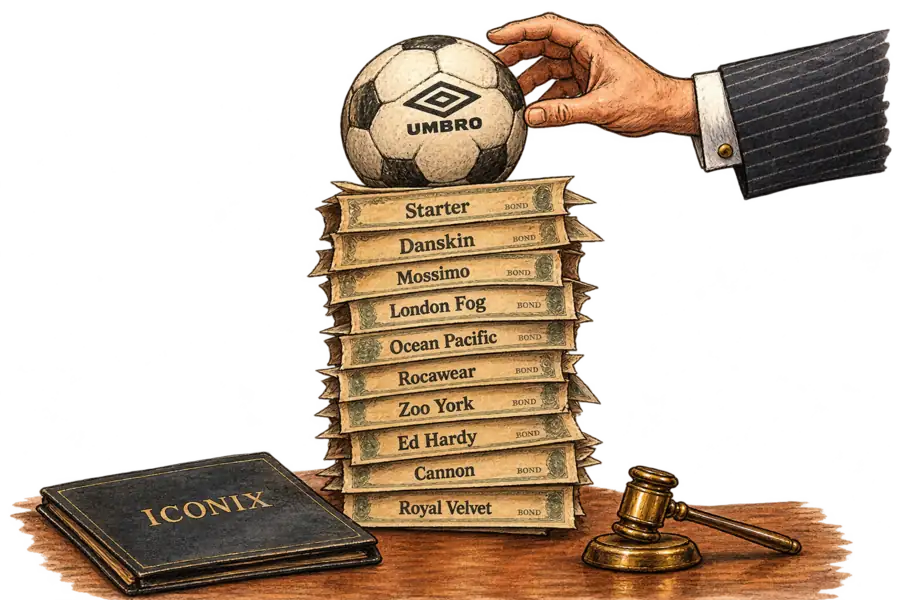
The Brands That Paid for Umbro Are the Hard Part of Selling Iconix
Iconix paid for Umbro in 2012 with part of a bond secured on the North American rights of most of its other brands, and kept Umbro out of the pledge. If the brand managers J.P. Morgan is canvassing keep buying big names they can build, the sale to expect is one in parts, Umbro first, with the terms of Apollo's loan a likely constraint.
Admiral Neritus Vale
Iconix paid for Umbro in 2012 with part of a $600m bond secured on the North American rights of most of its other brands. On 2 October WWD reported, citing three sources, that Iconix had hired J.P. Morgan to find a buyer, with Umbro singled out as its most promising brand. If the brand managers J.P. Morgan is calling on keep paying for big names they can build, the sale to expect is one in parts, with Umbro first. That would cut against WWD’s framing of the consolidation pioneer as a business that “might just be consolidated itself”.
The pledge left Umbro out. The collateral was the US and Canadian rights of Starter, Danskin, Mossimo, London Fog and most of Iconix’s other names, plus its stakes in Ed Hardy, Zoo York and Peanuts, Iconix’s December 2012 8-K shows. The same filing says $225m of the proceeds paid for Umbro, and the offering papers state that Umbro “is not a Securitized Brand” and stays out of the collateral unless Iconix, in its sole discretion, chooses to contribute it. When Iconix sold its Peanuts stake with the rest of its entertainment arm in 2017, $152.2m of the money had to prepay the notes. The remaining pledged brands still carried the 2012 notes, a $275m add-on from 2013 and a $100m variable funding facility.
Several of the pledged names depended on exclusive deals with single retailers, and the retailers left. Target’s Mossimo licence ended in 2018. By early 2021 four more retailers had declined to renew, Iconix’s 2020 annual report says: Kohl’s for Candie’s and Mudd, Walmart for Danskin Now, J.C. Penney for Royal Velvet and Macy’s for Material Girl. Royalties fell far enough in the year to March 2019 to break the notes’ debt-service test. From April 2019 everything left after interest and fees went to repay principal, and Iconix kept only a management fee.
A private loan, not another bond, ended the arrangement. Last December Iconix upsized its existing loan from affiliates of Apollo to discharge the securitisation facility that began with the 2012 bond. Its announcement puts the retail sales of the whole portfolio, not Umbro’s alone, at about $6bn. It added that Iconix was now free to pursue “strategic alternatives” for all its brands’ North American rights; by October J.P. Morgan had been hired to find a buyer.
Brand managers have spent this year buying big single names. In May Authentic agreed to pay up to $1bn for Lee, Kontoor’s release says. Authentic plans to convert Lee to a licensing model and puts its annual retail-equivalent sales at about $1.5bn, TheIndustry reported. WHP Global and G-III completed their purchase of Marc Jacobs from LVMH in September, and Marquee agreed in May to buy a majority of Roberto Cavalli from Dubai’s Damac. WWD describes a turn towards “bigger, higher-profile brands that can be developed in new ways”.
Per dollar of retail sales, Authentic’s headline price for Lee is about four times what Iconix would fetch at $1bn. WWD reports some buzz that a buyout of the whole company could be close at a price above $1bn, and that the price has met “a fair bit of skepticism” from informed sources. Both retail figures are company estimates, and Lee’s price also buys an operating business, so the comparison flatters Lee. WWD does not say whether Iconix’s $1bn includes debt. The caveats narrow the gap without closing it.
This year’s brand deals pay out if one name grows. A $250m slice of Lee’s price is an earn-out tied to how the brand performs under Authentic. G-III bought the Marc Jacobs operating business and licenses the name from a joint venture it half-owns with WHP. Damac keeps a significant stake in Cavalli, and Milan’s The Level Group will lead development, production and distribution. Iconix’s December release says its securitisation facility prohibited “targeted investments and partnerships” in the pledged brands’ North American rights.
When Iconix sold Umbro’s Chinese rights in 2020, $44.7m of the $59.6m in net proceeds went to repay its term-loan lenders.
Whether Umbro can now be sold free of Apollo’s claim turns on the terms of Apollo’s loan, which Iconix has not published. We found no accounts that break out Umbro’s royalties, so its share of Iconix’s royalties is unknown. The 2017 term loan required prepayment from the proceeds of certain asset sales, and the 10-K records the Umbro China repayment as “due to asset sales” without saying it was mandatory. Apollo managing director Kurt Hoffman said the December upsizing would help “position Iconix to fully leverage its unified global brand platform”. If the new loan has a similar clause, most of an Umbro price would go to Apollo, and Iconix’s owner, Lancer Capital, would keep the formerly pledged brands, the pool whose coverage ratio fell below the test in 2019. Lancer would also keep Salt Life, whose retail sales doubled to nearly $100m in its first year under Iconix: another name a buyer could take alone.
The strongest case for a sale of the whole is a buyer that needs retail volume more than any one name. WWD says brand management companies are “looking for scale”. Authentic fits on paper: WWD says it aims to more than double to $100bn of retail sales in five years, and it said in May it plans a listing within 12 months. One signing would add a whole portfolio’s retail sales and settle Apollo in a single transaction. If that buyer exists, the brands sell together and Umbro never has to be priced alone.
Authentic has already held talks with Iconix, and one source told WWD that a deal never came together. Another said WHP Global and Marquee were not interested. Authentic signed for Lee in May, and on 1 October a source told Reuters it had approached Mattel, the maker of Barbie, about a takeover. The Wall Street Journal reported the approach first, and Reuters notes there is no guarantee Mattel is open to a deal and no formal sale process. The buyer with the biggest stated target is looking at names that are already big.
Iconix’s last annual report describes its own test for selling a brand’s territories or categories: whether the offer is worth more than the current and potential revenue stream. If buyers keep paying for big names, that test points to Umbro first and leaves the rest to be valued on their own royalties. Holding out for one buyer means accepting whatever discount it applies to the pool. Either way the pool gets a price; Lancer’s choice is whether it is set with Umbro attached or after Umbro has gone.