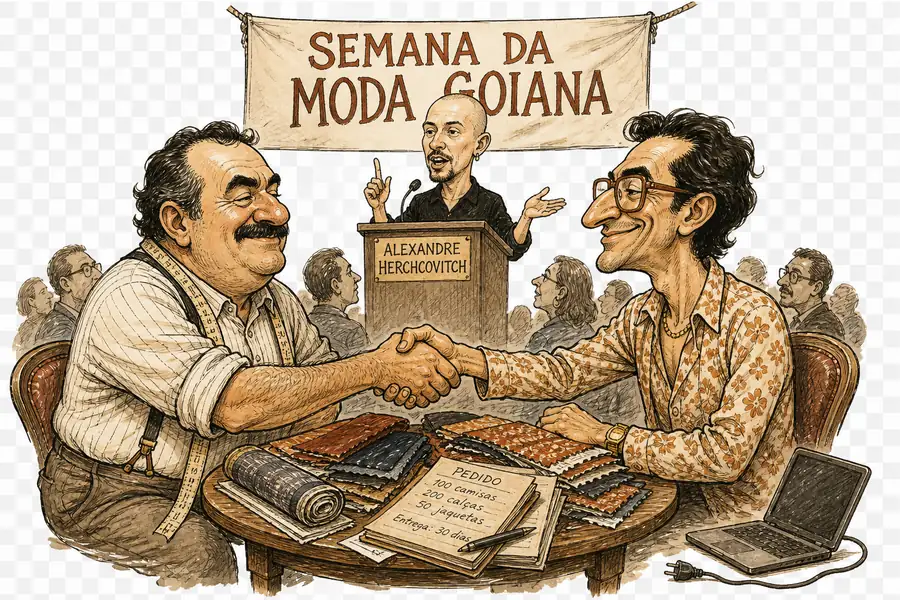
Brazil's Order Book Still Gets Written Across a Table in Goiânia
Semana da Moda Goiana gave four days in May to workshops, retail panels and a business round, which is where Brazil's second-largest apparel hub actually set its order book. The AI demand-planning tools now recommended as the answer to Shein will model that book from outside the room.
Sir John Crabstone
Brazil’s second-largest apparel hub set its next order book in May, across a table in Goiânia, and no model was in the room. Fieg’s Semana da Moda Goiana gave four days to lectures, workshops, retail panels and a business round. A business round is a schedule of appointments: makers on one side, buyers on the other, quantities settled before anything is cut. Vendors and buyers meet, deadlines get set, and nothing is entered into a system anyone outside the hall can query. The demand-planning tools now sold to Brazilian brands will forecast that book from outside it. The hall does not livestream, and the deals inside it do not populate a dashboard anywhere.
Goiás makes clothes at national scale. Fieg counts roughly 60 million garments a month, more than R$10 billion a year and some 200,000 direct and indirect jobs, with over 12,000 wholesale stores in Goiânia’s Região 44. Three-quarters of the Centre-West’s output comes from the state. That is more apparel than most countries produce, moving through wholesale relationships no platform indexes. The volume is national; the record of who finally bought it stops at the wholesale counter.
The advice to Brazilian retail runs the other way. With Shein’s Hong Kong listing expected within the quarter, BTG Pactual told clients the domestic defence is quicker product development, stronger brands, omnichannel reach, AI-driven personalisation and a better customer experience, in a note reported by Folhapress. Every item on that list assumes the retailer already knows who bought the last thing.
Shein’s own signal is not doing especially well. Sales reached US$41.8 billion in 2025, up 8%; revenue grew 1% in the first quarter of 2026, and the United States, its largest market, fell 14%. Reading demand at the till does not guarantee reading it correctly.
Goiás cannot make that assumption at all. Its factories sell wholesale through Região 44, and the sale that decides whether a style repeats happens at a till the producer will never see. Lojas Renner cut inventory 3% and still grew revenue 9.2% in 2025 because it owns the shelf its data comes from, as we reported in April. A Goiás manufacturer has no such claim on its own sell-through.
The programme was not innocent of the problem. Talks on artificial intelligence applied to fashion and on smart labelling shared the same four-day agenda as the denim session, the tax-reform panel and the business round, booked by the same chamber. The room that sets the signal spent the week beside the instruments built to read it.
Software cannot forecast a conversation it was not invited to.
None of this makes the technology useless. It makes it partial. A demand-planning model reads the visible fraction of a market — wholesale stores, storefronts, returns data — not the row of handshakes in Goiânia that decided what got made in the first place.
The spring-summer 2026/2027 trend presentation was on that agenda too. What Brazil will wear next year was described in an auditorium to the people who will cut it. Nobody asked them to type it in.