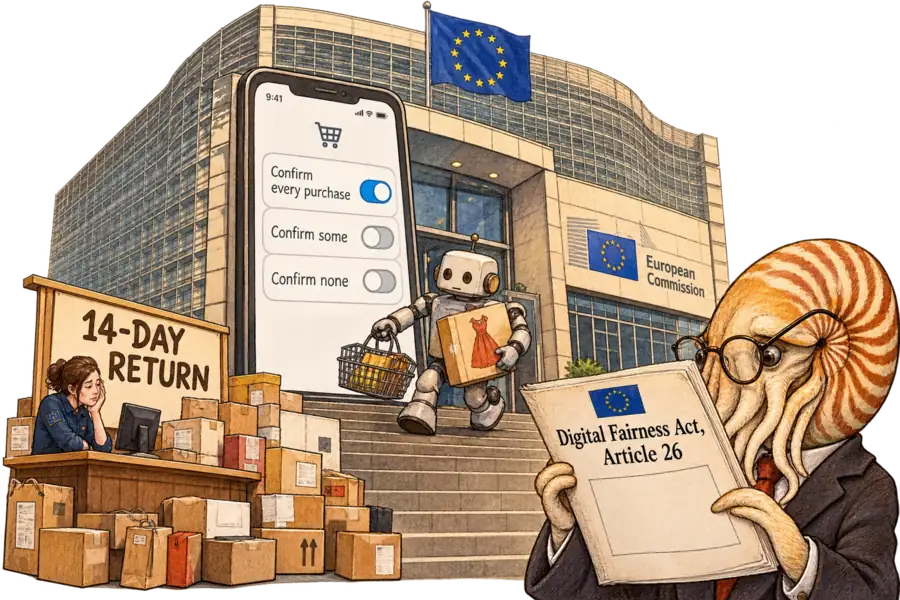
Brussels Offers Agent Shoppers a Settings Menu and Leaves Errors to the 14-Day Return
The Digital Fairness Act's agent article makes whoever supplies a shopping agent offer a confirmation menu and flag paid suggestions. Whether a purchase outside the shopper's settings binds is left to national contract law, and the Commission dropped a pre-contract veto partly because consumers already have a 14-day withdrawal right.
Neritus Vale
The EU’s first consumer rules written for shopping agents amount to a settings menu. Article 26 of the Digital Fairness Act, proposed on 11 November, has an agent’s supplier ask each shopper whether to approve every purchase, some or none. Whether a purchase that breaks those settings binds the shopper, the proposal leaves to national contract law. Brussels dropped a right to stop agent purchases before they bind, partly because consumers already have a 14-day withdrawal right.
Agents got a passing clause in the Commission’s release, in a bullet on subscriptions: consumers “will have clear rights when using an AI agent to buy products on their behalf”. Euronews and Ecommerce News covered dark patterns and fines of up to 6% of global turnover, and left agents out. The impact assessment, though, notes that “in the absence of specific EU rules on automated contracting”, courts in a member state found early tools in breach of the Consumer Rights Directive.
Nowhere does the proposal call them AI agents. It regulates “automated systems”, software capable of “taking decisions producing legal effects for its user, including concluding contracts”. When the software errs, Article 2(2) defers: the regulation is “without prejudice to contract law”, including “the validity, formation or effect of a contract”.
Article 26 puts the duties on “traders making available to consumers automated systems”. That would likely include OpenAI, Meta or Google in Europe, or a retailer’s own assistant, since the recitals also reach systems “provided by third parties”. Shoppers confirm every contract, none, or some, picked by criteria such as a maximum price, and can put a time limit on that choice.
Money gets the sharpest clause. If the provider is paid “for proposing a contract” or has a conflict of interest, the agent must disclose it and ask, whatever the setting. The recitals cite “a sponsored suggestion”. If a sales commission counts as such a payment, an agent paid by the shops it buys from could never buy unasked.
Shops’ new duties are few: confirm the contract, and never run an interface that “requires consumers to use automated systems”. The recitals add that traders “should make available” the pre-contractual information in all cases. Nothing in the text obliges a shop to let an agent in; it only bars forcing consumers to use one. On the day the proposal appeared, United Airlines said it would “prohibit use by unauthorized, third-party personal AI agents or assistants”, citing security, account changes, MileagePlus miles, FAA and DOT check-in rules, and “unintended purchases”.
The Commission’s impact assessment weighed, and dropped, a right to “reverse the actions of the automated system or object to them before they become legally bound”. It found the idea potentially overlapping with the settings and considered it likely to increase “uncertainty on the status of transactions concluded by automated means”. Since consumers “already have a 14-day right of withdrawal”, its “added-value was considered low”.
For clothing, that makes the returns desk the agent’s undo button.
The proposal supplies the plumbing. Recital 78 says that using an automated system “does not imply any waiver of consumer rights accorded under Directive 2011/83/EU, even in case the consumer decides not to pre-approve any contracts”. Article 24 requires a “withdraw from contract here” function on online interfaces.
Some goods have no 14-day exit. The Consumer Rights Directive allows no withdrawal from goods “made to the consumer’s specifications or clearly personalised”, or from hygiene-sealed goods once opened, and keeps passenger transport out of most of its rules. A monogrammed bag bought without the confirmation its owner’s settings required has no such exit. United’s ban covers a purchase the directive never made returnable.
Pre-selection was a possible named ban in Taylor Wessing’s preview. It made the blacklist in narrow form. The annex bans “default options which the consumer is required to reject” as a way of inferring consent “to payment for an additional product”, a different quantity or “a different product”. That adds a ban beside the refund rule from our 9 November piece: the pre-ticked gift box is caught; whether a preset size is a different product is open.
On its wording, the blacklist targets the interface, not the buyer, so a pre-ticked add-on or a fake low-stock claim is banned whoever reads it. Article 10’s general ban is different: it covers interfaces likely to “deceive or manipulate consumers” or to “materially distort the economic behaviour of consumers”. Article 3(6) defines a transactional decision as “any decision taken by a consumer”. When an agent buys unconfirmed, the text never says whose decision that is.
Personalised prices show the same gap between agent and shopper. Harmful personalised pricing is banned only where the trader knows “with reasonable certainty” that the shopper is a minor or vulnerable. Otherwise the 2019 duty to disclose “that the price was personalised on the basis of automated decision-making” stands, as the impact assessment notes. Read literally, the list an agent must relay to a confirming shopper skips Article 6(1)(ea) of the Consumer Rights Directive, that notice.
The strongest case for the design: an agent is a tool, and tools should not unsettle contracts. The assessment considered a pre-contract veto likely to discourage “the take up of such solutions”. The first agents already ask: Muse “checks with you before” a purchase, Meta says, and ChatGPT Wallet needs Face ID or Touch ID for each order, as we reported today. For the thesis to fail, shoppers would have to keep confirmation on, or limit agents, as the recitals suggest, to “only those traders that provide a right of withdrawal”.
Nothing in the text secures either: it permits the no-confirmation mode and leaves the filter optional. Where the drafters wanted a purchase not to bind, they said so; for a free trial turned paid without express agreement, “the consumer shall not be bound by the contract”. Article 26 has no such sentence. The assessment does record errors with earlier assistants: in a Fitness Check survey, 15% of respondents said they had been charged for a purchase they “did not intend to make” when using a virtual assistant. It gives no base for that figure, and a virtual assistant is not an agent with a settings menu.
Delay is the other price. Ecommerce News, citing unnamed legal experts, says the rules could take at least another two years to enter into force. Ecommerce News stops there; the proposal then waits 12 months before it applies. If the experts mean entry into force literally, agent rights reach EU shoppers in late 2029 at the earliest.
The agents are not waiting. Meta’s Muse started in the US and has since reached Singapore; ChatGPT Wallet began in the US; and Google’s agent checkout runs in the US and Canada. Parliament and Council can use those years to settle what Article 2(2) leaves to national law: whether a purchase outside the shopper’s settings binds the shopper at all.