Brussels Will Charge the Parcel and Crawl the Listing
A leaked draft of the European Product Act adds a market surveillance fee on non-EU goods, set lower for bulk imports than for parcels, which suits platforms already stocking European warehouses. Its larger change is a check, by marketplaces and Commission webcrawlers, that listings match the product's passport or records, and the duty to verify applies to any product aimed at EU buyers; the proposal itself has been postponed.
Sir John Crabstone
A leaked draft of the European Product Act contains what Ecommerce News Europe on Friday called “another parcel tax”: a third charge on non-EU goods, after the €3 duty that began in July and the €2 customs-clearance fee expected in November. Importers would bear it; who is liable for parcels shipped direct to shoppers remains to be determined. Its larger change is a check that listings match the product’s own records, and that check applies to any product aimed at EU buyers, wherever the seller sits.
Euronews, which saw the draft in September, reported that the fee’s calculation is left to secondary legislation. Its shape, Euronews adds, is fixed: lower “for products imported in bulk rather than as individual parcels shipped directly to consumers”. A fee with a bulk discount is a shipping instruction.
Shein’s first report as a listed company set out a plan to hold more stock in Europe, as we reported last week. If the draft counts pallets as bulk imports, those bound for its Polish hub could qualify for the lower rate. A dress bound for Cologne would simply stop in Wrocław first.
Stock can be moved closer to the shopper; the product page is already there.
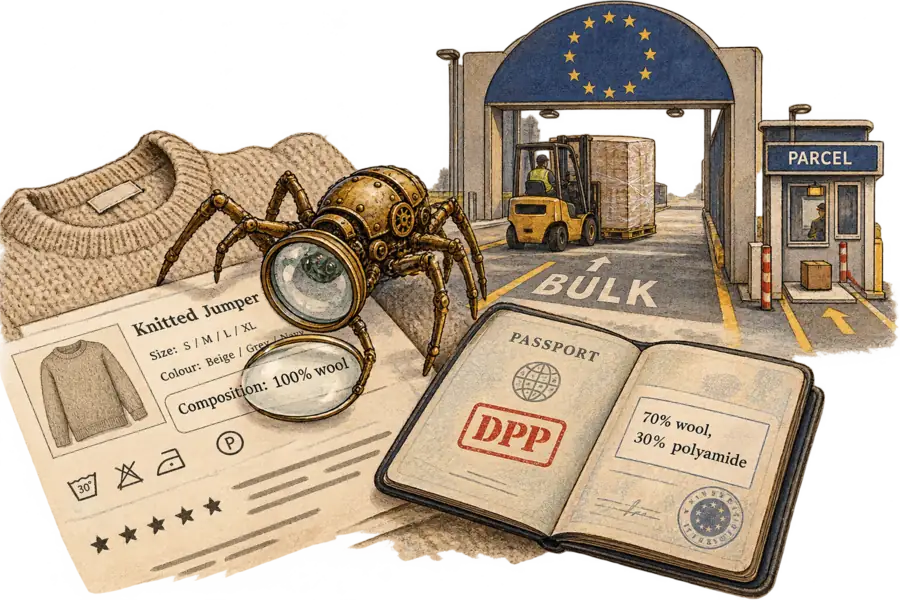
The product page is where the draft reaches everyone. In Osborne Clarke’s reading, a marketplace would have to verify, before listing a product, that it has a digital product passport (DPP) or responsibility record matching the listing. The draft also contemplates Commission webcrawlers that identify failing listings and trigger automated takedown notices. “Product listing data and DPP records that do not correspond to each other will therefore be a direct enforcement target,” the firm writes. The duty to verify does not depend on the seller’s address; the liability shift for a failed check does, since it applies only where no EU-established operator exists.
Clothing’s fibre data is already unreliable. In tests the Commission published in June, 49 of 132 garments carried fibre labels that did not match the cloth, as we reported in August. Garments bought online failed more often, 46% against 36% in shops, though the online group was only 28 garments. A listing that contradicts its own passport is the case Osborne Clarke expects enforcement to target.
For garments, the passport is some way off. The Commission plans to adopt the textile rules in the last quarter of 2027, with no application date given, and says the passport may include fibre composition. If it does, the fibre line will exist twice, and a crawler would need only the two copies to disagree.
Germany’s e-commerce association asked on Thursday for sterner policing. Duties alone “are not enough”, bevh said; the EU must strengthen the market surveillance authorities (our translation). The draft’s answer is to give the Commission direct enforcement powers, crawler included.
None of this is yet a proposal, let alone law. The formal proposal was due on 6 October. On 29 September the office of industry chief Stéphane Séjourné postponed it until later this year, MLex reported, so general rules can arrive with sector-specific changes. The text may still change on its way through the legislative process. If the crawler arrives, it will not ask which of the two records the merchandiser meant.