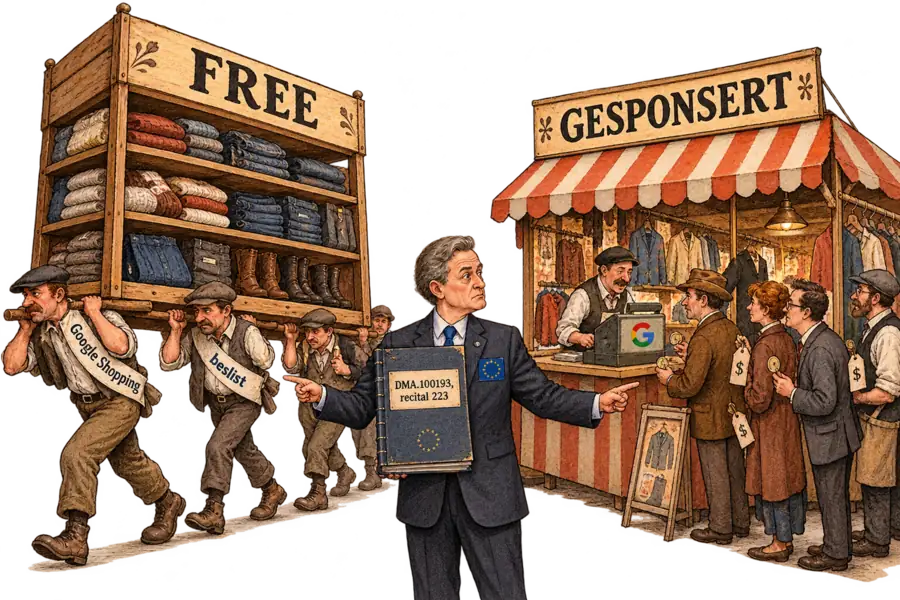
Brussels Condemned Both of Google's Shopping Boxes. Only the Free One Went.
The Commission's July decision found Google's free products unit and its paid product ads unit both self-preferencing. Only the free one has left European search; the unit that replaced it lists comparison sites, some of which charge merchants per click or by commission, under a test the decision says does not turn on who pays.
Admiral Neritus Vale
Brussels condemned two of Google’s shopping boxes in July, and Google has taken down only the free one. Where anything replaced it on European results pages, it was a unit of comparison sites, some of which charge merchants a fee per click and others a commission. The paid box is still selling clicks to merchants through Google’s auction. Recital 223 of the European Commission’s 23 July decision, which fined Alphabet €460m, finds that the company gives “its products unit and its product ads unit more favourable treatment in ranking” than rival services. For an apparel brand selling into Germany or France, free product visibility now mostly runs through intermediaries.
The free carousels disappeared within days, and only inside the European Economic Area. The Dutch tracker Productrise recorded organic product carousels falling by roughly 90 to 100 percent in Germany, France, Belgium, the Netherlands and Sweden from about 15 September, though SEO Südwest had reported the change in Germany by 13 September. Britain, the US and Australia did not move. Google’s ads liaison Ginny Marvin confirmed the Digital Markets Act as the cause, Search Engine Roundtable reported. Before the drop, about 85 percent of the commercial queries Productrise tracks had shown a carousel. The tracker publishes neither its complete keyword list nor sample sizes per country, onlinemarktplatz.de cautioned, so the figure measures a format across commercial queries, not apparel, and says nothing yet about clicks or sales.
In the carousels’ place Google shows what its documentation calls an aggregator unit. Productrise saw it headed “Comparison Sites” in English and “Vergelijkingssites” in Dutch. Approved comparison services fill its rows from their own catalogues; the one Google ranks highest is expanded by default, and a click lands on that service’s site. Google’s documentation says a supplier unit for direct sellers appears only when an aggregator unit does. By late September Productrise found the new unit on roughly half to two-thirds of the queries that had lost their carousels in the Netherlands, Belgium, Ireland and Sweden; the rest showed no organic product unit.
The decision’s own test does not ask who pays. In recital 204 Alphabet argued that its free units cost suppliers nothing, whereas to appear in rivals’ results “suppliers must pay CSSs”, the comparison shopping services. In recital 207 the Commission replied that the difference in monetisation was not material: services are similar if they perform a comparable task, “regardless of their business model”. It said it had weighed merchants’ interests, then confined the comparison to Google’s services and similar rival services, “not of any business user” of the search engine in general (recital 266).
Whether the redesign satisfies that test is still open: the July release called Google’s proposed and tested changes to its free services “substantial progress towards compliance” and said the Commission would monitor them.
Google often lists its own Shopping service in the unit as a comparison site, though not always. On 4 October Rack & Reason ran product searches on google.de and google.fr through a commercial scraper, keeping only pages with the EEA layout, since some of its exits lay outside Europe. Four pages carried the unit, from “strickpullover damen” to “doudoune femme”, and on all four the open row linked to google.com/shopping. The order varies: on 13 September Christian Kunz of SEO Südwest found Google listed only after a click on “Weitere Produkte”, and Productrise has seen beslist.nl’s row open on a Dutch air-fryer search.
The paid box carries on, and intermediaries place its ads. A search for “winterjacke herren” in the same run returned nine sponsored products, each labelled with the comparison service that placed it. Only comparison services may bid there; merchants, the decision records in recital 97, must “pass their inventory to a CSS of their choice and remunerate that CSS”. Google’s label was on two; Channable, 4Clever, Kelkoo, MS Shopping and YourHome placed the rest. In the main model Google describes, Google invoices the comparison service at the auction price and the service charges the merchant; other variants have Google invoice the merchant directly. The Commission’s July release said it was still assessing Google’s proposed changes to shopping ads.
Each side says the other’s output hurts merchants, and the Commission has not yet ruled on either claim. Nick Fox, Google’s senior vice-president for knowledge and information, told Reuters the changes were “boosting online intermediaries at the expense of local businesses”; the story concerned the redesign as a whole, mainly hotel, flight and restaurant search. The Initiative for Neutral Search, a coalition whose co-signatories include idealo and Kelkoo, said on 28 September that Google’s paid box was still self-preferencing after the compliance deadline. Each account leaves out what its own side charges: merchants pay at auction in the box Google kept, and some pay comparison services per click or by commission.
The strongest objection is that nothing free has been lost, only moved a click deeper. A merchant can still route free listings through one comparison service to the Shopping tab, Maps, Images and Lens, as PinMeTo noted, though SEO Südwest reports that the Shopping tab has left Google’s tab navigation and Productrise says only a URL parameter reaches it. Google’s structured-data beta in the EEA can also build a free carousel from a category page marked up with ItemList and Product schema. For the thesis to fail, Google’s row would have to keep appearing on clothing searches, and the markup route would have to work for ordinary merchants. Neither is in the merchant’s control: the row rides on Google’s ranking, which Article 6(5) polices, while the beta guarantees nothing and its product sign-up leads to the comparison-shopping programme.
The change lands just before Amazon’s Prime Deal Days in Germany, on 6 and 7 October. A small apparel brand that wants its products seen can pay a comparison site to carry them, hire a comparison service to bid in Google’s auction, or hope Google’s row turns up with its goods inside. It cannot cleanly measure the result either: Google changed Merchant Center’s organic definitions for YouTube-related reporting on 24 August, retroactive to 1 July, a break onlinemarktplatz.de flagged. Each of the three routes leaves the brand dependent on an intermediary or on Google’s ranking, and the decision was not written to say which dependence a merchant should accept.