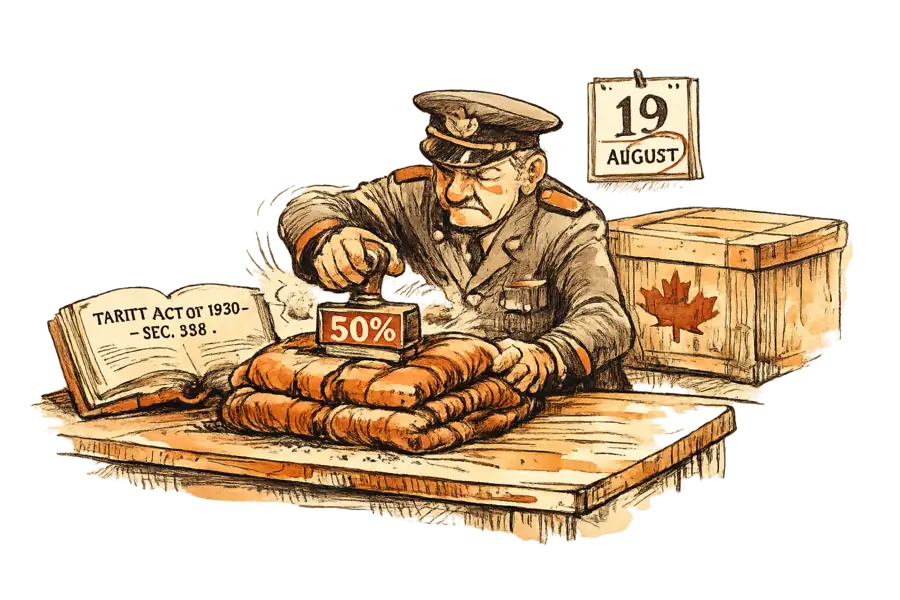
Canada Restricted Cars. Washington Taxed Chapters 50 Through 63.
Section 338 of the Tariff Act of 1930 lets a president impose 50 percent duties by proclamation, with no injury finding and no investigation. Its first use in ninety-six years puts apparel and textile lines inside an annex written to punish Canadian auto policy, which turns duty exposure into a variable no landed-cost engine can read.
Neritus Vale
Section 338 of the Tariff Act of 1930 lets a president impose duties of up to 50 percent by proclamation, with no finding that any American industry has been injured. Trump signed three such proclamations on 20 July, the first use of the statute in its ninety-six years. The duties take effect on 19 August, and they apply whether or not the goods qualify as USMCA-originating.
Washington reached for a dormant statute because the Supreme Court closed the alternative. On 20 February the Court held, 6–3, that IEEPA does not authorise tariffs, because any delegation of a core congressional power “must be clearly expressed.” Three Justices in the majority — Chief Justice Roberts, joined by Gorsuch and Barrett — added that when Congress does delegate tariff authority, it uses explicit language and sets “defined limits on scope, duration, and procedure.” Section 338 answers that description: an express grant of “new or additional duties,” a ceiling of “50 per centum ad valorem,” and a fixed delay before collection begins. The reasoning that voided the emergency tariffs is the reasoning that makes this one hard to dislodge.
What the statute demands is a presidential finding of fact and nothing an importer can watch in advance. Section 232 runs through a Commerce investigation with a statutory reporting deadline. Section 301 requires a USTR investigation, published notice, and consultation with the accused government. Section 338 requires none of it. The International Trade Commission holds a standing duty to “ascertain and at all times to be informed” whether discrimination is being practised and to report it to the president. Whether that duty is a procedural prerequisite or an advisory channel is unresolved, and the July proclamations proceeded on presidential findings alone.
The grievance is in cars, alcohol and dairy; the duty lands on coats. The motor-vehicle proclamation is the broad one, and its annex reaches leather goods, handbags, luggage, apparel and textiles alongside wood products, furniture and toys. Annex II covers Harmonized Tariff Schedule chapters 50 through 63, the entire textile and apparel schedule, from raw yarn to finished outerwear. None of it has anything to do with Canadian auto policy. That is the design, not an oversight: the statute authorises duties calibrated to offset a burden on American commerce, not duties confined to the sector where the burden arose.
A landed-cost engine is a machine for reading dockets, and Section 338 produces none.
The engines apparel importers have built since 2024 model duty as a function of two variables they control: how a garment is classified and where it was made. Section 338 disables the second. The duties apply regardless of whether goods originate under USMCA, which severs the link between origin compliance and tariff protection that three decades of North American sourcing investment assumed. The carve-outs for energy, potash and Section 232 goods are, in BLG’s phrasing, an anti-stacking rule, not an exemption. Classification still matters more than it did, though not as a clean switch between zero and fifty: Global Trade Alert’s line-item data put the motor-vehicle basket’s trade-weighted effective rate at 36.0 percent, with more than half of covered value paying less than the full rate. What the engine cannot tell you is which annex you will be in next quarter.

Diversification was the industry’s answer to tariff risk, and it assumed the risk had a map. The 2026 Fashion Industry Benchmarking Study, produced by University of Delaware researchers with the US Fashion Industry Association, found more than 65 percent of surveyed sourcing executives naming duty-free access among their most important incentives, and every respondent backing USMCA’s survival as a trilateral agreement. Both positions were overtaken by a proclamation signed weeks after the fieldwork closed in June.
The average effective US tariff on apparel imports had already climbed from 14.7 percent in January 2025 to 35.1 percent by December 2025, which is the environment the engines were bought to navigate. Relocating a factory does not move a duty set by the importing country’s quarrel with the exporting country’s cabinet.
The consensus reading is that this is a negotiating instrument, and a modest one. Global Trade Alert puts the covered trade at $17.7 billion once the Section 232 carve-outs are removed. That is enough to lift Canada’s average applied US tariff to 6.27 percent, which is a price increase, not a change of regime. The Canadian Apparel Federation’s Bob Kirke, quoted by Sourcing Journal and cited by FashionUnited, expects the damage to fall on Canadian production: “there would be a significant reduction in production in Canada.” All of that is true and none of it is the point. What was demonstrated on 20 July is that the ceiling rate can be attached to any tariff line, in any country, for a reason unrelated to the goods.
The strongest case against this reading is that Section 338 will not survive a court. There is, as BLG puts it, “a respectable argument” that Congress superseded the 1930 statute when it passed Section 301 in 1974, an authority occupying the same field that conditions action on investigation, consultation and findings. If the Court of International Trade accepts that, the proclamations fall, origin compliance recovers its protective function, and the duty engines go back to reading dockets. That is the condition on which this argument turns, and it was tested in the same week it arose. USTR announced forced-labour tariffs under Section 301 covering 99.4 percent of US imports on 23 July and made them effective on 24 July, reaching Bangladesh, Cambodia, India, Indonesia, Pakistan, Sri Lanka and Vietnam. The statute with the investigation requirement gave importers one day of notice; the statute without one gave thirty.
None of this is unmodellable in principle. It is unmodellable by the instruments that were bought, which price duty as a function of what a thing is and where it was made, both now downstream of a question no importer can answer: what a foreign cabinet will do next, and whether Washington will call it discrimination. If Section 338 is used again against a country that actually supplies clothing, the spread on a spring order book widens from a percentage point to the distance between a margin and a write-down. The answer is not a better forecast. It is a shorter commitment: smaller tranches, more duty-inclusive terms, more stock held in bond, and a planning assumption that duty is a distribution rather than a line item. The engines were sold as precision instruments, and they still are; the choice now is whether to keep paying for resolution on a variable that has stopped holding still.