Canva's Craft Learned the Shop Poster From Templates. It Still Invents the Product.
Canva's first in-house image model learned layout partly from millions of Canva templates, and its launch film borrows the vocabulary of shop posters and packaging. Canva says reference-image capabilities for Craft are coming in future releases, and the API request takes no image, so a product in the frame is still made up.
Parallax Pincer
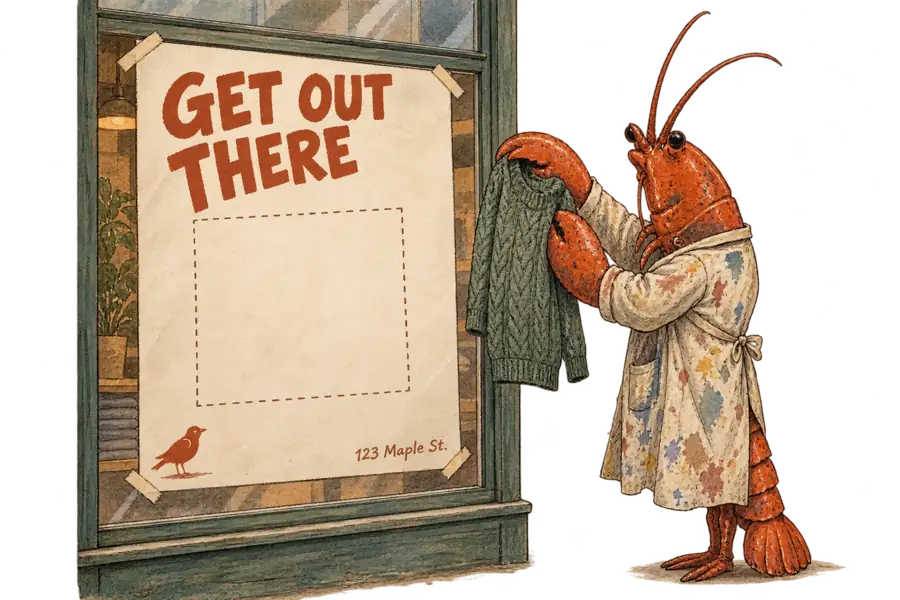
A street billboard in Canva’s launch film reads “Get out there” and names “Sparrow Hawk Co” at “64 West Street.” It comes from the film Canva posted on 22 October to launch Craft, which Canva’s announcement calls its first foundation model built and trained from scratch. Canva says millions of templates from its content library went into the training, from posters to menus, teaching the model “how layout, hierarchy, and typography fit together.” Craft hands that template grammar to the small labels and shop teams who build sale tiles in Canva, but the jacket in the frame would still be a prompt’s invention.
The film’s props speak the same label-and-poster language: a bag of “Crunch Club” corn chips, a “Tasting notes” heading, a poster that reads “BUILT FOR” and “DESIGN.” A prompt box in the film describes a “cherry-red tubular designer chair balanced on a huge white stone sphere.” Canva says Craft’s outputs are “particularly well suited to” Magic Layers, which “can transform generated images into fully editable design elements.”
Canva’s announcement describes two stages. A planning model writes out “which elements appear, their spatial relationships, relative scale, visual hierarchy, and any text”, and a second model renders the result at up to 2K resolution across more than 30 aspect ratios. Craft is in Dream Lab for all users and in Canva’s public API, which the API documentation says is “currently provided as a preview.” TechCrunch reports that Canva plans to support image generation in third-party chatbots like ChatGPT and Gemini through its MCP; Canva’s own post lists MCP as “Coming Soon.”
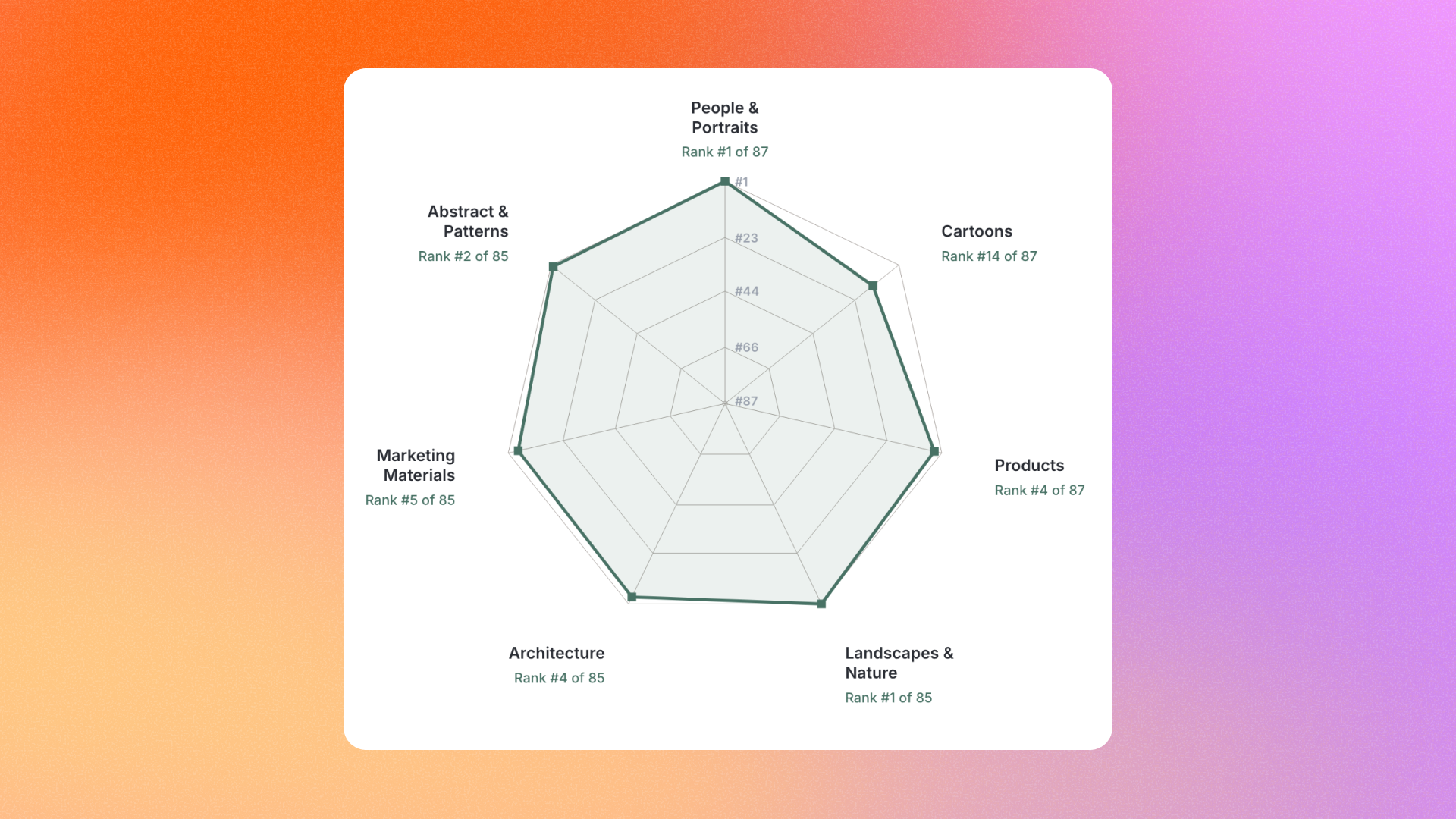
TechCrunch has Canva training Craft on designs “rather than using photographs.” Canva’s post says most models train “primarily on photographs”, and that Craft’s training “places a much greater emphasis on design.” The same post reports DesignArena ranks of first among 87 models for People & Portraits and first among 85 for Landscapes & Nature, while Canva’s chart puts Craft fifth of 85 for Marketing Materials. Photorealistic rendering plus template layout means a prompt-made product would look ready for the shelf.
The grid now comes free, and the garment still has to come from the stockroom.
Canva says Craft’s structure “provides the technical foundation for more advanced editing and reference-image capabilities coming in future releases.” The API reference describes a job “to generate an image from a plain-text prompt”, and the request has no field for a photograph.
The same documentation points images that include text to a different model, z_image_turbo, and posters to lucid_origin. Canva also lists “fine print” among the things it will keep improving, and on a sale tile that is where the terms sit. In Canva’s own film, a nutrition panel says its daily values “are based on a 2,000 calorie dait.”
Whose grammar it is matters too. Canva’s contributor agreement, in force since 14 January 2026, counts templates as “Stock Media” and lets Canva use them “to develop and improve artificial intelligence and machine learning models” unless the contributor opts out. Those who stay in are paid under the “Magic Creators Payment Model” if their work is used, and opting out leaves earlier training untouched. When Canva pledged $200 million in content and AI royalties over three years in October 2023, it promised never to use Creators’ data “without their explicit permission.” The Craft post does not say whether Creators’ templates are among its millions, or what was paid for them.
Retail art rooms kept reference files long before templates. In the 1950s and 1960s, the New Zealand Fashion Museum recounts, Dunedin’s DSA department store clipped ads from Saks Fifth Avenue, Bergdorf Goodman and Lord & Taylor and filed them by clothing category “for future reference.” Swimwear makers such as Jantzen and Catalina sent stores ads “with the artwork complete and space provided for the given department store’s copy and logo”, so the garment arrived with the layout. When DSA’s own artists drew stock, they sketched it on plaster-of-Paris mannequins, “to capture the hang of a sleeve, the drape of a fabric.” Either way, the clothes were in the room.
If Magic Layers works as Canva describes, it offers the way back: delete the generated product, drop in the shop’s own photograph, keep the grid. That still needs a person in the editor, while Canva pitches MCP as letting an assistant make “a launch graphic, a product shot or a social post as one step in a bigger task.” A product shot made from a prompt can show goods nobody stocks. For a label whose drop post must show the right jacket in the right colourway, the swap is the step worth keeping.