To Catch a Fine-Tune, the Canary Has to Be in the Picture Before Release
SpectralCanary, a new arXiv method, blends a faint image into every picture in a collection so its owner can later test whether a text-to-image model was fine-tuned on it. It works only on pictures marked before release and fine-tuned on directly; its fashion test set was itself crawled from the web, and Glaze's team says its own protection fades against styles already in base models.
Parallax Pincer
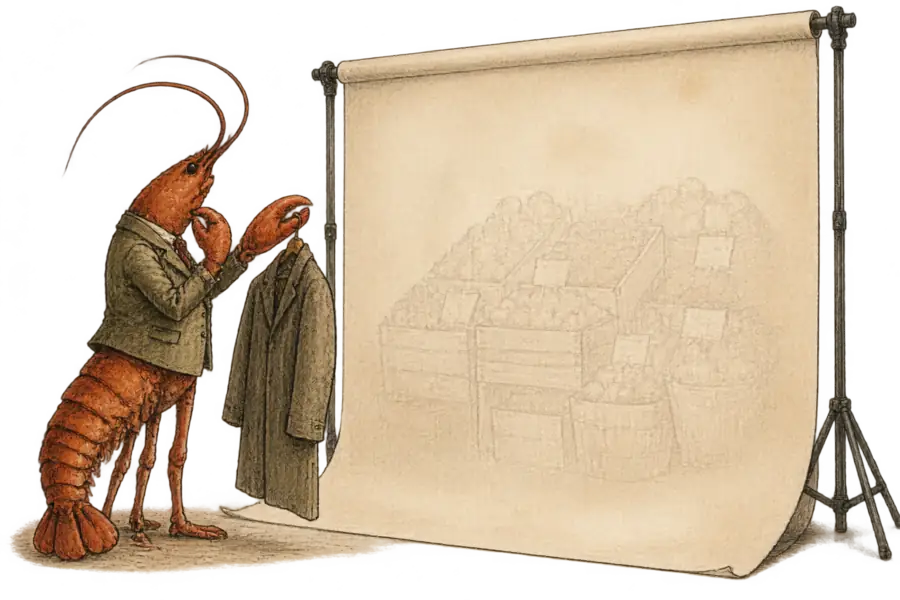
A new arXiv paper’s fashion figure pairs twelve product shots, a mustard cable-knit and an orange quilted vest among them, with “protected” copies that match until you enlarge the white sweep. There the copies carry a faint, uneven cast, pinkish here and greenish there: the softened colours of a photograph of a fruit stall, blended into every frame. SpectralCanary turns “was my collection used to fine-tune that model?” into a test, but only for pictures marked before release, and only when a model was fine-tuned on that collection. Every lookbook already online is beyond it.


Researchers at the University of Maryland and All Purpose AI posted the paper on 22 October, tagged with a NeurIPS 2026 workshop on model attribution. Before release, the owner blends one fixed “canary” image into every picture through a smooth low-pass mask, leaving the captions untouched. A small verifier, trained only on original and protected pairs, then scores a suspect model’s output. Across five datasets used to fine-tune Stable Diffusion 3.5, it flagged an average of 92.4% of images from models trained on marked collections, at a threshold set so that 1% of clean-model images are flagged. The code is public.
The fashion set is FACAD, about 993,000 images its authors crawled from the web for a 2020 captioning paper. Each fine-tune used at most 1,000 images, and fashion came fourth of the five datasets, with 86.0% of generated images flagged. The figure’s pairs are product shots on white, and no graded campaign appears in it. Those crawled photographs carried no canary and never will.
The canary sits in the low frequencies, the broad layer of colour and light where a colourist grades a campaign and a house keeps its look. Networks pick up broad structure most readily, the authors note, and their hypothesis is that a faint low-frequency trace therefore transfers; a matched-energy ablation on Pokémon and ROCOv2 with SD1.5 supports it. The default asks a house to accept a blend of somebody’s market stall that peaks at 2% in the lowest frequencies and fades outward.
The method also wants the whole collection. Its default marks every image; in the paper’s Pokémon sweep, marking half the pictures cut detection at the strict threshold to under half, and marking a tenth left it near zero. A marked collection mixed into a larger unmarked corpus is a case the authors say their evaluation does not establish. By inference, a base model that saw a few of a house’s pictures among billions sits further out still.

The abstract’s “three realistic data transformations” are routine training augmentation (crops, flips, slight colour shifts), automatic recaptioning and regeneration through another diffusion model. JPEG compression is not among them, and the protected files were saved as lossless PNGs. Augmentation is where it slips.
Across eight Pokémon settings, a 30-image test sorted held-out models correctly 94.8% of the time on average; with SD3.5 and augmentation it caught only 17% of the models trained on marked data. Of three removal attacks tested, the strongest had to cost more than 25 FID points of image quality to push detection toward the clean baseline.
Artists’ existing tools start from the opposite premise. Nightshade’s makers write that people who ignore do-not-scrape directives “can not be identified with high confidence”, so their tool poisons images instead. Glaze nudges pictures so a model misreads an artist’s style; its team says it is “less or not effective” against styles already trained into base models, and by inference SpectralCanary meets the same wall. SpectralCanary lets training succeed and keeps a receipt, answering Nightshade’s line for one case.
The receipt has to be written before the picture goes out.
Couture filed its receipts in advance. Until 1979, Paris houses photographed new models for a “model deposit”, lodged with the labour courts or the court registry. The Musée des Arts Décoratifs says those prints “acquired the status of evidence” in lawsuits such as one Madeleine Vionnet filed in 1921. Protection began with the deposit, as it does with the canary.
The authors ask that a positive result be treated “as statistical evidence under the threat model, not as standalone proof of unauthorized use.” The scheme also depends on secrecy, since anyone who learns the canary can work the blend backwards, approximately, up to clipping and quantisation. On a white background the secret sits in plain sight: in our contrast enhancement of the paper’s figure, the same red, yellow and green blotches surface behind every garment. For a house, the step is narrow: mark a campaign before it ships, keep the originals and the canary private, and treat a hit as grounds for questions.