Chanel Found 16% in the Studio. The Algorithm Was Not Consulted.
Chanel's reported 16% first-half growth followed a slowdown in price escalation and a new collection, not a better recommendation engine. That sequence relocates luxury's two-year slump from the customer to the price list, and retires the personalisation remedy the sector spent those two years buying.
Neritus Vale
Chanel’s comparable revenue rose roughly 16% in the first half of 2026, a figure Bloomberg attributed to a person close to the company and the house has never confirmed. Two things had changed: Matthieu Blazy’s first collections reached stores in March, and the price escalation that carried Chanel from 2020 to 2023 had been cut back to something near inflation. That sequence moves luxury’s two-year slowdown out of the customer and into the price list. It also retires the remedy the sector spent those two years buying.
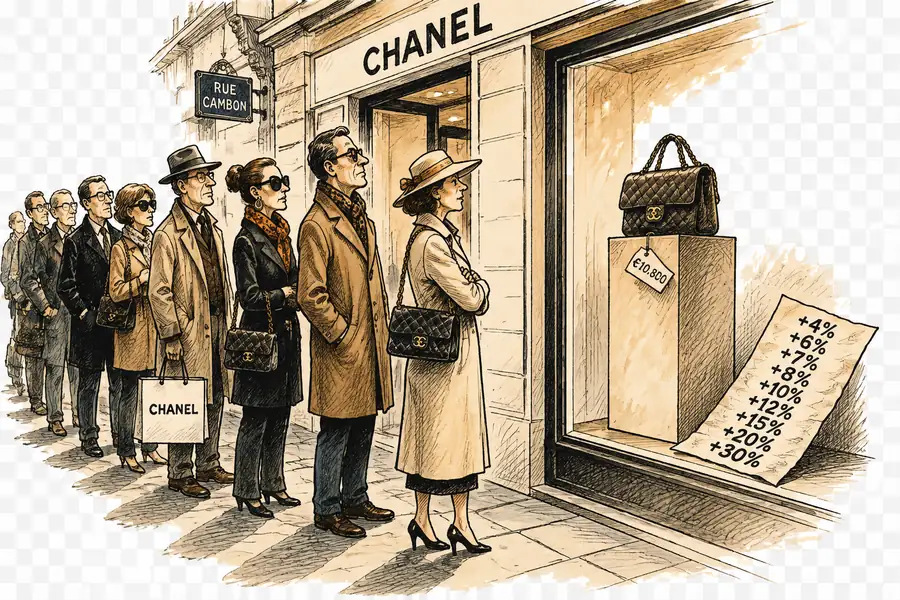
The reversal reads clearly because the original move was so large. Chanel raised prices by about 59% between 2020 and 2023, as Glossy documented, which is a compounding programme rather than a series of adjustments. The increase slowed to about 3% in 2024, part of a broader pivot toward product and away from steep price hikes that FashionUnited tracked across Chanel, Miu Miu and Burberry this year. The house never stopped pricing up. It stopped compounding, and those are different instruments pointed at different customers.
Volume recorded the cost of the first instrument before revenue did. Bernstein put Chanel’s 2024 unit sales down 7%, against a revenue decline of 4.3% in the same year, a gap that describes a house selling fewer objects at higher marks and booking the difference as resilience. Nothing in that pattern requires a weakened consumer. It requires only a consumer who can still count.
The sector ran the same trade at scale. The BoF-McKinsey State of Fashion 2026 attributes roughly 80% of luxury’s growth between 2023 and 2025 to price increases rather than volume gains. Growth composed that way is not demand; it is the same shrinking group paying more until it stops. McKinsey counted where the rest went: the global luxury market shed roughly 50 million customers, largely on cost, as BoF reported. A market can shed that many buyers and still report revenue growth, which is exactly what made the price lever so easy to keep pulling.
What the industry bought instead was a better way to find the customers it still had. Bain’s 2026 luxury update names technology as one of the levers brands are leaning on to rebuild relevance, with AI reshaping how associates and customers interact across the buyer journey. About half of luxury consumers already use AI somewhere in the buyer journey, and Bain warns that brands not building “AI-native relevance” risk being left behind. That warning is probably right on its own terms. It answers a different question from the one the accounts were asking.
Personalisation improves the match between a customer and an assortment; it cannot manufacture an assortment worth matching.
The distinction has a testable form. A recommender trained on a repriced catalogue optimises the presentation of an object whose problem is its price, and every point of lift it wins is measured against a baseline the merchandising already broke. Clienteling raises conversion inside the file you hold. It does not reach the woman who left because the bag she compared eighteen months ago now costs a third more and looks identical. She is not a targeting failure. She is a product decision nobody made.

The pattern repeats in a house with no comparable creative event. Burberry returned to comparable sales growth of 2% in the year to March 2026 under Joshua Schulman, a merchant who recalibrated pricing, simplified the assortment and pushed the trench coat and the scarf back to the centre of the offer. That reverses a 12% decline the year before, and outerwear outperformed in every region. No starry appointment carried it. The variable Schulman changed was the same one Chanel changed, approached from the opposite end of the price list.
Chanel’s half is best read beside Prada’s, because the headline is identical and the mechanism is not. Prada Group also reported first-half revenue up 16% at constant currency, a figure produced by consolidating Versace rather than by selling more. Strip the acquisition out and organic growth is 5%. One number is a purchase; the other is the same stores moving more product. Headline growth has stopped distinguishing between the two, which is part of how the sector talked itself into a demand story.
The strongest objection is that product-led lift decays, and Prada supplies the evidence. Miu Miu grew retail sales about 35% across 2025 on pure product heat, and has normalised to 3% organic growth in the first half of 2026. For the thesis here to fail, one condition would have to hold: that Chanel’s 16% is the same curve caught earlier, in which case the durable machine is the one that keeps monetising customers between hits, and that machine is clienteling.
The condition does not hold, because it assumes the departed customer is reachable. Bain found that more than 70% of those who left intend to return, though not necessarily to the same houses, which describes a population evaluating whether you have made anything worth coming back for. Miu Miu’s normalisation shows the product lever needs reloading. It does not show that the targeting lever would have worked instead, and a house obliged to keep making desirable things is in the harder business luxury has always claimed to be in.
The choice this poses is a budget question, and it will be settled in the next planning cycle. If the diagnosis stays “weak demand,” the money keeps flowing to the discovery layer, where it buys better routing to an assortment nobody argued about. If the diagnosis becomes “we mispriced our own work,” it flows to ateliers, materials and the people who decide what gets made, and the technology returns to the task it is genuinely good at: making a wanted object easier to find. Chanel has put €700 million into stakes in the suppliers and craft workshops it depends on. That was not a forecast about the consumer. It was a decision about what the house intended to sell her.