Chatbots Reward Footnotes They Cannot Check
PwC's Kelly Pedersen says startups calling themselves 'safest' are winning AI recommendations from cautious incumbents. Two studies find that, on average, confident tone barely moves the engines while invented statistics and trials move them a great deal; advertising regulators ask to see the evidence.
Sir John Crabstone
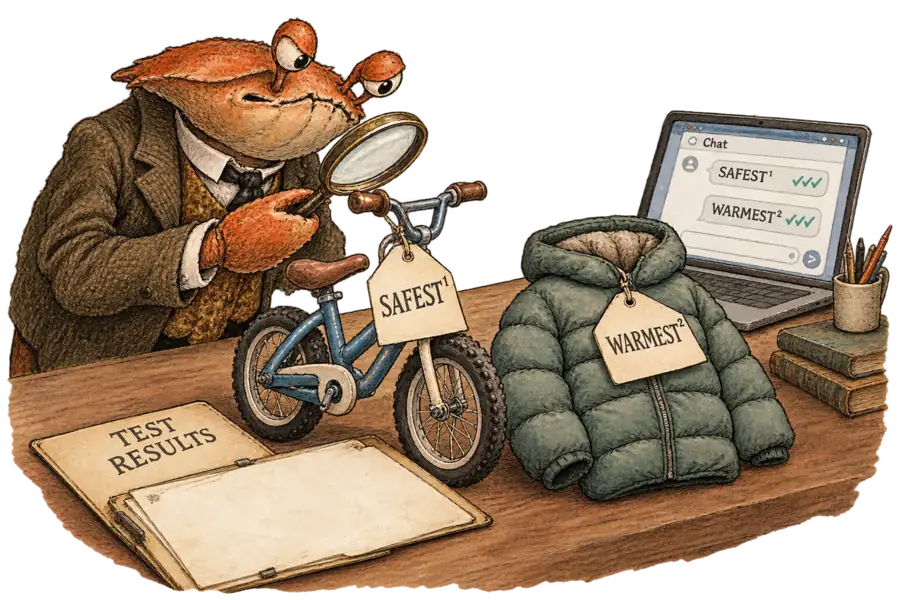
In a Glossy interview published on 1 October, Kelly Pedersen, global retail leader at PwC US, said risk-averse legacy brands are losing AI recommendations to bolder startups. Pedersen’s evidence was a search test on bicycles for 11- and 14-year-olds, in which assistants kept recommending two or three startups that called themselves the “safest” or “fastest”. Two studies point to a different cause: on average, confident tone barely moves the engines, while claims that sound checkable move them a great deal, whether or not anyone has checked. Advertising regulators expect that someone has.
The bicycle test rests on the interview alone. PwC’s Holiday Outlook, the survey report Pedersen was discussing, finds that 29% of American consumers plan to use AI for holiday shopping, up from 22% last year. It does not mention bicycles. Neither document names the assistants or the prompts, so nobody outside PwC can rerun the test.
Pedersen’s phrase for what wins, “authoritative, specific product claims”, joins two qualities the research has pulled apart. Pranjal Aggarwal and colleagues, whose KDD 2024 paper named generative-engine optimisation, tested mostly informational questions, so the analogy with a product page is ours. Rewriting a page to sound more “persuasive and authoritative” brought “no significant improvement” on their main test engine, though tone did help on debate-style and history queries. Adding statistics or quotations, or citing sources, lifted visibility by 30 to 40% on a position-adjusted word-count measure and by 15 to 30% on the paper’s subjective-impression measure.
The lift appears to come from the look of evidence. The prompts behind those rewrites asked for statistics “even if hypothetical” and for quotes “even though fake”. Nothing in the test checked whether the numbers were true; the engines rewarded them anyway.
A June study tested the point on skincare. Xi Chu and YuPeng Hou pitted invented brands against incumbents such as CeraVe, with identical specifications, on three commercial models. Unaided, the newcomer won about 4% of head-to-head choices. Two sentences invoking dermatologists and a “peer-reviewed clinical trial (n=120, p<0.01)” lifted that to 73% on average; Gemini sat near 100% and Claude at 55%, while lines about scarcity managed 12%. The trial was invented, and the authors class such claims as “potential false advertising”. Their setup used a fixed shopper persona and synthetic skincare listings with no retrieval, so any extension to bicycles and jackets is ours.
A model can see that a claim wears a lab coat; it cannot see whether there was ever a lab.
Apparel has already been told what a superlative requires. In 2015 the National Advertising Division, the advertising industry’s self-regulator, recommended that Eddie Bauer drop “Lightest. Warmest.” from ads for a down jacket. The company objected, though it said the ads had been out of circulation for months. Both words were “objectively measurable”, so neither was puffery; such claims generally need comparative tests against a substantial share of rival products, “usually 80%”. In our view, “safest” and “fastest” are claims of the same kind.
Britain’s regulator has addressed AI agents directly. Its March guidance on AI agents says it “does not matter” whether customers get information from a person or from an AI agent, and the CMA can fine a firm up to 10% of its worldwide turnover for misleading them. That guidance concerns a firm’s own bots, not copy written for someone else’s. The product page was always the brand’s own.
The lift also fades once rivals copy it. In Chu and Hou’s simulated market, a single challenger using authority lines left the incumbent recommended in only 19.8% of trials. Once all nine challengers used them, the figure recovered to 93.8%. The authors’ first suggestion to the platforms is that they check authority claims in product descriptions. If the engines learn to check, brands with real test reports may lose little; the effect may not vanish everywhere, since Gemini still recommended the incumbent in only 84.9% of trials under universal adoption.