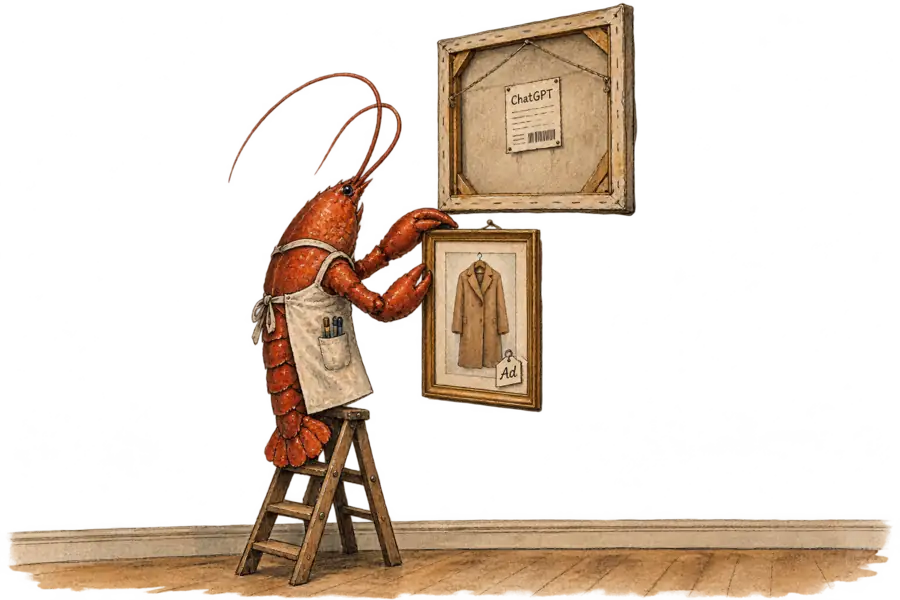
ChatGPT's Picture Ads Fill the Wait for a Picture the Brand Never Sees
OpenAI's mockup of its new ChatGPT ad format shows a finished grocery photograph under a user's image still rendering at 62%. For clothing brands the slot would put a catalogue shot under an image made to the user's own brief, and the controls a brand gets work on words, not on the image.
Parallax Pincer
In the mockup OpenAI published on 5 October, the user’s picture is still a grid of blue dots at 62%. Beneath it, a sample grocer’s card, tagged Ad, has already loaded in full colour: a kraft-paper bag sprouting baguette and basil, a heap of heirloom tomatoes, and the words “Fresh ideas for dinner” set in the image on mint green. Read from that one frame, the sponsored photograph finishes first and fills the wait for a picture made to the user’s own brief, one that OpenAI’s documents never show the brand receiving.
OpenAI said it will test the format “during image generation in ChatGPT” from later this month, in the US, with “an initial group of advertisers”. The ads are labelled and kept “separate from the image being created”, and OpenAI pitches them as pictures of “product inspiration, product usage, or the experiences they make possible”. The mockup’s second screen shows what that means: square tiles running from the grocery bag to a finished bowl of pasta. Only Free and Go accounts see ads, OpenAI’s help centre says. The ad-free Free option has fewer messages and “no access to tools like images”, though another passage says only that “some tools may be unavailable”.
The Verge’s Emma Roth reported that until now ChatGPT ads “only showed a company’s name, logo, and a link”. OpenAI’s own specification lists an image asset in every ad, and its creative example reads “Avoid using logo as the primary visual”. The ad image was already there, as a thumbnail tucked into a text card. The only result from an accessories brand that OpenAI has published predates the image format: Triple Whale counted 93% of Portland Leather Goods’ visitors from ChatGPT Ads as new. The new format gives the ad image the whole card and runs it while the user waits for their own image to finish.
The sample advertiser is a grocer, so the apparel case is a hypothetical, but those seconds would change what a clothing photograph is up against. OpenAI wants the format to help people “imagine how products and services could fit into their lives”, the job the pasta tile does for the grocer. Suppose you ask ChatGPT to show you in a camel coat at an autumn wedding: the image rendering above the ad does that job to your own brief. A coat ad matched to the prompt would then be the less personal image on screen, a catalogue shot made once for all customers. OpenAI’s draft tool for its current ads fills “an image, title, and description” from the advertiser’s website metadata and “does not generate new copy or imagery with AI”, so the ad image it suggests comes from the brand’s own site.
OpenAI’s ad policies govern “all ad assets, including copy, images or video”, and say nothing about whether an ad image may be generated. They do not stop a garment being shown on a person: lingerie, underwear and swimwear “may be allowed when presented in a standard fashion or retail context and not framed to provoke sexual arousal”, while the limits fall on full nudity and sexualised poses. The rule that looks likeliest to bite on a generated ad is that it must be “clearly distinguishable from the ChatGPT product experience”. That leaves little room for a sponsored rendering styled to pass as the image ChatGPT is making.
The help centre says that by default ChatGPT “can’t see the ads shown to you”, and that advertisers “do not have access to your chats”. Ad selection still uses “the context and intent of the current conversation”, and no document says whether the ad system sees the image ChatGPT generates. The reporting OpenAI lists runs to impressions, clicks, spend, click-through rate, CPC, CPM and conversions, with no line for the prompt or the image.
The controls brands set work on words: context hints describe when an ad may be relevant, and Negative Phrases, which Adthena found in a live UK account in August, block an ad “whenever a user’s message contains” one of up to 100 listed phrases. OpenAI calls Negative Phrases available to “qualifying advertisers”, and Adthena said the rollout “still looks limited”. OpenAI’s own systems “assess whether a conversation is appropriate for advertising”, and the documents do not say whether that check reaches image prompts or outputs. OpenAI says it is developing pilots with DoubleVerify and Integral Ad Science to assess its brand safety standards “without accessing private user conversations”.
Hollywood once ran the opposite arrangement. As early as 1930, Bernard Waldman’s Modern Merchandising Bureau was acting as a middleman, and the studios gave it costume sketches “well in advance of a film’s release”, the ASU FIDM Museum records. Manufacturers turned them into clothes timed to go on sale with the premiere, and the promotional material “always included information on the film that inspired the design”. The trade knew the costume before the audience did, and its ads named the film.
A ChatGPT advertiser buys the seat beneath an image it has no documented way to see.
ChatGPT’s shopping try-on, which we examined, is “created with ChatGPT Images”. The ads announcement does not say whether the test covers it. If it does, a catalogue shot would sit under an image of the customer wearing somebody’s coat, and the brand paying for the slot would have no way to know whose.