ChatGPT Wallet Takes No Cut Yet. Its Documents Leave Retailers the Agent's Mistakes
OpenAI's ChatGPT Wallet lets its agents pay on retailers' own checkouts, at no fee to start. Its documents can leave the shop with the agent's declines, repeat orders and wrong sizes, and the old checkout spec, whose calls carried a duplicate-order key, now redirects to the Wallet guide.
Neritus Vale
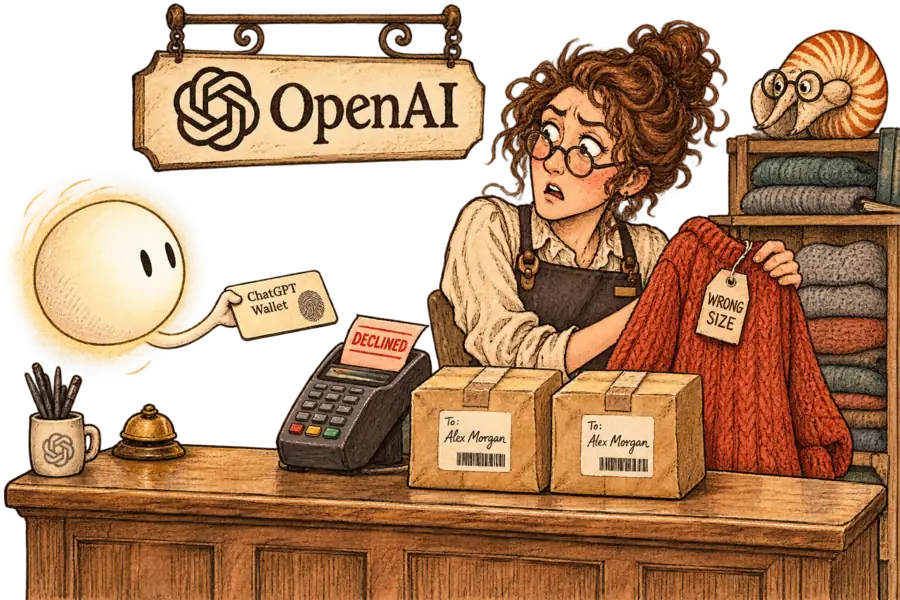
OpenAI’s agents can now pay at a retailer’s own checkout, and an OpenAI guide tells retailers to handle the agent’s order errors as the customer’s own. ChatGPT Wallet, launched on Friday, needs no product feed or plugin, and OpenAI is “not taking a cut of transactions to start,” CNBC reported. What the shop gives up is structure: the agent arrives as a browser, and false declines, repeat orders and wrong sizes may arrive with it.
TechCrunch and The Verge judged Wallet mainly from the shopper’s side. TechCrunch relayed that users are “fully in control of the purchases,” and The Verge stressed the card details agents never see. Neither mentioned returns or repeat orders.
The safeguards are built around the card. Each purchase by a dot, as OpenAI calls its agents, waits while the shopper checks the merchant, items, total and card and approves with Face ID or Touch ID. A payment token then stands in for the card number, the help page says. For now only US Pro subscribers qualify, out of the 1.2bn people who use ChatGPT each week.
Wallet arrives after a checkout route that ran on data. Instant Checkout charged merchants 4% of each sale, AP said in June, and OpenAI retired it in March. Its spec, archived in October, still called Instant Checkout “currently available to approved partners,” had ChatGPT call the merchant’s checkout API and told merchants to “enforce idempotency.” That address now redirects to the Wallet guide, Accept payments, which never mentions idempotency.
The idempotency key is the protocol’s guard against the double order. The Agentic Commerce Protocol’s checkout RFC requires one on every request that changes a checkout, and bars the merchant from repeating “side effects (e.g., payment capture, inventory reservation).” A timed-out agent can resend without buying twice. Neither the payments guide nor the agent-access guide specifies a key for the browser route.
Where the old spec had a key, the Wallet documents offer a warning to the shopper. “Ready to check out” means only that “your approval is complete,” the help page says; it “does not confirm that the merchant has placed your order.” Each token covers a single approved transaction, the payments guide says. Beyond that and a fresh approval per purchase, the duplicate guard is a shopper checking for a merchant confirmation.
The shop’s own systems may miss the repeat. Wallet generates a token “for each use,” the help page says, so a second order can arrive on a new card number. The payments guide points merchants to the Payment Account Reference, which ties each token to the underlying account.
OpenAI’s agent-access guide assigns payment or order errors in one sentence: “Customers are ultimately responsible for the actions they take, so any customer service or support should be handled in the same way you would if a customer took the action themselves.”
Fraud screening is where that rule bites. OpenAI’s payments guide concedes that ChatGPT’s cloud browser can set off shops’ risk systems “by accident and cause purchases to fail.” The fix, a Forwarded header relaying the user’s own signals, is still rolling out and works only if the shop’s risk tools read it.
OpenAI says it is working with vendors on the shop’s side of the sale: the release names Forter, Riskified, Sardine and Signifyd for fraud, and Adyen, Checkout.com and Stripe for payments. Shops are also asked to set their firewalls to admit the cloud browser’s requests, which are signed with Web Bot Auth.
The same rule governs a wrong size. The help page’s first example request is “Help me find a new sweater.” Neither it nor the Wallet terms mentions size, and the terms limit an approval to what is “shown to you.” The plugin route names size as a field, but its guide says OpenAI is “still working on the interaction patterns between third-party plugins and ChatGPT Wallet.”
Once approved, an agent’s wrong pick becomes the shopper’s choice. The release keeps card protections for “eligible disputes,” such as a defective item; the help page leaves returns to the merchant’s “own policy” and sends only “a purchase different from what you approved” to OpenAI Support. Visa’s Jack Forestell said in June, AP reported, that agent disputes would follow the usual tests of intent and processing. The rules might change, he added, where “something happened in the middle,” and Visa was reworking its tokens “with Visa Intelligent Commerce” for that case. Until a network says how Wallet orders are treated, an approved sweater in the wrong size is a return.
No OpenAI document promises the shop the screen the shopper approved. The terms let OpenAI keep “the confirmation screen, and your approval,” and say it “may provide ChatGPT Wallet records,” without naming a recipient. The release, help page, payments guide and terms also leave open whether the card authorisation flags an agent.
The strongest objection is that humans mis-size and double-click too, that the retailer keeps the customer at no fee, and that card networks are moving to absorb agent error. In April Amex’s Luke Gebb told Digital Commerce 360 that when a registered agent errs, Amex will “stand behind that transaction and credit the consumer so they’re not out of pocket,” and that Amex “will back the consumer and merchant.” On Friday Gebb called Wallet Amex’s “first American Express Agentic Commerce Experiences integration,” the kit to which the April protection for registered agents is tied. That makes cover for Amex cards plausible. For the thesis to fail, agents would have to err no more often than humans, or a network would have to absorb their errors.
Neither condition is established. OpenAI anticipates agent-specific declines and warns shoppers against repeating an unclear purchase: it is rolling out a header for its browser, and its help page cautions against “immediately repeating the purchase.” Amex’s pledge opens with “In the future” and applies only when an agent sends “authenticated purchase intent”; neither firm said on Friday whether Wallet purchases qualify. And a returnable sweater in the wrong size still goes back through the shop’s returns, whoever is credited.
Wallet leaves an apparel retailer two choices. It can admit the dot and do the work: have its fraud vendor read the Forwarded header, match repeat orders by Payment Account Reference and price agent returns into its policy. Or it can block the dot and lose the shopper who asked ChatGPT for a sweater. Free, in this arrangement, describes the commission and nothing else.