The Cheapest Merchant Is the One Nobody Hired
Target eliminated 1,800 corporate roles last October, and 800 of them had nobody in them. The layoff is the decoy: the real move is a middle layer that never gets hired, and that layer was where merchants learned to be wrong cheaply.
Sir John Crabstone
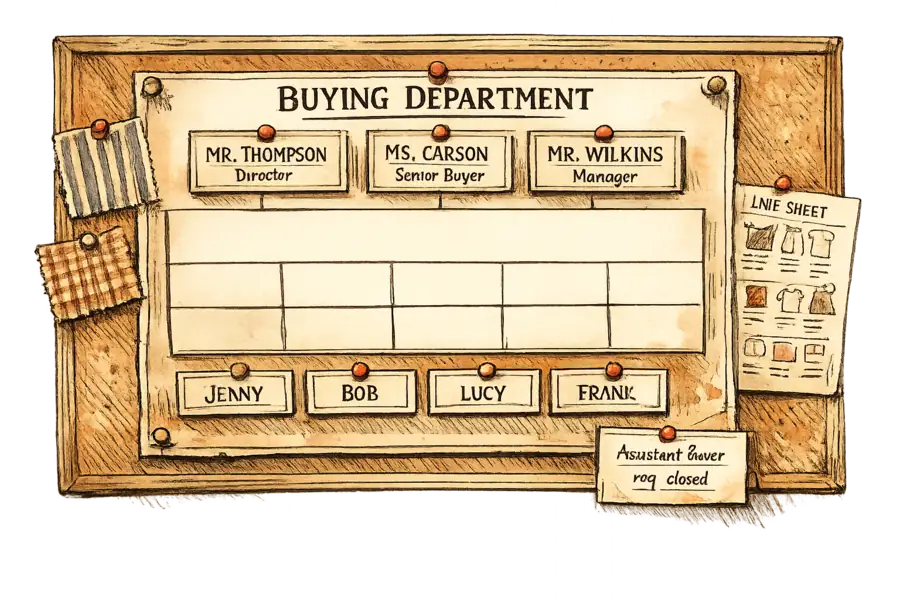
Eight hundred of the 1,800 corporate roles Target eliminated last October had nobody in them. Retailers are not, in the main, replacing merchants with AI. They are using AI to justify never hiring the layer beneath them. Roughly a thousand Target staff were made redundant; the other 800 were open positions, closed, together 8% of the corporate workforce. The layoffs took the headlines. The expensive number was the one nobody had to announce.
The research points the same way. Two Harvard economists tracked 62 million workers across 285,000 firms. From early 2023, junior employment at generative-AI adopters fell sharply against non-adopters while senior employment kept rising. The fall, they write, is “driven by slower hiring rather than increased separations or promotions”. Nobody was pushed out. The intake stopped.
Using the largest US payroll processor’s records, Stanford’s Digital Economy Lab found a 16% relative decline in employment among workers aged 22 to 25 in the most AI-exposed occupations. Those are software and support roles, not buying offices; the analogy has to be drawn, not assumed. Retail’s version leaves no record at all, because a merchandising team that never opens the requisition has nothing to report.
Walmart has put the arithmetic on the record. Doug McMillon told The Wall Street Journal that AI “is going to change literally every job,” CNBC reported, and headcount will stay flat at roughly 2.1 million for three years while revenue grows. Flat headcount at a growing company promises that nobody will be sacked. Read from the other end, it promises nobody new.
Look at what the software has been handed. Modern Retail reported in June that Walmart’s Wally assistant handles merchants’ data entry and root-cause analysis, and that Target’s Trend Brain reads trend signals for its private brands. Those are the tasks an assistant buyer used to grind through for years before anyone let them buy anything. Nobody enjoyed them. That was rather the point.
A buyer is an assistant buyer who has been wrong often enough to stop guessing.
One economist has worked through the consequence. Enrique Ide argues that automating entry-level work can lower long-run growth and welfare even when total employment holds up, because it steers novices away from the most skilled practitioners, interrupting how tacit skill passes down. It is a model rather than a measurement. The saving is real enough; it is drawn on an account nobody has paid into since 2023.
The optimistic reading has a hole in it. Writing in The Robin Report in March, Rich Honiball urges retailers to rebuild merchant roles around what AI cannot do: reading culture, and shaping what a category means to a customer. He is right about the destination. His argument assumes a merchant who already has judgement, and says nothing about where the next one comes from.
Retail diagnosed this before it had anything to blame. In 2017, Frederick Lamster warned in Total Retail that the decline of executive training programmes had left the industry short of prepared successors. That was nine years ago, without a model in sight. What AI supplied was not the cause — it supplied the reason to give. In five years somebody will ask why nobody in the building can read a season. The answer will be in a 2026 headcount plan, filed under efficiency.