China's AI Agent Registry Arrives After Taobao's Refusals and the Wallet's Mandate
China unveiled an identity registry for AI agents at Wuzhen as 20 organisations, Alibaba and Tencent among them but not JD.com, Meituan or PDD, released a voluntary conduct pledge. A shopping agent on Taobao already meets a shop's right to refuse and a payment mandate; the pledge leaves access to negotiation between platforms.
Sir John Crabstone
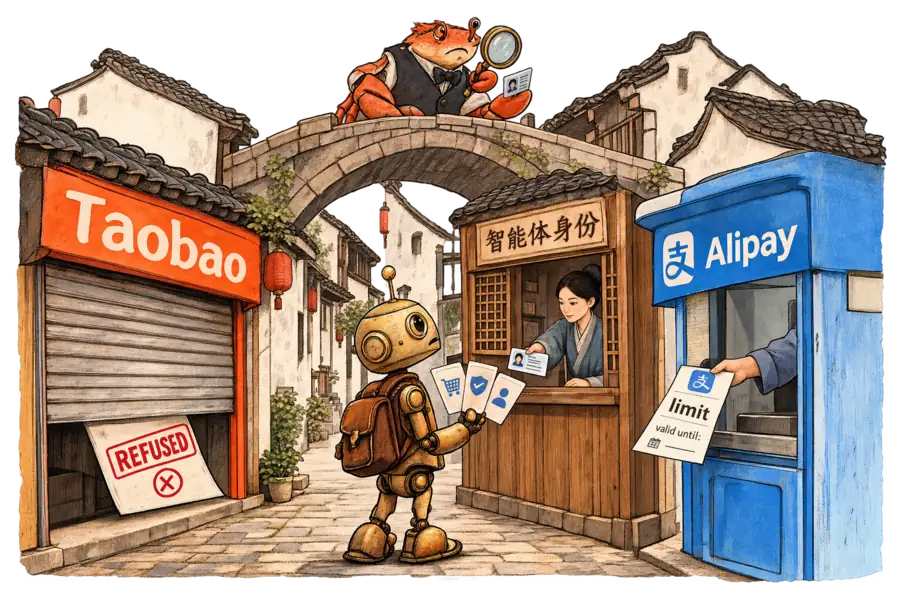
An AI agent shopping on Taobao this Double 11 already meets two checks. A shop can refuse it by name, as Doubao found, and a payment institution is asked to have the user sign a mandate.
On 4 November China unveiled a registry that could add a third check: identity. The launch came at a World Internet Conference forum in Wuzhen, Pandaily reported, relaying IT Home and China Daily’s Chinese site. Twenty organisations, Alibaba and Tencent among them, jointly initiated a voluntary conduct pledge beside it.
The registry is still being built. China Daily’s Chinese site, in a piece centred on Ant Group, says parties at national level are co-building it to handle identity coding and cross-domain resolution. Ant’s first services to connect to the operating platform include Alipay’s 晓政 agent, which Pandaily glosses as a government-services agent, and Sesame Credit. Neither name suggests a shop.
Alibaba’s own shopping agent is the one we have followed this Double 11. Qwen Go!, in phased testing since October, claims price-protection refunds for Taobao shoppers.
Strangers meet a shut door. By mid-October Taobao had refused ByteDance’s Doubao phone agent, and so had Pinduoduo and Meituan; JD.com had not. Each refusal covers the whole app.
Alibaba shut that agent out before helping to draft the pledge, and the clauses reported do not let it back in.
The interoperability article cuts both ways. As ThePaper quoted it, signatories are to lower interoperability barriers “in an orderly way” (有序降低智能体互操作壁垒) and to respect each party’s intellectual property and legitimate interests through open collaboration and equal consultation (平等协商). The same clause calls for graded authorisation and behaviour limits on delegated tasks. It states no duty to grant access; on our reading, a shop that negotiates may still decline.
The China Academy of Information and Communications Technology drafted the text with Tencent, Ant, Alibaba, Douyin, Huawei, Baidu and others, MyDrivers reported, citing the academy. The list of twenty it published omits JD.com, Meituan and PDD, but carries ByteDance’s Volcano Engine.
The Wuzhen pledge is not the first agent pledge. In July, 31 companies, Meituan among them, signed one on personal data at the China Internet Conference, Xinhua reported.
The August payment pact, from the China Payment & Clearing Association, spells out what a paying agent carries. The association supervises compliance under the central bank’s guidance. Its text asks members to explore know-your-agent checks that verify agent identity, to use agents registered or filed with the competent authorities, and to sign mandates stating a transaction limit and a validity period. Autonomous agent payments need a filing first. Responsibility sits with whoever provides the payment service (谁提供支付服务谁负责).
The Wuzhen pledge’s headline line, as IT Home’s headline carries it, rejects 算法压榨, algorithmic squeezing. The clause names no victim. It does not say whether charging regular customers more counts.
That practice already has a rule. Article 21 of the algorithm-recommendation provisions, in force from 1 March 2022, bars sellers that use recommendation algorithms from imposing unreasonable differential treatment (不合理的差别待遇) on price and other transaction conditions based on consumers’ preferences or trading habits.
Wang Jingtao, deputy director of the Cyberspace Administration of China, told the forum that governance should extend to trustworthy actors, controllable behaviour and traceable responsibility (主体可信、行为可控、责任可溯), China News Service reported.
Under August’s pact, responsibility already follows the money, and the pact already points at registration. The registry is meant to handle identity coding and resolution. On our reading, behaviour stays with each shop, and Taobao’s owner helped write the pledge.