In Clothing, an AI-Visibility Score Measures the Questions
Dekuple Insight's study of ChatGPT and Gemini counted 496 brands in 560 clothing answers, the widest scatter of six French retail sectors. A visibility vendor's own arXiv paper shows aggregated brand profiles break when the questions change, so the number a clothing retailer can use is the intent each engine names it for.
Admiral Neritus Vale
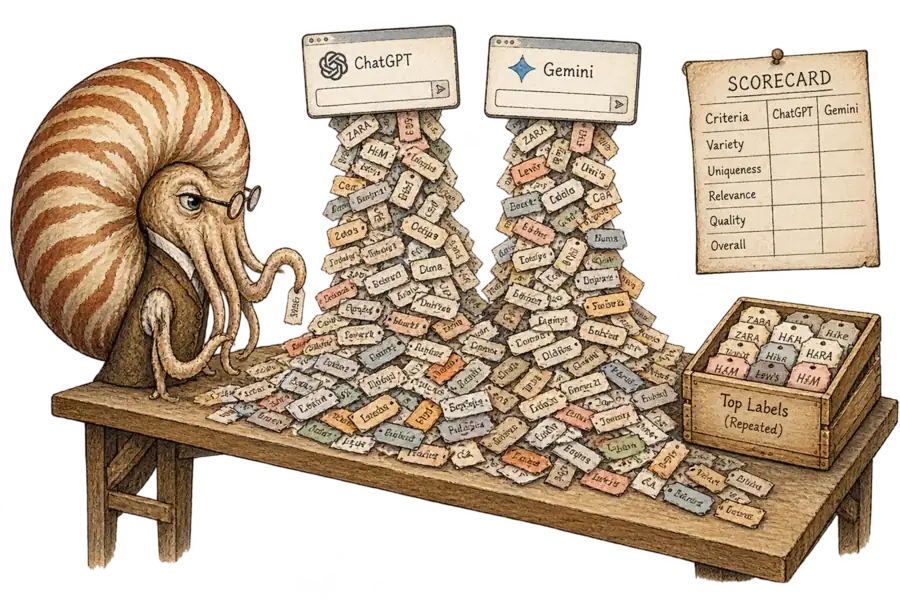
Dekuple Insight spent two months recording how ChatGPT and Gemini recommend French retailers across six sectors. Comarketing-News published its release, which counts 496 brands in 560 clothing answers. A clothing retailer’s AI-visibility score describes the questions it was computed on, and the number worth having is narrower: the intent each engine names the retailer for. The release does not say how often each brand appeared, so the count measures breadth, not stability.
Clothing scatters further than any other sector in the study. Divide each sector’s brands by its answers and, by our arithmetic, clothing comes out at 0.89, the highest of the six; food sits at 0.18. EcommerceMag and e-marketing.fr printed the six counts on 2 October, both from the same press release. The ratio has two innocent explanations. Fashion has a far larger brand universe than grocery, and the release does not describe how Dekuple decides what counts as a brand.
Dekuple’s central claim, carried by The Media Leader FR on 29 September, is that each intent builds its own field of competitors. Clothing’s sector-specific intent was trends. Our reading, which the release does not confirm, is that trend questions invite new labels, so part of the clothing scatter may sit in the prompt list. The release adds that only the most established leaders held relatively steady, while secondary positions moved with the model, the sources and the period. That finding covers the whole study, not clothing alone. The release names twelve retailers, none of them for clothing, and Dekuple has published no method beyond its sample counts.
Dmitrij Żatuchin, founder of the AI-visibility vendor Rankfor.AI, shows in a paper submitted to arXiv on 23 September that a single answer betrays the engine that wrote it. His corpus holds answers from five deployed systems, GPT-5.2 and Gemini 3 Flash among them, to gift, corporate-reputation and category-ownership questions, the last asking which brand owns a category. The answers were collected last winter. He did not study clothing, so the analogy here is ours. On answers cut to their first 800 characters, one answer on its own identified the system that wrote it 97.84% of the time. The paper locates that signal mostly in layout: masking brand names and capitalised tokens barely moved it.
Brand behaviour, the material an AI-visibility report summarises, did not survive a change of domain. Żatuchin aggregated the answers into profiles of each system’s brand habits, and a classifier trained on category-ownership profiles assigned every gift profile to the wrong system. In gift answers, Gemini 3 Flash named 8.41 brands per response and GPT-5.2 named 0.94. The order reversed in category ownership, so the apparent gap between engines depended on the question. Two caveats apply: the paper’s brand dictionary undercounts GPT-5.2’s gift brands, and the reversal rests on the minority of Gemini answers that were not truncated. Żatuchin says the reversal is consistent with the transfer failure but not shown to cause it.
In Żatuchin’s data, an engine’s handwriting survived a change of questions and its brand habits did not.
The paper’s appendix shows how far such figures can spread before anyone reruns them. It corrects an earlier version, some of whose values “have appeared in talks, posts and a book”, and withdraws claims for which, he writes, no code exists. The most quotable casualty, a sentiment gap between GPT and Gemini, falls from +0.511 to +0.043 once GPT’s answers are cut to the length of the paired Gemini ones. Most of the measured warmth was length. His verdict for anyone reading AI-visibility numbers is that, in this corpus, a brand-behaviour profile “does not travel between the two domains where it could be tested”.
The best case for the score is that it never needed to travel. A retailer that reruns a fixed prompt set every month, as brand trackers rerun a questionnaire, learns from the changes even if the level means little. That holds on one condition: the changes must come from what the retailer did. Dekuple’s results point the other way, because the secondary positions it found unstable moved with the engine and its sources as well as with time. A monthly delta cannot say which of those did the moving, and adding prompts would not separate the retailer’s effect from the engine’s.
The unit a clothing retailer can use is the intent it is named for, and Dekuple’s sport results show why. Decathlon appeared in 80% of ChatGPT’s answers to quality questions in sport, yet came first in only 30% of them. A presence score credits Decathlon with the question; the ranking hands it to someone else most of the time. The engines, in Dekuple’s reading, give Decathlon the role of accessibility and value for money, and Au Vieux Campeur that of technical expertise.
The intent has to be read engine by engine, because ChatGPT and Gemini do not describe the same market. On technical sport questions Gemini named 34 distinct brands and ChatGPT 15, with Gemini widening to niche specialists and ChatGPT concentrating on a core of leaders. A niche label can therefore appear on one engine and vanish from the other for the same question. Żatuchin’s gift answers show a similar gap on a different measure, brands per response, and it reverses in category ownership. Pooling the two engines into one score averages away the difference a retailer could act on.
The intent also points to which evidence a retailer should fix, since the engines’ sources change with the question. For operational facts such as delivery, availability and click-and-collect, brands’ own sites carry the answer, making up 91% of the domains the engines used for high-tech omnichannel services. Dekuple measured that in high-tech; carrying it over to clothing is our analogy. Judgements of quality, price and reliability send the engines to consumer associations, comparison sites, specialist media and review platforms. A clothing retailer buying an AI-visibility audit this autumn can pay for one number, which depends on the vendor’s prompt list, or for a grid of intents by engine, which describes what it can change. If it buys the number, its budget will end up serving the vendor’s questions.