Apparel Leads a Google Ad Slot No Brand Can Buy or Measure Separately
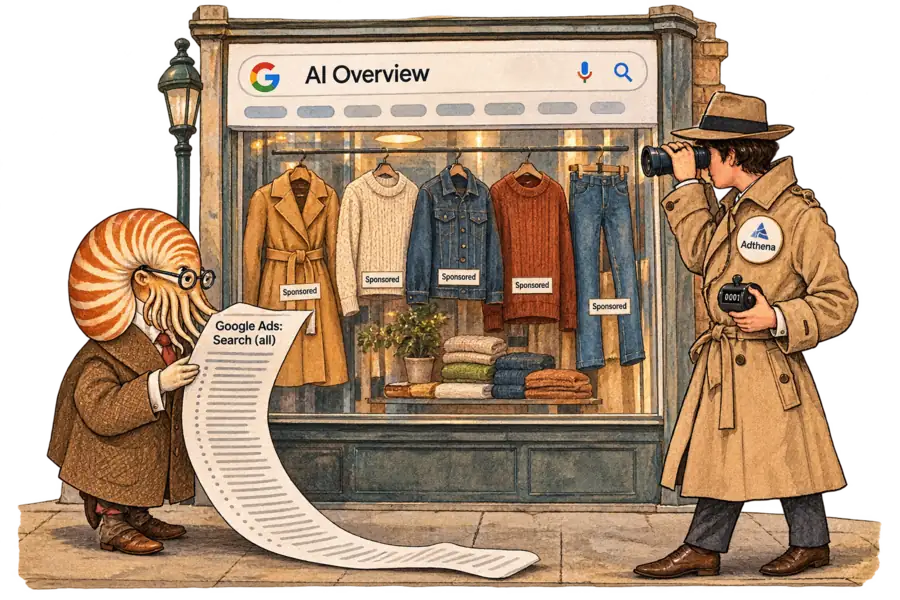
A tracker's holiday report puts apparel at about 111,000 of the 175,100 ad placements it counted inside Google's AI Overviews and AI Mode across five US holiday categories. Google sells no separate slot there and reports it only in aggregate, so the count shows apparel's presence but not what it costs or sells.
Neritus Vale
Apparel supplied most of the ads that one tracker counted in Google’s AI answers across five holiday categories. No brand can buy, target or read that slot on its own. Adthena’s holiday report found about 175,100 paid placements in US AI Overviews and AI Mode from June to September. It shows where the ads appeared but, as Search Engine Journal noted, tracks no clicks, spend or conversions.
Apparel’s share, about 63% on Adthena’s own figures, comes from a narrow count. That count covered only apparel, consumer electronics, travel, beauty and toys, with electronics taking most of the rest. The report does not say how many searches Adthena watched in each category, or how it chose them. Nor does it define apparel, for example whether footwear or accessories count. The share describes Adthena’s tracked set as much as Google’s market.
The report never says what a placement is. The nearest it comes is “Paid ads served directly within Google’s AI Overview and AI Mode panels, US”, which could mean an answer, a block or each card in it. One UK AI Mode block described in Adthena’s 2 November post held “four used Range Rover listings”. Adthena counted AI Mode advertisers for an August post; the holiday report gives no such count for Google’s box. It cannot say whether apparel leads through more brands, more searches or more cards per answer.
Google sells the slot only as part of the rest of Search. Existing Search, Shopping and Performance Max campaigns are “automatically eligible”, its help page says. Brands cannot target AI Overviews or AI Mode alone, or opt out of them separately from Search. The controls the page lists include negative keywords and brand exclusions.
Feed-based campaigns are matched to the answer as well as the query. Shopping and Performance Max ads are eligible for matching “contextually to both the user’s query and the AI response”. Among keyword types, only exact and phrase match on Search are held to queries with direct commercial intent.
Google also reports the slot only in aggregate. Its results are “included in aggregate” in standard campaign reports, the help page says, search terms included. An apparel brand sees its Search spend but cannot isolate clicks from inside an answer. Site owners got an impressions count for AI answers in Search Console this year; Google Ads has no such line.
That blind spot is the market Adthena sells into. Google Ads gives AI Mode no separate line, the firm wrote, so the only way to see where you appear “is to track it from the outside.” Chief executive Phillip Thune says brands that “learn how ChatGPT and AI Overviews placements perform this season will be ahead”. On Google, neither the platform’s reports nor Adthena’s count can show it.
Adthena’s ChatGPT count, 204,489 placements, records something different. A ChatGPT advertiser builds a campaign for that surface, and OpenAI’s Ads Manager Beta reports its impressions, clicks, spend and conversions. Apparel led there too, with about 44% of placements on the report’s figures. Every ChatGPT placement traces back to a campaign someone set up for ChatGPT, while Google’s box fills from campaigns built for Search. The ChatGPT count also spans “all markets”, against Google’s US-only figure.
Adthena says ChatGPT ads “skew to research and discovery”, meaning “people comparing or asking what’s best rather than naming a product”. The release illustrated the skew with beauty, travel and toys, led by beauty’s 83%. As SEJ also observed, it left out the two largest categories.
Those two categories sit below the half-way line. Apparel’s share was 48%, and electronics’ was lower still. Weighted by placements, our own calculation puts all five categories at about 52.5%, a mild skew.
Adthena described the Google slot two ways in two days. Its release says paid ads “now regularly appear inside Google’s AI answers”. A day earlier, the firm’s Ashley Fletcher wrote that ads inside the AI Overview “are still rare: under 7% of placements in the US categories we tracked”. The blog counted AI Overviews alone, in different categories, so both can stand, though they leave opposite impressions.
Coverage of the report stretched what it counted. Ebrun’s news robot headlined the June-to-September figures as half a year (半年) of AI Overview ads, and put apparel and electronics together at 八成, or 80%. The report’s own figures give 94.8% (166k of 175.1k). In MediaPost, the same figures became “AI Overview Ads Surge”, though the report gives only a combined AI Overviews and AI Mode total, with no trend.
The report’s one growth figure measures AI Overviews, not ads. Its 89% rise in US appearances over a year belongs to the AI Overviews themselves, and, as SEJ noted, the report does not describe the queries behind it.
The data stops in September, before Black Friday and before October’s changes. On 28 October Google launched multiturn ads in the US, carrying ads into AI Mode’s follow-up questions, and took AI Mode ads to more countries. A week earlier OpenAI took ChatGPT ads to 89 countries and promised new “measurement capabilities”.
The strongest objection is that the slot needs no report because Google prices it like the rest of Search. The same auction applies, and Google advises letting Smart Bidding work across “both direct searches and exploratory questions”. If an answer-box click is worth less, the bidding pays less, and the blend hides nothing useful. For that to hold, AI-answer clicks must convert like other search clicks, or Google’s bidding must price the difference correctly.
Neither condition can be checked from outside Google, and Google’s published figure tests something else. Google says sponsored and organic product listings in AI Mode draw similar click-through rates on two weeks of US data, a claim we examined last month. That compares an ad with the free listing beside it and says nothing about sales. Adthena’s own August post concedes that “nobody outside Google can attribute a conversion to an AI Mode placement with confidence”.
Only Google can see what apparel’s lead is worth.
Before Black Friday, a clothing brand can at least ask Google for an AI-answer line. ChatGPT advertisers already get their own reporting from OpenAI. If Google keeps widening the slot without one, more holiday search money will be priced by a model no brand can audit. The outside view of apparel’s lead will then be a count from a tracked set, drawn by a firm that sells ad tracking.